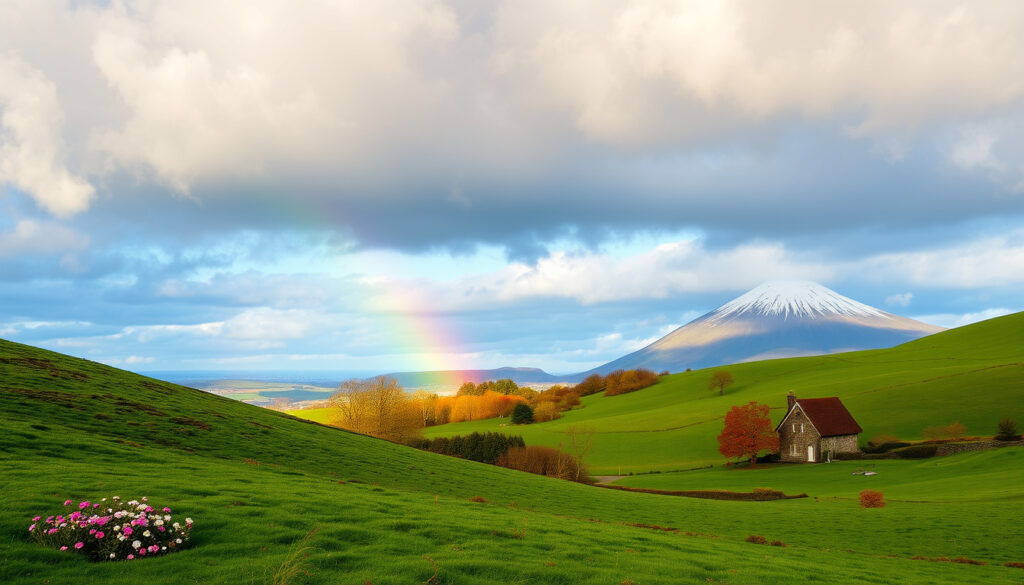
Seasons of the Year: Months, Ireland & Weather
Anyone who has glanced at an Irish weather forecast in March and seen both “spring” and “winter” used in the same week already knows the seasons aren’t as tidy as the calendar suggests. Ireland’s maritime climate, Celtic traditions, and modern meteorology all pull the definition in different directions — and the result is a seasonal calendar that surprises newcomers and locals alike.
Number of standard seasons: 4 ·
Months per season (meteorological): 3 ·
Meteorological spring start (Ireland): March 1 ·
Astronomical spring start (2025): March 20 ·
Seasons in Irish language: Earrach, Samhradh, Fómhar, Geimhreadh ·
Summer 2026 prediction reliability: Low due to forecast horizon
Quick snapshot
- Meteorological: March–May (Met Éireann)
- Astronomical: March equinox to June solstice (Met Office)
- Ireland: mild, increasing daylight (Met Éireann)
- Meteorological: June–August (Met Éireann)
- Astronomical: June solstice to September equinox (Met Office)
- Ireland: cool, occasional warm spells (Met Éireann)
- Meteorological: September–November (Met Éireann)
- Astronomical: September equinox to December solstice (Met Office)
- Ireland: cooling, increased rainfall (Met Éireann)
- Meteorological: December–February (Met Éireann)
- Astronomical: December solstice to March equinox (Met Office)
- Ireland: mild but wet and windy (Met Éireann)
Seven key facts that anchor everything you need to know about the seasons in Ireland and beyond.
| Fact | Value |
|---|---|
| Number of standard seasons | 4 |
| Standard season names | Spring, Summer, Autumn, Winter |
| Meteorological spring start (N. Hemisphere) | March 1 (Met Office) |
| Astronomical spring start (N. Hemisphere) | March 20 or 21 (Met Office) |
| Meteorological summer start (N. Hemisphere) | June 1 (Met Office) |
| Astronomical summer start (N. Hemisphere) | June 20 or 21 (Met Office) |
| Ireland’s climate classification | Maritime temperate |
The implication: Ireland’s seasons refuse to align neatly with calendar conventions, and the contrast between the standard framework and lived experience drives every section below.
What are the four seasons and their months?
The four seasons — spring, summer, autumn, and winter — divide the year into roughly three-month blocks, but the exact boundaries depend on which system you follow. The two main frameworks are meteorological seasons (fixed by calendar dates) and astronomical seasons (tied to Earth’s orbit around the sun).
Meteorological seasons give forecasters like Met Éireann fixed cut-offs for comparing weather data. Astronomical seasons follow the actual sunlight patterns that our ancestors tracked for millennia — but they shift by a day or two each year.
What are the meteorological seasons?
- Spring: March 1 to May 31, according to both Met Éireann (Irish National Meteorological Service) and the Met Office (UK National Weather Service)
- Summer: June 1 to August 31 (Met Office (UK National Weather Service))
- Autumn: September 1 to November 30 (Met Éireann (Irish National Meteorological Service))
- Winter: December 1 to February 28/29 (Met Éireann (Irish National Meteorological Service))
The Met Office (UK National Weather Service) explains that these fixed three-month periods were chosen because they make it easier to compare weather statistics year after year. No confusion about whether a warm spell in late March belongs to spring or winter — the calendar decides.
What are the astronomical seasons?
- Spring: From the vernal equinox (around March 20) to the summer solstice (around June 20) — Met Office (UK National Weather Service)
- Summer: From the summer solstice (around June 21) to the autumnal equinox (around September 22) — Met Office (UK National Weather Service)
- Autumn: From the autumnal equinox (around September 22 or 23) to the winter solstice (around December 21) — Met Office (UK National Weather Service)
- Winter: From the winter solstice (around December 21) to the vernal equinox (around March 19 or 20) — Met Office (UK National Weather Service)
Meteorological spring starts on March 1 every year — a full 19 or 20 days before the astronomical spring equinox. That gap matters for anyone planning around “spring” weather, because the March 1 date captures the early warming trend in records, while the equinox marks the moment day length overtakes night.
What are the seasons in Ireland?
Ireland follows the same four-season pattern as the rest of the Northern Hemisphere, but the country’s maritime temperate climate gives each season a character distinct from continental Europe or North America. Mild winters, cool summers, and rain year-round are the baseline.
Ireland’s seasons are famously subtle — a “heatwave” in summer might mean 25°C — yet the cultural calendar treats seasonal transitions as major events, from St Brigid’s Day marking early spring to Samhain signaling winter’s arrival.
What are the four seasons in Irish?
The Irish language names for the seasons, as documented by Met Éireann (Irish National Meteorological Service), are:
- Earrach — spring
- Samhradh — summer
- Fómhar — autumn
- Geimhreadh — winter
Met Éireann maps these to the modern meteorological calendar: winter covers December, January, and February; spring is March, April, and May; summer is June, July, and August; autumn is September, October, and November (Met Éireann (Irish National Meteorological Service)).
What months are winter in Ireland?
- Meteorological winter: December, January, February (Met Éireann (Irish National Meteorological Service))
- Astronomical winter: From the winter solstice (around December 21) to the vernal equinox (around March 19 or 20) — Met Office (UK National Weather Service)
- Traditional Celtic winter: From October 31 or November 1 (Samhain) through to January 31 or February 1 — Irish Examiner (Irish National Newspaper)
Why this matters: if you’re looking at weather warnings from Met Éireann (Irish National Meteorological Service) in late November, you’re still in autumn by their calendar — but many Irish people would already call it winter by tradition. The mismatch is not a mistake; it’s the coexistence of two valid systems.
What is the typical weather for each season in Ireland?
Ireland’s climate is classified as maritime temperate, resulting in mild winters (average 4–8°C) and cool summers (average 15–20°C), with rainfall distributed fairly evenly across the year. Met Éireann (Irish National Meteorological Service) notes that summer — June, July, and August — represents the three warmest months, though “warm” in Ireland rarely means hot by European standards. Spring sees increasing daylight and March can bring surprises, while autumn typically brings increased rainfall and cooling temperatures as the Atlantic weather systems strengthen.
What are the 12 months and their seasons?
The 12 months of the Gregorian calendar map onto the four meteorological seasons in a straightforward way — three months per season, no overlap. But that tidy scheme is not universal.
How are months grouped into seasons globally?
- Northern Hemisphere: Winter = Dec/Jan/Feb · Spring = Mar/Apr/May · Summer = Jun/Jul/Aug · Autumn = Sep/Oct/Nov
- Southern Hemisphere: The opposite. Summer = Dec/Jan/Feb · Autumn = Mar/Apr/May · Winter = Jun/Jul/Aug · Spring = Sep/Oct/Nov
The Met Office (UK National Weather Service) and Met Éireann (Irish National Meteorological Service) both use the same fixed meteorological grouping, making weather comparisons between Ireland and the UK straightforward.
Does every country assign months to seasons the same way?
No. While the meteorological system is widely used by weather services, many cultures have different seasonal frameworks:
- Traditional Celtic calendar (Ireland): Spring starts February 1 (St Brigid’s Day), summer starts May 1 (Bealtaine), autumn starts August 1 (Lughnasa), winter starts November 1 (Samhain) — Irish Examiner (Irish National Newspaper)
- Indian meteorological year: Six seasons (Vasant, Grishma, Varsha, Sharad, Hemant, Shishir)
- Indigenous Australian calendars: Some recognize up to eight seasons based on local ecological markers
The catch: global agreements on season definitions are convenient for data and travel, but local traditions nearly always reflect what the land actually does — and Ireland’s Atlantic weather patterns do not conveniently switch on March 1.
What season are we in now?
Finding the current season depends on two things: your hemisphere and whether you follow the meteorological or astronomical calendar. For practical purposes, most Irish weather services use the meteorological system, so if it’s March 1, it’s spring.
How can I find out the current season in my location?
- Check the date against meteorological cut-offs: March 1 (spring), June 1 (summer), September 1 (autumn), December 1 (winter)
- Check the astronomical calendar: Equinoxes (around March 20 and September 22) and solstices (around June 21 and December 21) mark the shifts
- Visit Met Éireann: Ireland’s national weather service publishes seasonal forecasts and updates
What tools show the current season?
- Online calendars and weather apps (most display the current season, but check which system they use)
- Met Office (UK National Weather Service) and Met Éireann (Irish National Meteorological Service) publish seasonal outlooks with defined start dates
- Astronomical almanacs and websites like Timeanddate.com show equinox and solstice dates each year
For anyone in Ireland wondering what season it is right now, the simplest answer: check the date. If it’s after March 1, Met Éireann calls it spring. If you want the traditional answer, check if February 1 has passed — that is St Brigid’s Day and the Celtic start of spring.
Will summer 2026 be hot in Ireland?
This question is surprisingly common for a country where summer temperatures above 25°C make headlines. The short answer: nobody knows yet, and anyone claiming certainty is guessing.
What factors influence summer temperatures in Ireland?
- Atlantic Ocean: Ireland’s maritime climate means sea surface temperatures heavily moderate air temperatures
- Jet stream position: A southerly jet stream often brings cooler, wetter summers; a northerly one can allow warm continental air to move in
- Climate change: Long-term trends show Ireland’s summers are gradually warming, and the frequency of heatwaves may increase (Met Éireann (Irish National Meteorological Service))
- North Atlantic Oscillation (NAO): Positive NAO phases tend to bring milder, wetter conditions; negative phases can bring colder or more variable summers
How reliable are long-range weather forecasts?
Reliable seasonal forecasts are generally limited to about three months ahead, with confidence dropping sharply beyond that. A prediction for summer 2026 — more than two years away — is well outside the range of any operational forecasting model. The Met Éireann (Irish National Meteorological Service) seasonal outlooks extend only a few months, and even those are expressed in probabilities, not certainties.
The implication: anyone planning an event or holiday for summer 2026 in Ireland should assume typical Irish summer conditions — mild, changeable, with a mix of rain and sun — and treat any specific “will it be hot?” prediction as speculation. Climate trends suggest the odds of an unusually warm spell are increasing, but that is a probability shift, not a guarantee.
What are the six main seasons?
The idea of six seasons may surprise anyone raised on the standard four-season model, but it has deep roots in Irish tradition and appears in several other cultures worldwide.
What are the six seasons in the ancient Irish calendar?
According to Irish Examiner (Irish National Newspaper), the ancient Celtic year was divided into six distinct periods, each marked by a major festival:
- Fómhar (August–September) — harvest season
- Geimhreadh (November–January) — deep winter
- Earrach (February–March) — early spring
- Samhradh (April–May) — late spring/early summer
- Bealtaine (May–June) — summer starting at the Bealtaine festival
- Samhain (October–November) — the period around the Samhain festival marking winter’s start
Whether this six-season system was universally used across ancient Ireland is not entirely clear — written records are sparse — but it reflects an agricultural society that tracked fine-grained changes in weather, daylight, and harvest readiness rather than a simple four-part division.
What are the six seasons in other cultures?
Several other cultures recognize five or six seasons. The Indian subcontinent, for instance, has six seasons (Vasant, Grishma, Varsha, Sharad, Hemant, Shishir) that align with local monsoon and temperature cycles. Indigenous Australian calendars can have up to eight seasons, each defined by changes in local flora, fauna, and weather. Japan’s traditional calendar originally had 24 micro-seasons (sekki), though most modern Japanese people use the standard four-season system.
The pattern: the closer a calendar is tied to local ecology and agriculture, the more fine-grained its seasonal divisions become. Ireland’s ancient six-season system was the same — a practical tool for knowing when to plant, harvest, and move livestock, not a bureaucratic convenience.
“In Ireland, the three warmest months of the year are June, July, and August.”
— Met Éireann (Irish National Meteorological Service)
“Meteorological seasons are fixed three-month periods, used for easier comparison of weather patterns and statistics.”
— Met Office (UK National Weather Service)
“The traditional Irish calendar marks the start of spring on February 1, St Brigid’s Day, a full month before the astronomical equinox.”
— Irish Examiner (Irish National Newspaper)
The contrast between Met Éireann’s fixed meteorological dates and the older Celtic system is not just academic. For farmers, gardeners, and anyone living on the land in Ireland, February 1 has real meaning — it’s when the earliest signs of spring appear, even if the meteorological calendar still says winter for another month. For weather statisticians, the fixed March 1 start makes year-to-year comparisons clean. Both are valid; they just serve different purposes.
What’s next for your understanding of the seasons?
Whether you rely on the meteorological calendar, the astronomical one, or the older Celtic system, the seasons in Ireland resist a single tidy label. The maritime climate blurs boundaries — a mild February can feel like spring, a rainy July can feel like autumn — and the cultural calendar adds another layer of meaning.
For anyone living in Ireland or planning a visit, the practical guide is this: use the meteorological months (Mar–May for spring, Jun–Aug for summer, Sep–Nov for autumn, Dec–Feb for winter) for weather comparisons and forecasts from Met Éireann (Irish National Meteorological Service). But keep the traditional Celtic markers in your back pocket — they tell you when to expect the real changes in daylight, growth, and atmosphere, which often ignore the calendar entirely. For the Irish traveler or expatriate planning a return visit, the choice between meteorological and traditional dates matters less than knowing that Ireland’s seasons are subtle, changeable, and best experienced with a rain jacket and an open schedule.
The catch: how you define the seasons changes what you see. A meteorological purist might say spring begins on a fixed date, but anyone who has watched the first lambs in February knows the land has its own timing.
bbc.com, met.ie, en.wikipedia.org, irishexaminer.com, weather.metoffice.gov.uk, weather.metoffice.gov.uk, metoffice.gov.uk
For those interested in the traditional Irish names, Irish month names with seasons offer a fascinating look at how the seasons and months were historically observed.
Frequently asked questions
What are the seasons in the Southern Hemisphere?
The Southern Hemisphere experiences opposite seasons to the Northern Hemisphere. When it’s summer in Europe (June–August), it’s winter in Australia and South America. Spring in the Southern Hemisphere is September–November; summer is December–February; autumn is March–May; winter is June–August.
When does autumn start in Ireland?
Meteorological autumn in Ireland starts on September 1 and runs through November 30 (Met Éireann (Irish National Meteorological Service)). Astronomical autumn begins around September 22 or 23 (the autumnal equinox) and ends around December 21 (the winter solstice). The traditional Celtic autumn started on August 1 (Lughnasa) according to the Irish Examiner (Irish National Newspaper).
What is the spring equinox?
The spring equinox (also called the vernal equinox) is the moment when the sun crosses the celestial equator from south to north, making day and night nearly equal in length. In the Northern Hemisphere it occurs around March 20 or 21 each year and marks the start of astronomical spring (Met Office (UK National Weather Service)).
How does climate change affect the length of seasons?
Research indicates that climate change is causing seasons to shift — spring is arriving earlier in many regions, and summer is lengthening at the expense of winter and autumn. In Ireland, Met Éireann (Irish National Meteorological Service) has noted a trend toward warmer summers and milder winters, though the impact on season lengths is still being studied.
What months are considered summer in Ireland?
Meteorological summer in Ireland is June, July, and August — described by Met Éireann (Irish National Meteorological Service) as the three warmest months of the year. Astronomical summer runs from the June solstice (around June 21) to the September equinox (around September 22).
Why does Ireland have mild winters?
Ireland’s mild winters are due to its maritime temperate climate, heavily moderated by the North Atlantic Ocean and the Gulf Stream. The surrounding seawater retains heat from summer and releases it slowly during winter, keeping average winter temperatures typically between 4°C and 8°C (Met Éireann (Irish National Meteorological Service)).
Are there only four seasons in every culture?
No. Many cultures recognize more than four seasons. Ancient Ireland had a six-season system tied to agricultural festivals (Irish Examiner (Irish National Newspaper)). India traditionally recognizes six seasons. Indigenous Australian calendars can have up to eight. Japan historically had 24 micro-seasons. The four-season model is a Western convention, not a universal rule.
Related reading: Next Bank Holiday in Ireland · Dublin Castle Christmas Market Cancelled
More related posts
 Master Your Maths 4 Answers: PDF, Online & Weekly Sheets
 Great Wall of China: Length, History, Facts & Why Built
 Kia EV6 Price Ireland 2025: New, Used, Grants & Common Problems
 New Horror Movies 2025: Scariest, Worst & Best Picks
 Brasileirão Série A Statistics 2026: Top Scorers & Table
 Robot Vacuum and Mop: Best Models, Lifespan & Buying Guide (2025)