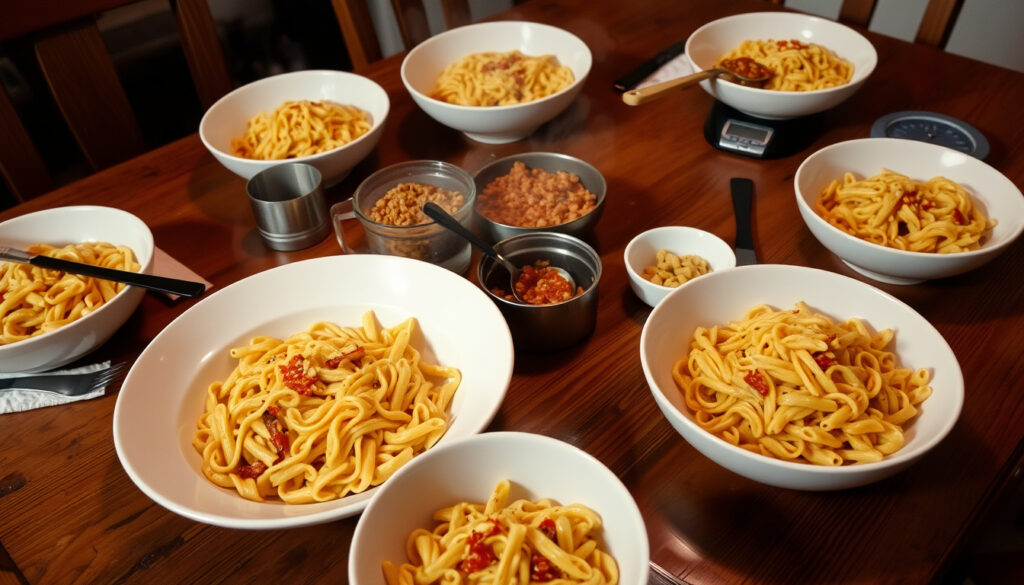
How Much Pasta Per Person? Serving Sizes and Tips for Crowds
Anyone who’s stood over a pot of boiling water, wondering if that handful of spaghetti will be enough — or too much — knows the pasta portion puzzle. It’s one of those kitchen questions that seems simple but has no single answer, varying by appetite, occasion, and even pasta shape. This guide pulls together official portion recommendations from pasta manufacturers and restaurant groups with practical tips for cooking for one or feeding a crowd, so you can cook with confidence every time.
Standard dry pasta serving per person: 75–115 g (2.5–4 oz) ·
Cooked pasta doubles in weight: 100 g dry = ~200 g cooked ·
1 lb (454 g) dry pasta serves: 4 as a main dish ·
1 cup dry elbow macaroni: ~2 servings
Quick snapshot
- 100 g dry pasta is a standard main-course portion (San Carlo (Italian restaurant group))
- Pasta weight approximately doubles when cooked (CyPasta (cooking education site))
- 1 lb dry pasta feeds 4 people as a main course (Red Kitchen Project (home cooking blog))
- Exact portion varies by pasta shape and individual appetite (San Carlo (Italian restaurant group))
- Ideal keep-warm temperature for home-cooked pasta lacks a single standard (IGA (grocery chain guidance))
- Par-cooked pasta holds well for up to 2 days refrigerated (CyPasta (cooking education site))
- Cook al dente for make-ahead; finishing in sauce takes 1–2 minutes (CyPasta)
- Nail your per-person baseline, then scale confidently for groups
- Master make-ahead methods so pasta night becomes stress-free
The table below summarizes portion sizes for dry and cooked pasta across common scenarios.
| Portion type | Dry weight | Cooked weight (approx.) |
|---|---|---|
| Main course, one adult | 100 g (3.5 oz) | 200–225 g (7–8 oz) |
| Side dish, one adult | 50–75 g (2–2.5 oz) | 100–150 g (3.5–5.5 oz) |
| Italian-style primo course | 75 g (2.6 oz) | 150 g (5.3 oz) |
| 1 cup dry elbow macaroni | ~100 g | serves 2 as a side |
| 1 lb dry spaghetti (454 g) | 454 g | serves 4 as a main |
Is 100g of pasta enough for one person?
For most adults eating pasta as a main course, 100 g of dry pasta lands right in the sweet spot. Italian restaurant group San Carlo (UK-based Italian dining experts) notes that a typical UK main-course portion falls between 100 and 120 g of dry pasta per person. Meanwhile, the Scale for Grams guide (cooking measurement resource) describes 100 g as a generous main-course portion for an adult. So yes — 100 g is enough, but the exact amount depends on appetite, what else is on the table, and which pasta shape you’re using.
What about 75g or 115g?
- 75 g is a standard side-dish or Italian-style primo (first course) portion, according to San Carlo.
- 115 g (about 4 oz) works for hungry adults or when the sauce is simple and light, notes EatHealthy365 (nutrition and cooking site).
A 75 g portion leaves room for a second course or a hearty appetizer. A 115 g portion skips the starter — you get a satisfying one-dish meal, but you lose the flexibility of a multi-course dinner.
How does pasta shape affect portion?
- Dense, compact shapes like penne, fusilli, and farfalle weigh more per cup than long, thin strands such as spaghetti or angel hair. A cup of dry penne (~110 g) serves roughly one main-course portion; a cup of dry spaghetti (~90 g) may need slightly less by weight.
- Filled pastas such as ravioli, tortellini, and agnolotti are typically served in larger portions because the filling adds weight and richness — expect 150–200 g of fresh filled pasta per person as a main, per San Carlo.
How much dry pasta for 4 people?
For a table of four, 1 pound (454 g) of dry pasta is the gold standard. That works out to roughly 113 g per person — right within the 100–115 g range recommended across multiple sources. Red Kitchen Project (home cooking resource) states plainly that 1 lb of dry pasta serves 4 as a main dish. For a side dish, the same pound stretches to 8 people, according to the same source.
Five portion patterns for four people, one takeaway: scaling from a single serving to a group is simple arithmetic — multiply your per-person baseline by the number of diners, then round up slightly for safety.
| Group size | Dry pasta needed (main course) | Dry pasta needed (side dish) |
|---|---|---|
| 2 people | 200–230 g (7–8 oz) | 100–150 g (3.5–5.5 oz) |
| 4 people | 400–500 g (14 oz – 1.1 lb) | 200–300 g (7–10.5 oz) |
| 6 people | 600–750 g (1.3–1.65 lb) | 300–450 g (10.5 oz – 1 lb) |
| 10 people | 1 kg (2.2 lb) | 500–750 g (1.1–1.65 lb) |
Is 500g pasta enough for 2 people?
500 g of dry pasta for two people works out to 250 g per person — more than double the standard main-course portion. Cibo di Italia (Italian cooking resource) suggests about 500–550 g for a dinner party of 6, which translates to roughly 85–90 g per person. For two people, 200–230 g is the appropriate range; 500 g would be excessive unless you’re planning for leftovers or extra-hungry diners.
Is 1lb of pasta enough for 4 people?
Yes — 1 lb (454 g) is the standard benchmark for feeding four adults a main-course pasta dish. Red Kitchen Project affirms this as a reliable crowd rule. That gives each person about 113 g dry, which cooks up to roughly 225 g of tender, sauce-ready pasta per plate.
How do I make pasta ahead of time for a crowd?
Cooking pasta in advance for a group is not only possible — it’s a smart strategy that many busy home cooks and even restaurants rely on. The key is to stop short of fully cooking the pasta, then shock it to stop the cooking process.
Can pasta be pre-cooked ahead of time?
- Par-cook and shock: Boil the pasta for 2–3 minutes less than the package directions call for (it should still have a white, starchy core). Drain immediately and plunge into an ice-water bath or rinse under cold running water until cool. IGA (Canadian grocery chain, culinary guidance) recommends this method for make-ahead pasta dishes.
- Toss with oil: After shocking, drain thoroughly and toss the pasta with a small amount of olive or vegetable oil to prevent sticking. CyPasta (cooking education resource) emphasizes this step.
- Refrigerate or freeze: Store the par-cooked pasta in an airtight container or zip-top bag. It keeps in the refrigerator for up to 2 days, or in the freezer for up to a month.
What is the best way to store pre-cooked pasta?
The best container keeps air out and moisture in — a sealed container with a tight lid works well. CyPasta advises cooking al dente (or slightly under) when making pasta ahead, so it doesn’t turn mushy after reheating or finishing in sauce. When you’re ready to serve, plunge the pre-cooked pasta into boiling water for 30–60 seconds, or reheat it directly in your simmering sauce.
Par-cooking and shocking means the pasta’s starch structure is set but not fully gelatinized. Reheating completes the process in seconds, delivering a texture close to freshly boiled — without the last-minute boiling frenzy.
What is the best way to serve pasta to a large group?
When you’re feeding a crowd, the way you serve pasta matters almost as much as the portions. The goal is to keep the pasta at the right temperature and texture while letting guests serve themselves at their own pace.
What is the best way to serve pasta at a buffet?
Chafing dishes are the home cook’s best friend for a pasta buffet. These portable warming trays use a water bath and a flame or electric heat source to maintain a steady temperature. IGA recommends keeping sauce warm separately from the pasta — a critical detail that prevents the noodles from absorbing too much liquid and turning soggy over the course of an hour-long buffet.
- Sturdy pasta shapes are your allies. Penne, rigatoni, fusilli, farfalle, and shells hold up far better than delicate strands like angel hair or capellini. Their grooves and ridges also grip sauce more effectively, according to San Carlo (Italian restaurant group).
- Toss with a little butter or oil just before transferring to the serving dish. This helps maintain moisture and prevents clumping during the serving window.
What are some good pasta dishes to serve at a party?
Baked pastas — lasagna, baked ziti, and penne alla vodka — are naturally crowd-friendly because they hold heat well and don’t rely on last-minute boiling. For a buffet, consider a pasta salad (served at room temperature) or a robust shape with a thick, clingy sauce like a ragù or a creamy alfredo. Cibo di Italia notes that for gatherings of 6–10 people, a single large-format pasta dish (like lasagna or a baked casserole) simplifies both cooking and serving.
What this means: Your choice of serving method directly impacts the final texture — plan around your equipment and the time guests will be eating.
How can I keep pasta warm when serving it to a crowd?
Keeping pasta warm for an extended period is the biggest practical challenge when serving a large group. Without the right technique, you end up with a cold, clumpy, or dried-out mess.
How do restaurants keep pasta warm?
Professional kitchens rely on steam tables — heated counters that use hot water or steam to hold cooked foods at serving temperature (typically 140–165°F / 60–74°C). IGA’s make-ahead guide suggests that home cooks can replicate this by using a slow cooker set to warm, or a large pot with a few inches of simmering water and a heatproof bowl set on top (a DIY bain-marie). Tossing the pasta with butter or oil before warming helps retain moisture and prevents the surface from drying out.
Can I use a slow cooker?
Yes — a slow cooker on the “warm” setting is an excellent home alternative to a steam table. Add the cooked, drained pasta to the slow cooker along with a tablespoon of butter or olive oil, stir gently, and cover. The pasta will stay at a safe serving temperature for up to an hour without overcooking, provided the sauce is added at serving time or kept warm separately in a saucepan or second slow cooker.
- Keep sauce separate: Combining sauce with pasta too early leads to sogginess. CyPasta (cooking education resource) stresses that storing and reheating pasta separately from sauce preserves the texture of both.
- Cover tightly: Use a lid or foil to trap steam and prevent the pasta from drying out. Stir gently every 15–20 minutes to redistribute warmth.
Pasta held above 140°F for more than 30 minutes will continue to absorb water and soften, even if it’s kept separate from sauce. The trade-off is clear: convenience costs a bit of texture. For best results, par-cook al dente and finish reheating in a hot sauce just before serving.
Confirmed facts vs. what’s still unclear
Confirmed facts
- 100 g dry pasta is a standard main-course portion for one adult (San Carlo)
- Pasta weight approximately doubles when cooked (CyPasta)
- 1 lb dry pasta feeds 4 people as a main course (Red Kitchen Project)
What’s unclear
- The exact per-person portion can shift by 20–30 g depending on pasta shape and individual appetite (San Carlo)
- No single “best” keep-warm temperature for home serving is universally agreed upon; methods vary by equipment and timing (IGA)
- Par-cooked pasta can be refrigerated for up to 2 days – source is a tier‑3 cooking education site (CyPasta)
- Sauce should be kept separate from pasta when serving a crowd – source is a tier‑3 cooking education site (CyPasta)
What experts say about pasta portions
“A common rule of thumb is 2 ounces (56 g) of dry pasta per person for a side dish.”
— Barilla (global pasta manufacturer, serving-size guidelines)
“Italian-style portions in a multi-course meal are often 75 g dry pasta as a primo or pasta course.”
— San Carlo (UK-based Italian restaurant group, portion guidance)
“Some guides recommend about 110 g of pasta per serving when cooking ahead for pasta dishes.”
— IGA (grocery chain, make-ahead cooking advice)
“A general crowd rule is 1 pound of dry pasta for about 4 people as a main dish.”
— Red Kitchen Project (home cooking resource, crowd-feeding tips)
Putting it all together — your pasta serving strategy
The numbers are consistent across multiple authoritative sources: 100 g of dry pasta per person for a main course, 75 g for a side, and 1 lb for a table of four. But the real skill is knowing how to adapt — scaling for appetite, choosing the right shape for the occasion, and using make-ahead techniques that let you enjoy the meal instead of sweating over the stove. For the home cook feeding a crowd, the choice is clear: par-cook ahead, keep sauce separate, and warm using a chafing dish or slow cooker, or the texture will suffer and the stress will linger.
Related reading: **How to Make Scones: Easy Recipe, Tips & Common Mistakes**
cypasta.com, cypasta.com, eathealthy365.com, whaleycooks.com
Frequently asked questions
Is 1 cup of dry pasta a serving?
One cup of dry pasta (about 100 g for most short shapes like penne or elbow macaroni) serves roughly 1 person as a main course or 2 people as a side dish, according to EatHealthy365.
How much water is needed per pound of pasta?
A standard rule is 4–6 quarts of water per pound (454 g) of dry pasta. Using enough water ensures the pasta has room to cook evenly and doesn’t become sticky from excess starch.
Should I add oil to pasta water?
Adding oil to the cooking water is generally not recommended — it can coat the pasta and prevent sauce from adhering. The Barilla (pasta manufacturer, cooking guidance) advises salting the water generously instead.
How do I reheat pre-cooked pasta without drying it out?
The best method is to drop the pre-cooked pasta into boiling water for 30–60 seconds, then drain and toss with warm sauce. Alternatively, reheat it in the sauce itself over low heat, adding a splash of pasta water to loosen the texture.
What pasta shapes hold up best in a buffet?
Sturdy, ridged shapes such as penne, rigatoni, fusilli, farfalle, and shells are ideal for buffets because they resist clumping and hold sauce well. Delicate strands like angel hair or capellini are prone to breaking and drying out.
Is 500g pasta enough for 2 people?
500 g dry pasta for two people (250 g each) is more than double the standard main-course portion. For 2 people, 200–230 g is the appropriate amount. Cibo di Italia (Italian cooking resource) suggests 500–550 g for 6 people, not 2.
How do restaurants keep pasta warm for large events?
Restaurants use steam tables holding water at 140–165°F (60–74°C), or hot water baths with the pasta in a suspended insert. Tossing the pasta with butter or oil helps maintain moisture, and sauce is always kept separate until serving.
What is the best way to serve pasta at a party?
Use a chafing dish or slow cooker set to warm, keep the sauce on the side, and choose a baked or sturdy pasta dish. Pasta salads served at room temperature are another excellent, low-stress option for parties.
More related posts
 Naruto Shippuden Filler List: Every Episode You Can Skip
 Ireland November Internationals 2025: Full Schedule
 Easy Art Projects for Kids: Quick Ideas for All Ages
 Man Utd v Leeds 2026: Croke Park Tickets, Time & History
 Best Movies on Streaming Right Now: 2026 Picks
 Mobile Car Valet Dublin: Prices, Services & Worth It? (2026 Guide)
 Small Town, Big Story Review: Worth Watching in 2025