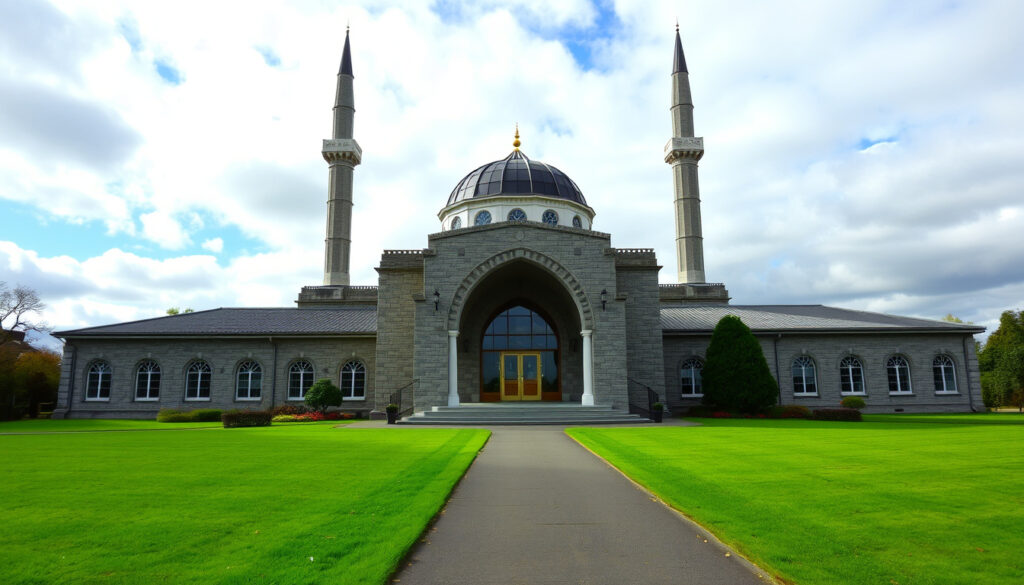
Dublin Islamic Cultural Centre: Clonskeagh Mosque Guide
Dublin’s largest mosque sat empty for nine months after an internal dispute. The Islamic Cultural Centre of Ireland reopened its doors on February 13, 2026—nine months after the Al Maktoum Foundation, the UAE-based owner and funder, closed it following a confrontation that Irish Times described as involving “chaos and violence at a meeting.”
Location: Clonskeagh, south Dublin · Funded by: al-Maktoum Foundation · Muslim community status: Ireland’s third-largest religious community · Recent update: Reopened February 2026 · Features: Mosque, multipurpose hall, bookshop, restaurant
Quick snapshot
The centre’s recent history divides into confirmed facts, unresolved questions, key dates, and what comes next.
- Ireland’s largest mosque, capacity 1,700 (Irish Times)
- Al Maktoum Foundation provides €2.5 million annually (Irish Times)
- Reopened February 13, 2026, for Maghrib prayers (Irish Times)
- April 19, 2025 — closure incident (Irish Times)
- February 11, 2026 — board announces reopening (5Pillars)
- February 13, 2026 — doors reopen (Irish Times)
- February 17, 2026 — Ramadan begins (Irish Times)
- Rotating imams replace permanent position (Irish Times)
- Volunteer-led operations planned (Irish Times)
- Koranic school remains closed (Irish Times)
The table below summarises the centre’s key operational and financial facts drawn from verified sources.
| Fact | Detail |
|---|---|
| Full Name | Islamic Cultural Centre of Ireland |
| Address | 19 Roebuck Road, Clonskeagh, D14 |
| Funding | Al Maktoum Foundation (UAE) |
| Capacity | 1,700 worshippers |
| Closure period | April 2025 – February 2026 (nine months) |
| Reopening date | February 13, 2026 |
Why is the mosque closed in Dublin?
The Islamic Cultural Centre of Ireland’s mosque shut down following a confrontation on April 19, 2025, that Irish Times described as involving “chaos and violence at a meeting.” According to the Islamic Cultural Centre board, the closure became necessary after an internal dispute escalated beyond reconciliation.
Recent closure reasons
The exact sequence of events that triggered the April 2025 closure involved an altercation at a board meeting. RTE reported that southside Dublin Muslims were unable to access the mosque for daily prayers during the nine-month shutdown, with only the Muslim National School remaining open to serve the community.
Gardaí have been investigating alleged financial irregularities, reportedly involving millions of euro sent abroad annually, including €1 million in both 2023 and 2024, according to Irish Times. Gardaí have also been liaising with foreign authorities as part of the inquiry.
High Court proceedings added another layer: the court ordered Dr Abdel Basset El-Sayed, who had been director since 2012, to pay legal costs after his claims of corporate criminality failed, Irish Times reported.
The Garda investigation into financial irregularities remains open, and any resulting charges could permanently damage the centre’s reputation.
Protest over Clonskeagh mosque
Community members held protests during the closure period, calling for resolution and reopening. The statement “Leave no room for extremism and discord” appeared in communications from the Clonskeagh mosque, reflecting attempts to move past the internal divisions that prompted the shutdown.
According to media reports, concerns were raised about alleged links to certain ideologies, though the Irish Times noted these concerns had been disputed internally. The centre has maintained that it operates independently and follows Irish law.
Reopening updates
The ICCI board announced on February 11, 2026, that the mosque would reopen the following Friday. The official reopening on February 13, 2026, drew dignitaries, board members, and visitors from Dubai, RTE reported. The timing coincided with Ramadan beginning on February 17, 2026.
Sheikh Hussein Halawa, 70, had departed following an out-of-court settlement. The centre has not appointed a permanent imam, instead introducing rotating imams. The Koranic school, however, remains closed with no immediate plans to reopen.
The centre stated: “We are now on a path to recovery, thanks to the continued support of donors in Dubai and the community at large.” A second statement confirmed the reopening was timed for Ramadan, calling it “a long period of closure.”
The restaurant and bookshop continued operating throughout the closure, serving community members even when prayer services were suspended.
What is the biggest mosque in Ireland?
The Islamic Cultural Centre of Ireland in Clonskeagh holds the distinction of being Ireland’s largest mosque, with a capacity of up to 1,700 worshippers. RTE separately reported a figure of 5,000, though this appears to reflect an alternative measurement or potential error in reporting.
The venue regularly hosts Eid celebrations drawing around 3,500 attendees, with weekly Friday prayers attracting approximately 1,000 worshippers.
Islamic Cultural Centre of Ireland overview
Located at 19 Roebuck Road in Clonskeagh (Dublin 14), the centre serves as the primary Islamic institution in Ireland. The Al Maktoum Foundation, a UAE-based charity, owns the property and provides €2.5 million in annual funding, making it one of the better-resourced religious institutions in the country.
The centre’s governance structure has faced scrutiny. Dr Abdel Basset El-Sayed, who served as director since 2012, became embroiled in legal disputes that concluded with him ordered to pay costs after failing to substantiate claims of corporate criminality.
Facilities and features
Beyond the mosque itself, the complex includes a multipurpose hall, bookshop, restaurant, and administrative offices. The Muslim National School operates on the same site and remained functional throughout the mosque closure, demonstrating the centre’s role as a broader community hub.
The restaurant and shop continued serving customers even when prayer services halted, maintaining some community presence during the nine-month disruption.
How many Muslims live in Dublin?
Islam represents Ireland’s third-largest religious community, following Christianity and those with no religion. The Islamic Cultural Centre serves as the focal point for Dublin’s Muslim population, which has grown steadily over recent decades.
Muslim population in Dublin
Dublin’s Muslim community has grown significantly since the 1990s, with the Clonskeagh centre becoming increasingly important as the population expanded. The centre’s Friday prayers drawing roughly 1,000 worshippers provide a snapshot of regular active participation.
The closure period displaced southside Dublin Muslims, forcing them to travel to other mosques or prayer spaces across the city. The reopening has restored access for thousands who previously had no nearby facility.
Muslims in Ireland context
Ireland’s Muslim population remains relatively small compared to other European countries but has grown faster proportionally in recent years. The Islamic Cultural Centre of Ireland’s status as the country’s largest mosque reflects Dublin’s position as the primary centre for Muslim community life.
Are non-Muslims allowed inside mosques?
Non-Muslims are generally permitted to visit mosques, and the Islamic Cultural Centre of Ireland has opened its doors to the public for events like Culture Night Dublin. Visitors are typically asked to remove shoes and dress modestly.
Visiting rules at Dublin Islamic Cultural Centre
The centre welcomes visitors for cultural and educational purposes outside of prayer times. During Ramadan, when the mosque hosts significant additional programming, access may be more restricted. Those planning a visit should check current availability through the centre’s official channels.
The multipurpose hall and restaurant areas generally have more flexible access policies than the prayer hall itself, which is primarily reserved for Muslim worshippers.
Can Catholics visit?
People of any faith or none can visit the centre during open events. Culture Night Dublin has provided opportunities for non-Muslims to tour the facility, ask questions, and observe aspects of Islamic architecture and practice. The experience often includes explanations of prayer customs and the role of the mosque in Muslim daily life.
Islamic Cultural Centre of Ireland prayer times
Current prayer times at the centre, as listed on Islam Ireland (the official website), reflect the daily schedule observed by the Muslim community. As of mid-April 2026, the times were: Fajr at 03:58, Dhuhr at 13:24, Asr at 17:17, and Maghrib at 20:34.
Prayer times shift throughout the year based on astronomical calculations, with early morning prayers (Fajr) occurring before dawn and evening prayers (Maghrib) at sunset. Friday prayers hold special significance and typically draw larger congregations.
Dublin mosque prayer timetable
The Islamic Cultural Centre follows standard Islamic prayer schedules, with five daily prayers: Fajr (dawn), Dhuhr (midday), Asr (afternoon), Maghrib (sunset), and Isha (night). During Ramadan, the schedule may be adjusted with additional Taraweeh prayers held after Isha.
Visitors seeking current prayer times should consult the Islam Ireland website directly, as times change daily and vary by season.
Current access status
Following the February 2026 reopening, the mosque is now accessible for daily prayers after a nine-month closure. The centre has shifted to a volunteer-led operational model, with rotating imams rather than a permanent religious leader. Future plans emphasize community involvement over institutional staffing.
The Islamic Cultural Centre of Ireland faced its most serious governance crisis in decades, yet emerged with its doors open for Ramadan 2026. Whether it has fully resolved the underlying tensions that caused the April 2025 closure remains an open question.
Timeline
The sequence below tracks the centre’s most significant events from closure through reopening and the subsequent controversy.
| Date | Event |
|---|---|
| April 19, 2025 | Mosque closes following altercation at meeting |
| February 2026 – February 2026 | Nine-month closure period |
| Early 2026 | High Court orders Dr El-Sayed to pay legal costs |
| February 11, 2026 | ICCI board announces reopening |
| February 13, 2026 | Official reopening with prayers |
| February 16, 2026 | Books-dumping controversy reported |
| February 17, 2026 | Ramadan begins |
Confirmed
- Location in Clonskeagh, Dublin 14
- Funded by Al Maktoum Foundation (€2.5 million/year)
- Ireland’s largest mosque
- Closed April 19, 2025, after internal dispute
- Reopened February 13, 2026
- Ramadan began February 17, 2026
- Restaurant and shop remained open during closure
- Muslim National School stayed operational
- Rotating imams replacing permanent position
Unclear or disputed
- Exact capacity (1,700 vs 5,000 reported)
- Full facts on February 16 books-dumping incident
- Gardaí investigation status and conclusions
- Nature of alleged extremist ideology concerns
- Permanent future governance structure
What people said
We are now on a path to recovery, thanks to the continued support of donors in Dubai and the community at large.
— Islamic Cultural Centre of Ireland (via Irish Times)
We are happy to confirm that, after such a long period of closure, our Mosque is officially re-opening on Friday, 13th February 2026 in time for Ramadan.
— ICCI board (via 5Pillars)
Leave no room for extremism and discord.
— Clonskeagh mosque statement
Related reading: Dublin to Galway Train Timetable
Frequently asked questions
Is Islam the fastest growing religion in Ireland?
Islam has grown significantly in Ireland over recent decades, though reliable comparative growth data across religions varies. Islam is currently Ireland’s third-largest religious community.
Why are Muslims moving to Ireland?
Muslims have relocated to Ireland for reasons similar to other immigrants: employment opportunities, education, family reunification, and refugee resettlement. Ireland’s growing economy and multicultural policies have attracted diverse communities.
Is hijab allowed in Ireland?
Yes, wearing hijab is legal in Ireland. Muslims freely practice their faith, including wearing religious dress. Ireland’s equality laws protect religious expression in employment, education, and public services.
Is Ireland safe for a Muslim woman?
Ireland generally reports lower levels of anti-Muslim sentiment compared to some European countries, though no country is entirely free from discrimination. The Islamic community has established itself comfortably, with mosques and Islamic schools operating openly.
Which city in Ireland has the most Muslims?
Dublin hosts the largest Muslim population by far, given its status as Ireland’s largest city and primary economic centre. Smaller Muslim communities exist in Cork, Galway, and other cities.
What happened in the Islamic cultural centre?
The centre experienced a nine-month closure following an internal dispute on April 19, 2025. Gardaí investigated alleged financial irregularities. The centre reopened February 13, 2026, with a new governance approach emphasising volunteers and rotating imams.
Is the Dublin Islamic Cultural Centre open to visitors?
Yes, the centre has opened to the public during events like Culture Night Dublin. Visitors should check current access policies, as restrictions may apply during religious observances like Ramadan.
For those tracking the saga, the reopening marks the end of one chapter but not the entire story. Gardaí investigations continue, the volunteer model remains untested at scale, and questions about governance persist. For Dublin’s Muslim community, however, the immediate crisis has passed—the doors are open, prayers are happening, and the path to recovery, however uncertain, has begun.
More related posts
 Needle and Thread Dresses – Sizing Guide and Fit Tips
 River Island Ireland Sale – Up to 50% Off Dresses and Shoes
 How to Create a Backup Plan Step by Step: 3-2-1 Rule Explained
 Galaxy M32 to Buy – Current Prices and Availability in India
 Can Dogs Eat Rice? Safety, Benefits, and Risks for Dogs
 RTÉ 2 TV Guide: Schedule Today, Tonight & Live Stream
 Great Wall of China: Length, History, Facts & Why Built
 Steve Carell Movies and TV Shows: Complete Filmography & Guide