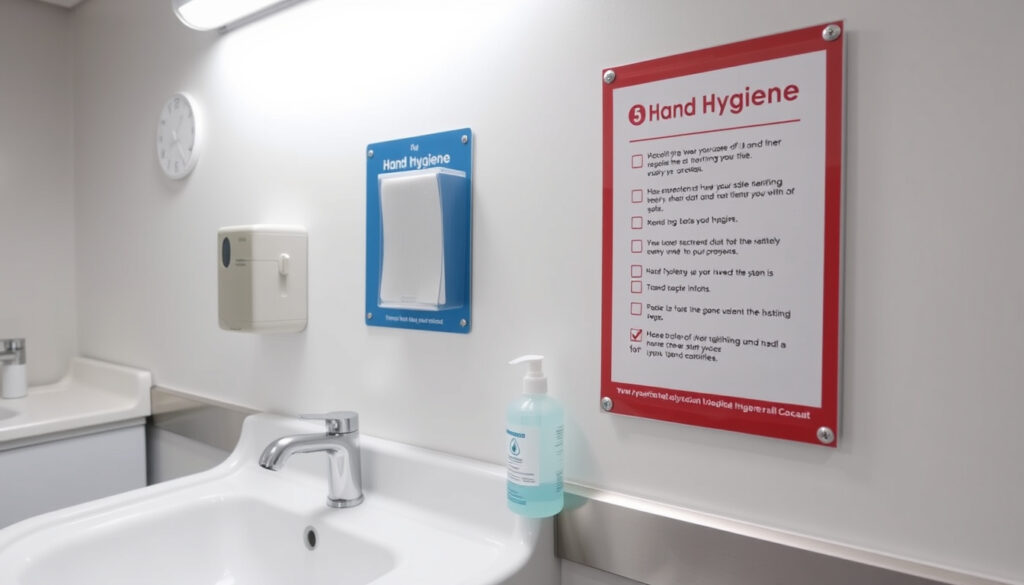
5 Moments of Hand Hygiene: WHO Guide for Healthcare
Anyone who has walked into a hospital room or aged care facility has seen the sink and the alcohol rub dispenser, but knowing exactly when to use them can feel like a guessing game. The World Health Organization’s “5 Moments for Hand Hygiene” framework removes that guesswork, mapping five critical points across every patient interaction.
Healthcare‑associated infections prevented annually with proper hand hygiene: up to 50% · Year WHO launched the initiative: 2009 · Recommended hand rub duration: 20–30 seconds · Most common hospital‑transmitted pathogen: MRSA
Quick snapshot
- WHO designates 5 Moments specifically for healthcare settings (World Health Organization (global public health authority))
- Proper hand hygiene reduces healthcare‑associated infections by up to 50% (HARTMANN Science Center (European hygiene research body))
- Whether the 5 Moments poster alone (without training) improves long‑term compliance
- How well the same model translates to non‑clinical public settings
- Optimal audit frequency for sustaining hand‑hygiene behaviour
- 2009 – WHO releases “Your 5 Moments for Hand Hygiene” poster (World Health Organization (global public health authority))
- Expansion of the 5 Moments framework into aged care and community health programmes (World Health Organization (global public health authority))
Five key facts capture the framework’s reach and relevance.
| Fact | Detail |
|---|---|
| Year introduced by WHO | 2009 |
| Number of steps in WHO hand‑washing technique | 7 |
| Recommended duration with soap and water | 40–60 seconds |
| Recommended duration with alcohol‑based hand rub | 20–30 seconds |
| Rate of HAIs in developed countries (approx.) | 1 in 10 patients |
| Most common hospital‑acquired pathogen | Staphylococcus aureus (MRSA) |
What Are the 5 Moments of Hand Hygiene?
WHO’s model condenses dozens of clinical situations into five distinct moments, each targeting a specific route of pathogen transmission (HARTMANN Science Center (European hygiene research body)).
Before touching a patient
- Clean hands when approaching the patient (World Health Organization (global public health authority))
- Purpose: protect the patient against harmful germs carried on the hands
Before a clean / aseptic procedure
- Clean hands immediately before a procedure such as wound dressing or catheter insertion (World Health Organization (global public health authority))
- Purpose: protect the patient — including from their own germs — from entering the body
After body‑fluid exposure risk
- Clean hands immediately after exposure to body fluids and after glove removal (World Health Organization (global public health authority))
- Purpose: protect yourself and the healthcare environment from harmful patient germs
After touching a patient
- Clean hands after touching a patient and her/his immediate surroundings when leaving the patient’s side (World Health Organization (global public health authority))
- Purpose: protect yourself and the environment
After touching patient surroundings
- Clean hands after touching any object or furniture in the patient’s immediate surroundings, even if the patient has not been touched (World Health Organization (global public health authority))
- Purpose: prevent transmission via the environment
Every moment protects a different link in the transmission chain. Missing one — for example, forgetting to clean hands after touching a bed rail — can undo the protection gained from the previous four moments.
The implication: the 5 Moments are not a checklist but a continuous, location‑aware habit. The patient zone concept — the patient plus their immediate surroundings — is the mental map that ties them together.
What Are the 7 Steps in Hand Washing?
WHO recommends a seven‑step technique for hand washing with soap and water, lasting 40–60 seconds (World Health Organization (global public health authority)). The steps ensure every surface of the hands is covered.
Step 1: Wet hands with water
- Use clean, running water (warm if available).
Step 2: Apply soap
- Enough to cover all hand surfaces.
Step 3: Rub palms together
- Rotational, covering both palms.
Step 4: Rub between fingers
- Interlace fingers, rub back and forth.
Step 5: Rub back of hands
- Place right palm over left hand dorsum, rub, reverse.
Step 6: Rub thumbs and fingertips
- Clasp each thumb and rotate; rub fingertips in opposite palm.
Step 7: Rinse and dry
- Rinse with water, dry thoroughly with a single‑use towel.
The 7‑step technique is not optional — it’s the evidence‑backed standard that closes the gap between “washing” and “disinfecting.” A quick 10‑second rinse leaves high bacterial loads on fingertips and thumbs (HARTMANN Science Center (European hygiene research body)).
The pattern: technique matters as much as timing. The 7 steps ensure physical removal of soil and microbes, while the 5 Moments tell you when to apply them.
How Do the 5 Moments Apply in Aged Care?
Aged care residents face a higher infection risk due to compromised immunity, close living quarters, and frequent hands‑on assistance (World Health Organization (global public health authority)). The 5 Moments adapt to daily care routines.
Differences from acute hospital settings
- Patient zone often includes the resident’s room, bed, and personal items — staff must clean hands after touching any of these.
- More frequent “before and after” moments because each activity of daily living (feeding, dressing, toileting) involves direct contact.
Importance for residents with compromised immunity
- Residents are more vulnerable to infections such as respiratory viruses and gastrointestinal pathogens. Moment 2 (before aseptic procedure) applies to wound care and catheter handling; Moment 3 (after body fluid risk) applies after every toileting or incontinence pad change (HARTMANN Science Center (European hygiene research body)).
Practical examples in daily care routines
- Before assisting with meals — Moment 1.
- After assisting with toileting — Moment 3 and Moment 5 (after touching surroundings).
- Before applying a topical cream to broken skin — Moment 2.
The trade‑off: aged care demands more frequent hand hygiene than acute care, but staff‑to‑resident ratios often make compliance harder. The framework works best when posters and training are tailored to the specific daily tasks (World Health Organization (global public health authority)).
What Are the 5 Principles of Hand Washing?
Beyond the moments, WHO defines five overarching principles that underpin effective hand hygiene.
Use the correct technique
- Follow the 7‑step sequence every time.
Use the appropriate product
- Alcohol‑based hand rub for routine care (20–30 seconds); soap and water when hands are visibly soiled or after exposure to spore‑forming organisms (World Health Organization (global public health authority)).
Wash at the right times
- Apply the 5 Moments to every patient interaction.
Maintain skin integrity
- Use moisturising hand rubs and lotions to prevent dermatitis, which can reduce compliance (HARTMANN Science Center (European hygiene research body)).
Include glove use when needed
- Gloves are not a substitute for hand hygiene — clean hands before donning and after removing.
The catch: principles 4 and 5 are often overlooked. Dry, cracked hands discourage frequent washing, while improper glove use can give a false sense of protection.
Why Are the 5 Moments of Hand Hygiene Important?
Healthcare‑associated infections affect about 1 in 10 patients in developed countries. Up to 50% of those infections are preventable with proper hand hygiene (HARTMANN Science Center (European hygiene research body)).
Reduction of healthcare‑associated infections
- Each moment interrupts a specific transmission path. When all five are followed consistently, rates of MRSA, C. difficile, and surgical‑site infections drop significantly (World Health Organization (global public health authority)).
Protection of both patient and healthcare worker
- Moments 1 and 2 protect the patient; Moments 3, 4, and 5 protect the worker and the environment.
Cost‑effectiveness of infection prevention
- The cost of hand rub and training is a fraction of the cost of treating a single HAI. Studies estimate that every €1 invested in hand‑hygiene programmes saves €16–24 in avoided infections (HARTMANN Science Center (European hygiene research body)).
What this means: the 5 Moments are not a bureaucratic exercise — they are the most cost‑effective single intervention in infection control.
Six moments, one pattern: each moment targets a distinct transmission route. The framework’s genius is its simplicity — five rules cover hundreds of clinical scenarios.
| Moment | When | Why |
|---|---|---|
| Before patient contact | Approaching patient | Protect patient from your germs |
| Before aseptic procedure | Immediately before clean task | Protect patient from own germs |
| After body‑fluid risk | After exposure, after glove removal | Protect yourself and environment |
| After patient contact | When leaving patient’s side | Protect yourself and environment |
| After contact with surroundings | After touching objects near patient | Prevent environmental transmission |
The takeaway: the 5 Moments work because they tie hand hygiene not to a clock but to physical proximity and risk cues.
“Clean your hands immediately before a clean / aseptic procedure.”
World Health Organization (global public health authority), Your 5 Moments for Hand Hygiene poster
“The concept was developed by Swiss scientists jointly with U.S. colleagues and based on experience from the University Hospital Geneva national hand‑hygiene program.”
HARTMANN Science Center (European hygiene research body)
For healthcare workers in Ireland, the choice is clear: embed the 5 Moments into every shift, or continue accepting preventable infection rates that cost lives and millions in treatment. For aged care providers, the adaptation is non‑negotiable — residents depend on consistent, moment‑based hygiene. The framework’s power is not in being new, but in being consistently applied.
meritech.com, pmc.ncbi.nlm.nih.gov, cdc.gov, instagram.com, qualitysafety.bmj.com, icanetwork.co.za
For a detailed breakdown of the proper technique, refer to WHOs hand washing guidelines which outlines the recommended timing and steps.
Frequently asked questions
What is the correct order of the 5 moments of hand hygiene?
The order is: 1. Before touching a patient, 2. Before a clean/aseptic procedure, 3. After body‑fluid exposure risk, 4. After touching a patient, 5. After touching patient surroundings. They should be performed in that sequence during a care episode.
Can I use hand sanitizer instead of soap and water?
Yes, alcohol‑based hand rub is the preferred method for routine hand hygiene in healthcare settings, unless hands are visibly soiled or after exposure to spore‑forming organisms (e.g., C. difficile). Use soap and water in those cases.
How long should I wash my hands to remove germs?
WHO recommends 40–60 seconds with soap and water, following the 7‑step technique. With alcohol‑based hand rub, 20–30 seconds until dry.
What are the 5 Fs of hygiene and how do they relate to hand washing?
The 5 Fs are Food, Fingers, Flies, Fomites, and Faecal‑oral transmission. Hand washing breaks the F‑chain by removing pathogens from fingers, the most common vehicle.
Do I need to clean my hands before and after wearing gloves?
Yes. Hand hygiene must be performed before donning gloves and immediately after removing them. Gloves are not a substitute for clean hands.
How does hand hygiene in aged care differ from a hospital?
Aged care requires more frequent hand hygiene because staff assist with multiple daily tasks. The 5 Moments still apply, but the “patient surroundings” moment often includes the entire room. Training must be tailored to care routines.
What is the most common mistake people make when washing hands?
Not covering all surfaces — especially thumbs, fingertips, and between fingers. The 7‑step technique is designed to prevent this, but many people rush through in fewer than 15 seconds.
More related posts
 Sally Nightmare Before Christmas – Ragdoll Character Guide
 I’m a Celebrity 2025: Cast, Start Date & Winner
 Joanne Cantwell Husband Shay: Family Life and Career Guide
 Cheapest Car Loan Ireland Calculator: Compare Rates & Save
 Pat Kenny Signs Off: Weekday Show Ends, Weekend Role Begins
 Best Time to Post on TikTok in Ireland: 2026 Guide
 Ryder Cup Envelope Rule: How It Works, History & 2025 Controversy
 Car Service Near Me: Costs, What’s Included & How to Choose