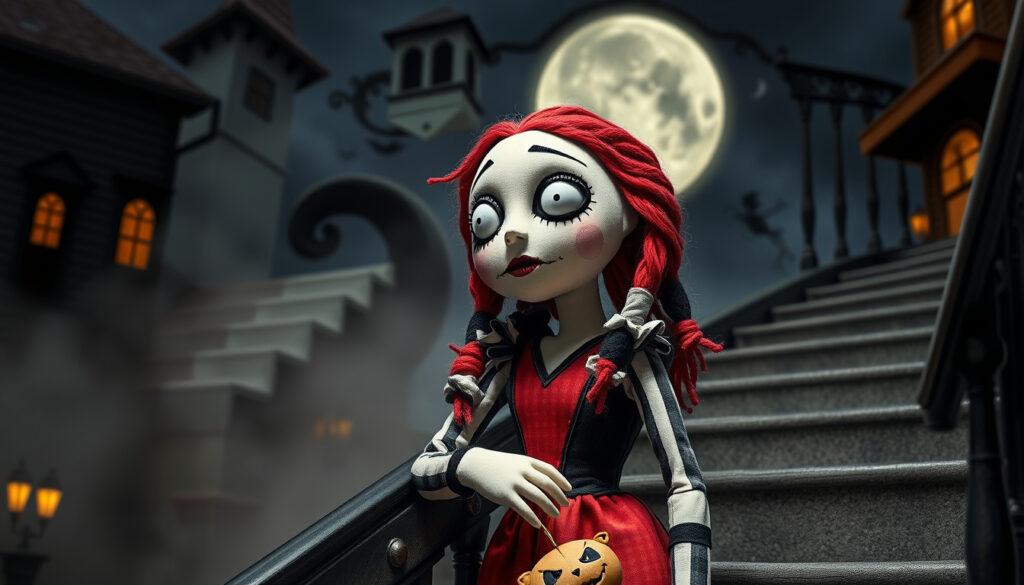
Sally Nightmare Before Christmas – Ragdoll Character Guide
Sally stands as one of animation’s most memorable romantic figures, serving as the deuteragonist of Disney’s beloved 1993 stop-motion film. This ragdoll creation of the eccentric Dr. Finkelstein has captivated audiences for decades with her gentle nature, fierce independence, and the quiet longing that defines her throughout the story. Her journey from captive assistant to beloved companion represents one of the film’s most touching narrative arcs.
Within Halloween Town’s peculiar hierarchy, Sally occupies a unique position as both creation and rebel, stitched together from mismatched parts yet possessed of remarkable emotional depth. Her relationship with Jack Skellington, the Pumpkin King, forms the emotional core of the story, offering a counterpoint to Jack’s existential wandering with themes of steadfast devotion and hard-won freedom. Understanding Sally requires examining her origins, her motivations, and the cultural significance she has achieved since her debut.
Who is Sally in The Nightmare Before Christmas?
Ragdoll creation of Dr. Finkelstein and Jack’s love interest
Catherine O’Hara
Self-disassembly and reassembly
Lives happily with Jack following the film’s conclusion
- Sally functions as Jack Skellington’s voice of reason throughout the film, consistently attempting to guide him away from his increasingly dangerous Christmas scheme
- Her creation by Dr. Finkelstein draws direct parallels to Frankenstein’s monster, representing themes of creation, autonomy, and the creator-created dynamic
- Unlike many animated romantic interests, Sally demonstrates active agency, repeatedly escaping confinement and making independent choices despite her circumstances
- Fan theories suggest deeper origins for Sally, including possibilities that she was once a witch punished by dismemberment or a resident of the Dream Town dimension
- The 2022 novel Long Live the Pumpkin Queen establishes that Finkelstein kidnapped her at age 12 and erased her memories using a special potion
- Sally possesses prophetic visions that allow her to sense approaching tragedy, most notably foreshadowing the chaos Jack’s Christmas intervention would cause
- Her character has achieved significant cultural impact, spawning extensive merchandise including collectible dolls, clothing, and Funko Pop figures
| Fact | Details |
|---|---|
| First Film Appearance | 1993’s The Nightmare Before Christmas |
| Creator | Dr. Finkelstein |
| Voice Actor | Catherine O’Hara |
| Physical Appearance | Blue-skinned ragdoll with mismatched eyes and detachable limbs |
| Key Personality Traits | Intelligent, compassionate, inquisitive, independent |
| Signature Ability | Sews herself back together after disassembly |
| Key Song | “Sally’s Song” |
| Romantic Interest | Jack Skellington |
| Hometown | Halloween Town |
| Character Role | Deuteragonist of the film |
| Fate in Film | Survives and shares a kiss with Jack on Spiral Hill |
Sally’s character draws unmistakable inspiration from Frankenstein’s monster—created by a scientist from disparate parts, initially controlled by her creator, yet ultimately seeking autonomy and belonging. Unlike the monster, however, Sally achieves reconciliation and love, suggesting a more hopeful interpretation of the creator-created relationship.
What is Sally’s Relationship with Jack Skellington?
Sally’s romantic connection with Jack Skellington forms the beating heart of The Nightmare Before Christmas. From her earliest scenes, she demonstrates a clear infatuation with the Pumpkin King, often placing his happiness above her own safety and freedom. Their relationship develops gradually throughout the film, building from distant admiration to active involvement in Jack’s life to a genuine partnership based on mutual respect and affection.
The pair’s first meaningful connection occurs during Jack’s solitary lament in the graveyard, where Sally observes from hiding after escaping Dr. Finkelstein’s laboratory. This moment establishes the pattern that will define their relationship: Jack in turmoil, Sally offering quiet support from the periphery. Throughout the film, she attempts to redirect his attention away from the Christmas scheme, recognizing the disaster it would cause long before Jack acknowledges the consequences.
The Gift Basket Scene
One of their most significant early moments involves Sally’s dramatic escape from Dr. Finkelstein’s tower. Imprisoned by her overprotective creator, Sally employs her unique ability to disassemble herself, literally jumping from the tower window and leaving parts of herself behind to facilitate her escape. After sewing herself back together, she delivers a gift basket to Jack containing a pie, a note reading “Thinking of you,” and a small potion bottle. This gesture demonstrates both her resourcefulness and her genuine affection for Jack.
Warning Jack About Christmas
Sally’s prophetic visions play a crucial role in her attempts to protect Jack from himself. After plucking petals from forget-me-not flowers in a trance-like state, she experiences a vision of a flaming Christmas tree and immediate catastrophe. She rushes to warn Jack, interrupting his Christmas preparations with urgent pleas that he reconsider his plans. Though Jack initially dismisses her concerns, Sally’s persistence ultimately underscores the depth of her devotion.
The Climactic Rescue
The relationship reaches its peak during the film’s climax when Sally attempts to prevent Jack’s Christmas mission by pouring fog juice into the town fountain, only to be thwarted by Zero’s glowing nose revealing her sabotage. Later, Sally finds herself captured by Oogie Boogie, who plans to harm her as part of his scheme. Jack’s rescue of Sally from Oogie’s clutches becomes the turning point where he finally recognizes her wisdom and the value of her constant care.
The Spiral Hill Kiss
Following Jack’s successful retrieval of Santa Claus and the restoration of order, the film concludes with a tender moment atop Spiral Hill. As the residents of Halloween Town celebrate their successful navigation of Christmas, Sally approaches Jack with evident nervousness. Jack, having finally understood that Sally’s warnings and devotion represent genuine love and wisdom, shares a kiss with her. This moment cements their relationship and suggests a hopeful future together.
The evolution of Sally and Jack’s relationship mirrors the film’s broader themes of finding one’s proper place. While Jack must learn that his calling lies in Halloween rather than Christmas, Sally must break free from Finkelstein’s control to achieve genuine connection. Their eventual union represents the successful resolution of both characters’ journeys toward authenticity.
Why Does Sally Take Herself Apart?
Sally’s ability to disassemble and reassemble herself represents far more than a convenient plot device. Throughout The Nightmare Before Christmas, this unique capability serves as both a practical survival mechanism and a powerful symbol of her desire for freedom and autonomy. Unlike ordinary characters constrained by physical limitations, Sally possesses the extraordinary ability to literally remove herself from any situation, though the process clearly causes her discomfort and requires careful reassembly.
The most dramatic instance occurs when Dr. Finkelstein confines Sally to his tower laboratory, determined to keep her isolated from the outside world. Recognizing that normal escape methods would fail against her inventor creator, Sally employs her unconventional ability to free herself. She removes her own limbs, allowing her to squeeze through the tower window bars, then falls several stories before reassembling herself in the town below. This scene establishes immediately that Sally will endure significant physical discomfort to achieve independence.
Symbolism of Self-Disassembly
The imagery of Sally taking herself apart carries profound thematic weight. In a literal sense, it represents her rejection of the container Dr. Finkelstein constructed for her, her insistence that she contains more than her creator intended. Metaphorically, self-disassembly speaks to the experience of individuals who feel fragmented or constrained by circumstances beyond their control, suggesting that sometimes escaping requires literally removing oneself from limiting situations.
The contrast between Sally’s self-directed disassembly and her involuntary creation highlights the film’s interest in questions of autonomy and self-determination. Dr. Finkelstein assembled Sally from disparate parts, but she proves herself capable of her own reassembly—choosing not only when to separate but also how to reconstitute herself. This capacity positions her as neither truly Finkelstein’s creation nor entirely independent, but rather as someone in constant negotiation with the circumstances of her making.
Sally’s Song and Emotional Expression
Sally’s primary musical contribution, “Sally’s Song,” encapsulates her internal conflict between devotion and self-preservation. The lyrics express her growing anxiety about Jack’s Christmas scheme while simultaneously revealing her inability to abandon him despite recognizing the approaching disaster. When she sings “I can’t bear to see everything occur,” the audience understands that her prophetic visions create unbearable tension between her desire to protect Jack and her fear of losing him.
“I sense there’s something in the wind / That feels like tragedy’s at hand / And though I’d like to stand by him / I can’t bear to see everything occur…”
The song demonstrates Sally’s emotional intelligence and her capacity for profound feeling despite her unusual nature. Catherine O’Hara’s gentle, melancholic delivery transforms what could be a simple ballad into a meditation on love, anxiety, and the limits of devotion. Through this musical moment, the film invites audiences to understand Sally not merely as Jack’s love interest but as a fully realized character with her own interior life.
Unlike some theories circulating among fans, Sally does not die at any point in the film. While she frequently disassembles herself, these moments always represent voluntary, reversible choices rather than fatal events. She consistently reassembles herself following each disassembly, demonstrating remarkable resilience rather than mortality.
Who Voices Sally in The Nightmare Before Christmas?
Catherine O’Hara provides the voice for Sally in The Nightmare Before Christmas, delivering a performance that has become inseparable from the character’s identity. O’Hara, already established as a versatile comedic actress through her work on SCTV and later Schitt’s Creek, brings remarkable warmth and nuance to the ragdoll character, crafting a voice that conveys both vulnerability and quiet strength.
O’Hara’s approach to Sally emphasizes the character’s compassion and emotional sensitivity. Rather than playing Sally as merely sweet or passive, she infuses the character with determination and an underlying sadness that reflects Sally’s complicated circumstances. The result is a fully dimensional performance that grounds the fantastical character in recognizable human emotion.
Catherine O’Hara’s Career Context
Following The Nightmare Before Christmas, Catherine O’Hara continued building an illustrious career that would eventually include multiple Emmy Awards for her work on Schitt’s Creek. Her involvement in The Nightmare Before Christmas represents an early example of prominent comedic actors lending their talents to animated features, a practice that would become increasingly common in subsequent decades.
O’Hara performed alongside Chris Sarandon, who voiced Jack Skellington, creating a vocal chemistry that translates into the characters’ palpable romantic tension. The pairing of these two accomplished actors contributed significantly to the film’s emotional authenticity, ensuring that the central relationship resonated with audiences beyond the film’s striking visual design. For those interested in exploring more about the characters and their performances, you can find details on Devil May Cry säsong 2.
A Timeline of Sally’s Key Scenes
Understanding Sally’s character arc requires examining the specific moments that define her journey throughout the film. The following sequence traces her appearances from the opening moments through the film’s conclusion.
- Opening Escape: Sally escapes from Dr. Finkelstein’s laboratory to witness Jack’s annual Halloween presentation, eventually hiding in the graveyard where she first observes Jack during “Jack’s Lament.”
- The Graveyard Observation: From her hiding place, Sally watches Jack’s emotional breakdown and exit from the cemetery, establishing her initial infatuation with the Pumpkin King.
- Prophetic Vision: While plucking forget-me-not petals, Sally experiences a vision of a flaming Christmas tree and rushing toward inevitable disaster, alerting her to the coming catastrophe.
- Tower Escape: Confined by Dr. Finkelstein, Sally dismembers herself to escape the tower laboratory, falls to the ground, reassembles herself, and prepares a gift basket for Jack.
- Gift Basket Delivery: Sally delivers the basket containing pie and a potion to Jack, expressing her affection and concern for his wellbeing.
- Warning Jack: Sally confronts Jack about his Christmas plans, attempting to convince him that the scheme will end badly, only to be dismissed.
- Fountain Sabotage: Sally attempts to prevent Christmas by pouring fog juice into the town fountain, but Zero’s glowing nose reveals her presence and thwarts her plan.
- Captured by Oogie: Oogie Boogie captures Sally as part of his scheme, trapping her in his lair as leverage against Jack.
- Rescue and Recognition: Jack rescues Sally from Oogie’s clutches, finally acknowledging her wisdom and the genuine nature of her love.
- Spiral Hill Kiss: Following the resolution of Christmas chaos, Sally and Jack share a kiss atop Spiral Hill, cementing their romantic relationship.
What Fans Know for Certain Versus What Remains Unclear
While The Nightmare Before Christmas establishes certain facts about Sally definitively, other aspects of her character remain open to interpretation or depend on supplementary materials of varying canonical status.
| Confirmed Information | Theories and Uncertainties |
|---|---|
| Sally was created by Dr. Finkelstein from mismatched body parts | Theories about her origin as a witch punished by dismemberment remain unconfirmed within the film itself |
| Sally possesses prophetic visions that proved accurate regarding Christmas chaos | The precise mechanism and source of her prophetic abilities are never explained in the film |
| Sally does not die in the film; she consistently survives her disassembly | Whether Sally possesses true immortality or simply exceptional resilience is never addressed |
| Catherine O’Hara voices Sally throughout the film | Details of her backstory in Dream Town come only from the 2022 novel, which may or may not be considered canonical |
| Sally and Jack share a kiss at the film’s conclusion | The long-term stability of their relationship beyond the film remains speculative |
| Sally demonstrates consistent intelligence, compassion, and resourcefulness | The extent of her other abilities or limitations beyond self-disassembly is never fully explored |
| Dr. Finkelstein created Sally as a companion or surrogate daughter | The ethical implications of Finkelstein’s creation and control over Sally are left largely unexamined |
The Cultural Impact of Sally’s Character
Since her debut in 1993, Sally has achieved an iconic status that extends far beyond her original appearance in The Nightmare Before Christmas. Her distinctive design—a blue-skinned ragdoll with mismatched eyes, wild red hair, and visible stitching—has become instantly recognizable, inspiring countless costumes, art pieces, and collectible items. The character’s blend of gothic aesthetics and romantic vulnerability struck a chord with audiences that has only grown stronger over the decades.
Sally’s merchandise presence includes dolls of various sizes and materials, clothing items ranging from t-shirts to elaborate costumes, Funko Pop vinyl figures, jewelry, home décor, and numerous other products. Her appeal spans both Halloween enthusiasts and fans of romantic animated characters, positioning her as a unique figure who transcends simple categorization.
Sally in Kingdom Hearts
Beyond the original film and its sequels, Sally has appeared in several video game adaptations, most notably within the Kingdom Hearts franchise. The Halloween Town world, featuring both Sally and Jack, has appeared in multiple Kingdom Hearts titles, allowing players to interact with Sally within the context of Square Enix’s action RPG universe. These appearances have introduced the character to new audiences while reinforcing her status as an essential part of the Nightmare Before Christmas legacy.
Fan Interpretations and Community
Sally has inspired a dedicated fan community that celebrates her character through art, fiction, and cosplay. Her status as a romantic figure within a gothic aesthetic has made her particularly popular among fans interested in the intersection of horror aesthetics and love stories. The openness of her backstory has allowed fans to explore various interpretations, from accepting the expanded lore of Long Live the Pumpkin Queen to developing entirely original theories about her origins and nature.
Notable Quotes from Sally
“She’s the only one who makes any sense around this insane asylum.”
— Santa Claus, regarding Sally
This memorable assessment from Santa Claus encapsulates what makes Sally distinctive within the chaotic world of Halloween Town. While the other residents embrace the confusion surrounding Christmas preparations, Sally maintains clarity and reason, repeatedly attempting to redirect Jack away from his increasingly dangerous scheme.
Throughout “Sally’s Song,” she expresses her torn feelings: warnings about approaching tragedy combined with her inability to abandon Jack despite recognizing the coming disaster.
— From Sally’s Song
Summary
Sally represents one of animation’s most nuanced romantic figures, combining striking visual design with emotional depth that has resonated with audiences for over three decades. As Dr. Finkelstein’s ragdoll creation, she embodies themes of autonomy, self-determination, and the complex relationship between creator and created. Her persistent love for Jack Skellington, combined with her own struggles for freedom, creates a character arc that transforms her from peripheral observer to essential partner. Tim Burton’s vision for the character, brought to life through Catherine O’Hara’s voice work, ensures that Sally’s quiet devotion and occasional frustration feel genuinely human despite her unusual form. From her dramatic tower escape to her prophetic warnings to the tender conclusion atop Spiral Hill, Sally’s journey reflects the film’s broader meditation on finding one’s proper place in the world. For those interested in exploring other aspects of character creation in animation, Sally stands as a remarkable example of how thoughtful design and writing can elevate a character far beyond traditional romantic interest roles.
Frequently Asked Questions
Is Sally alive at the end of The Nightmare Before Christmas?
Yes, Sally survives the film entirely. While she frequently disassembles herself throughout the story, these moments represent voluntary choices rather than fatal events. She consistently reassembles herself, and the film concludes with her happily sharing a kiss with Jack on Spiral Hill.
What is Sally’s personality like?
Sally is characterized as intelligent, inquisitive, kind, compassionate, and deeply caring. Despite her unusual circumstances as Dr. Finkelstein’s creation, she demonstrates remarkable emotional depth and a fierce desire for independence. She enjoys sewing, cooking, and participating in Halloween Town celebrations, though she strongly dislikes being reprimanded or controlled by others.
Who is Sally’s creator in the film?
Dr. Finkelstein, the mad scientist of Halloween Town, creates Sally from mismatched body parts. Voiced by William Hickey, Finkelstein initially keeps Sally as his overprotective lab assistant, though she repeatedly escapes his control to pursue her own interests, particularly her love for Jack Skellington.
Does Sally die when she takes herself apart?
No, Sally does not die when she disassembles herself. Unlike the monster in Frankenstein, whose destruction is permanent, Sally can sew herself back together and continue functioning normally. Her self-disassembly represents a voluntary escape mechanism rather than a fatal event, demonstrating her exceptional resilience.
What song does Sally sing in the film?
Sally sings “Sally’s Song,” a haunting ballad that expresses her anxiety about Jack’s Christmas scheme while revealing her torn feelings. The lyrics convey her awareness that tragedy approaches and her struggle between wanting to support Jack and fearing the consequences of his actions.
What happens to Sally at the end of the movie?
At the film’s conclusion, Sally accompanies Jack to Spiral Hill following the resolution of the Christmas chaos. Jack, having finally recognized the wisdom of Sally’s warnings and the depth of her devotion, shares a romantic kiss with her. This moment establishes their official romantic relationship and suggests a hopeful future together.
Is Sally based on any source material?
While The Nightmare Before Christmas adapts Tim Burton’s 1982 poem “The Skeleton’s Thanksgiving,” Sally does not appear in that original work. She was developed specifically for the 1993 film, expanding Burton’s Halloween vision with a romantic dimension. The 2022 novel “Long Live the Pumpkin Queen” provides additional backstory, though its canonical status remains somewhat ambiguous.
More related posts
 boi ireland share price: live, forecast 2026, history
 Cole Palmer Injury Update: Toe Fracture, Return Date, and Latest News
 Chappell Roan Good Luck, Babe! – Song Meaning and Gaga Backstory
 What Is a Compost Tumbler? Pros, Cons & How It Works
 National Opera House Wexford: 2026 Events, Tickets & Schedule
 Things to Do in Waterford with Kids – Family-Friendly Guide
 Hug in a Box: Irish Care Package Ideas & Vendor Guide
 Brazilian Embassy in Dublin: Address, Appointments, Contacts