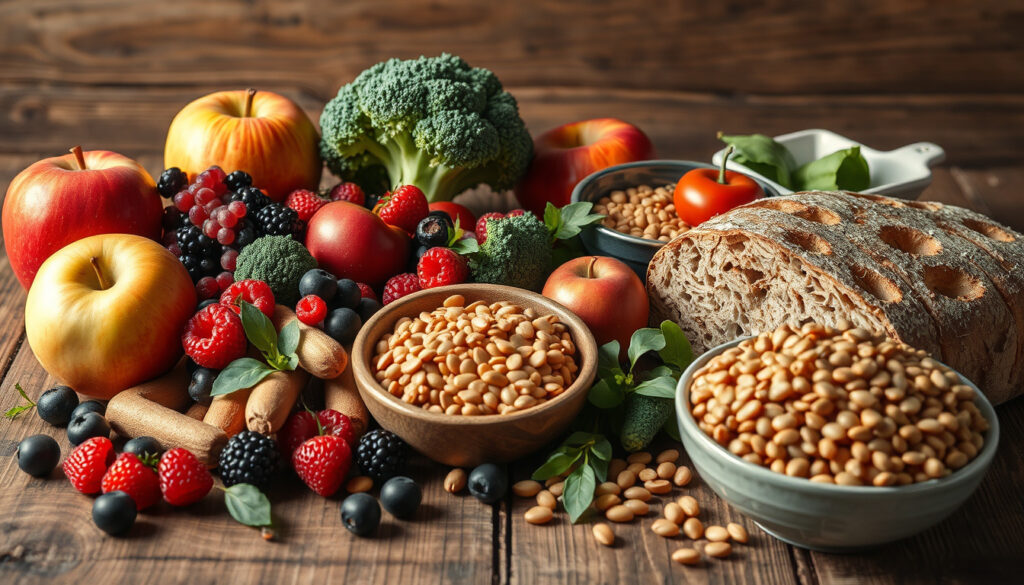
What Foods Are High in Fibre? Top Sources & Daily Needs
Most of us know we should eat more fibre, but figuring out which foods actually deliver enough can feel like guesswork—a banana here, a bowl of porridge there—do they really move the needle against the 30 grams you need daily? This guide lays out the fibre content of common foods, compares breakfast staples like Weetabix and porridge, and highlights surprising sources including drinks.
Daily fiber recommendation for adults: 25–38 grams ·
Fiber in 2 Weetabix: 3.6 grams ·
Fiber in a medium banana: 3.1 grams ·
Fiber in a medium apple with skin: 4.4 grams ·
Fiber in 100g cooked lentils: 7.9 grams ·
Fiber in 100g cooked oats (porridge): 1.7 grams
Quick snapshot
- Adults need 25–38g fibre per day (NHS guidance).
- Weetabix Original provides 3.6g fibre per 2-biscuit serving (Weetabix product page).
- Lentils deliver 7.9g fibre per 100g cooked (USDA FoodData Central).
- Exact fibre content in homemade smoothies depends on the ingredients used. (Mayo Clinic perspective)
- Whether added fibre supplements are as effective as natural food fibre remains debatable (Mayo Clinic perspective).
- No timeline data available — this is a general dietary reference, not an evolving event.
- More research into the role of fibre in gut microbiome health is expected in 2024–2025 (British Dietetic Association).
The snapshot confirms that while some foods are fibre-dense, most people need to combine multiple sources to meet daily targets.
Key facts at a glance
The table below shows fibre content per serving for common foods—note how much variety exists even within single food groups.
| Food item | Serving size | Fibre content |
|---|---|---|
| Chia seeds | 100g | 34.4g |
| Lentils (cooked) | 1 cup (about 200g) | 15.6g |
| Almonds | 100g | 13.3g |
| Black beans (cooked) | 1 cup | 15g |
| Raspberries | 1 cup | 8g |
| Peas (cooked) | 1 cup | 8.8g |
| Apple with skin | 1 medium | 4.4g |
| Weetabix (2 biscuits) | 37.5g | 3.6g |
| Banana | 1 medium | 3.1g |
| Oats (porridge, cooked) | 100g | 1.7g |
| Prune juice | 1 cup (240ml) | 2.6g |
Why this matters: A single serving of lentils or beans delivers more than half the daily fibre target, while fruits and breakfast cereals contribute smaller but still valuable amounts—making combination eating the only reliable strategy.
What foods have the highest fibre?
High-fibre fruits and vegetables
- Raspberries: about 8g fibre per cup (USDA FoodData Central).
- Apple with skin: 4.4g per medium fruit.
- Broccoli (cooked): 5g per cup.
- Peas (cooked): 8.8g per cup.
- Brussels sprouts: 4g per cup.
The pattern: Vegetables, especially legumes and cruciferous types, dramatically outrank fruits in fibre density—a cup of peas delivers nearly three times the fibre of an apple.
Legumes and pulses
- Lentils (cooked): 15.6g per cup (USDA FoodData Central).
- Chickpeas (cooked): 12.5g per cup.
- Kidney beans (cooked): 11g per cup.
The implication: A single serving of legumes covers half a day’s fibre in one go—yet most people eat them only occasionally. Swapping one meat-based meal per week for a lentil dish could close the fibre gap.
Nuts and seeds
- Chia seeds: 34.4g fibre per 100g (USDA FoodData Central).
- Flaxseeds: 27.3g per 100g.
- Almonds: 13.3g per 100g.
- Pumpkin seeds: 18.4g per 100g.
The catch: Despite high density, nuts and seeds are calorie-dense—eating 100g of chia seeds daily would also add 486 calories, so portion control is key.
Whole grains
- Oats (cooked): 10.6g fibre per cup.
- Quinoa (cooked): 5.2g per cup.
- Brown rice (cooked): 3.5g per cup.
- Whole wheat pasta (cooked): 6.3g per cup.
Why this matters: Whole grains are one of the easiest ways to add fibre to meals without drastic changes—replacing white rice with brown rice or pasta with whole wheat pasta adds 2–3g per serving effortlessly.
Is a banana a day enough fibre?
Fiber content in a banana
A medium banana (about 118g) provides approximately 3.1g of fibre (USDA FoodData Central). That’s roughly 10% of the daily 30g target for adults under NHS guidelines.
What this means: Even with a banana every day, you’d still need to find the other 27g from other foods—it’s a helpful start, not a complete solution.
Fiber in an apple compared to banana
A medium apple with skin contains 4.4g of fibre (USDA FoodData Central), about 40% more than a banana. Both are solid, but neither alone meets the daily requirement.
The trade-off: Choose an apple over a banana and you gain 1.3g of fibre with roughly the same calories—small swaps like this add up across a week.
How many bananas to meet daily fiber needs?
To reach 30g of fibre using only bananas, you’d need to eat nearly 10 medium bananas per day. That’s impractical and would deliver around 1,050 calories from bananas alone.
The pattern: No single whole fruit can cover your fibre needs—variety across fruits, vegetables, legumes, and grains is non-negotiable.
How Much Fibre Do We Need To Eat Per Day?
Recommended daily intake by age and gender
- Adults (US guidelines): 25g for women, 38g for men per day (NHS guidance).
- Adults (UK guidelines): 30g per day for both men and women.
- Children aged 4–10: about 15–20g per day.
- Teenagers: 20–25g per day.
The implication: Despite clear guidelines, the UK’s National Diet and Nutrition Survey shows average adult fibre intake around 18g—a consistent 40% shortfall.
UK NHS guidelines vs US dietary guidelines
- The UK’s NHS recommends 30g daily for adults (NHS guidance).
- The US Dietary Guidelines for Americans recommend 25g for women and 38g for men.
- The World Health Organization suggests at least 25g per day.
Why this matters: The difference between 25g and 38g is real—a man eating by US guidelines needs about 50% more fibre than a woman, which means he should look to legumes and seeds rather than fruit alone.
What drink is high in fibre?
High-fibre smoothies and juices
- A homemade smoothie with frozen berries, spinach, chia seeds, and almond milk can deliver 8–12g fibre per serving (Mayo Clinic notes).
- Green smoothies using whole fruits (not strained) retain the fibre.
The catch: Commercially bottled smoothies are often strained to improve texture, removing the pulp where fibre lives—check the label or make your own.
Fibre in prune juice
One cup (240ml) of prune juice contains about 2.6g of fibre (USDA FoodData Central). That’s only half the fibre of a whole apple, and prune juice often has added sugars.
The trade-off: Whole prunes deliver 12g fibre per cup—if you want fibre from drinks, a smoothie with whole fruit outperforms fruit juice every time.
Other drinks with added fibre
Some commercial drinks now add chicory root fibre (inulin) to boost fibre content. Brands like Activia and certain protein shakes include 3–5g added fibre per serving (British Dietetic Association commentary). However, added fibre from supplements may not offer the same benefits as naturally occurring fibre.
What to watch: “Fibre-enriched” drinks can be a convenient boost, but they shouldn’t replace whole food sources—research from the Mayo Clinic suggests whole-food fibre supports gut health more effectively than isolated fibre additives.
Which is better for you, Weetabix or porridge?
Fiber content in Weetabix vs porridge
A serving of 2 Weetabix biscuits (37.5g) provides 3.6g of fibre (Weetabix product page). A 100g serving of cooked porridge (made from oats) contains about 1.7g fibre (USDA FoodData Central).
The pattern: Weetabix delivers roughly double the fibre per serving compared to porridge—but porridge’s advantage lies elsewhere.
Nutritional comparison
The table below compares the nutritional profiles of Weetabix and porridge per serving.
| Per serving | Weetabix (2 biscuits) | Porridge (100g cooked) |
|---|---|---|
| Calories | 136 (Weetabix) | 71 |
| Fat | 1.4g | 1.5g |
| Carbohydrates | 26g | 12g |
| Of which sugars | 2.8g | 0.1g |
| Fibre | 3.6g | 1.7g |
| Protein | 4.5g | 2.5g |
| Salt | 0.45g | 0g |
Why this matters: Weetabix wins on fibre density, but porridge contains beta-glucan—a soluble fibre specifically linked to lowering cholesterol (British Heart Foundation background). The choice depends on your goal: maximum fibre or specifically heart-friendly beta-glucan.
Which provides more sustained energy?
Porridge’s beta-glucan forms a gel in the gut that slows carbohydrate absorption, providing steadier blood sugar levels. Weetabix, being a processed whole grain, has a higher glycemic index and may cause a quicker energy dip (Mayo Clinic notes).
The trade-off: For sustained morning energy and heart health, porridge edges ahead despite lower fibre—but if your priority is hitting the daily fibre target, Weetabix is more efficient per calorie.
For the average UK adult who eats only one fibre-heavy meal per day, the choice between Weetabix and porridge can determine whether they hit 30g or fall short—switching from porridge to Weetabix adds about 2g fibre per breakfast, a meaningful 7% of the daily target.
The choice between Weetabix and porridge depends on whether you prioritise fibre density or heart-healthy beta-glucan.
Comparison: High-fibre food categories
Four categories, one pattern: legumes and seeds leave all others behind in fibre density, while fruits and whole grains provide smaller but more accessible portions.
| Category | Best example (fibre per 100g) | Good example (fibre per serving) | Daily value per serving |
|---|---|---|---|
| Legumes | Lentils (7.9g) | Chickpeas (12.5g/cup) | ~42% of daily need |
| Seeds | Chia seeds (34.4g) | Flaxseeds (27.3g/100g) | >85% of daily need |
| Vegetables | Peas (8.8g/cup) | Broccoli (5g/cup) | ~17% of daily need |
| Fruits | Raspberries (8g/cup) | Apple (4.4g) | ~15% of daily need |
| Whole grains | Oats (10.6g/cup) | Quinoa (5.2g/cup) | ~18% of daily need |
| Breakfast cereals | Weetabix (3.6g/serve) | Bran flakes (~4g/serve) | ~12% of daily need |
The pattern: Seeds and legumes deliver the highest fibre density by far—but most people find them less convenient than an apple or a bowl of Weetabix, which is precisely why the fibre gap persists.
Upsides vs downsides of high-fibre eating
Upsides
- Improves digestive health and prevents constipation (NHS overview).
- Helps regulate blood sugar and lower cholesterol.
- Increases satiety, aiding weight management.
- Linked to reduced risk of heart disease, stroke, and bowel cancer (BHF resources).
Downsides
- Rapid increase can cause bloating, gas, and cramping.
- Excess fibre (over 70g daily) may interfere with mineral absorption.
- Some high-fibre foods are calorie-dense (nuts, seeds).
- Added fibre in processed foods may not offer the same benefits as natural fibre.
The trade-off: More fibre is almost always better, but ramping up too fast can make you miserable—increase by 3–5g per day weekly and drink more water.
Quotes from experts
“Adults should aim for 30g of fibre a day as part of a healthy balanced diet.”
— NHS (UK health authority)
“High-fiber foods include fruits, vegetables, whole grains, legumes, nuts, and seeds.”
— Mayo Clinic (US healthcare institution)
The message from both sides of the Atlantic is consistent: whole foods, not supplements, are the foundation of a high-fibre diet.
verywellhealth.com, weetabix.es, urmc.rochester.edu, spikesaver.com, postconsumerbrands.com, nestlehealthscience.co.uk, eatknowingly.com, nutrigate.app, tesco.com, eatthismuch.com, foodstruct.com
For those looking to meet their daily fibre targets, it’s worth exploring the best high-fibre foods in New Zealand top sources, including lentils, chia seeds, and oats, which are also highlighted in the main guide.
Frequently asked questions
What is the difference between soluble and insoluble fiber?
Soluble fiber dissolves in water to form a gel that helps lower cholesterol and regulate blood sugar; it’s found in oats, apples, citrus fruits, and carrots. Insoluble fiber does not dissolve and helps food pass through the digestive system, preventing constipation; it’s in whole grains, nuts, beans, and vegetable skins (NHS explanation).
Can fiber help with weight loss?
Yes—high-fiber foods increase satiety (feeling full) and slow digestion, which can reduce overall calorie intake. Studies show that increasing fiber intake by 14g per day is associated with a 10% reduction in calorie consumption (Mayo Clinic notes).
What are the signs of eating too much fiber?
Bloating, gas, stomach cramps, and constipation (if insufficient water is consumed). Extremely high intake (above 70g daily) can reduce mineral absorption. The solution: increase fiber slowly and drink plenty of water (British Dietetic Association guidance).
Are fiber supplements as good as food sources?
Not necessarily—isolated fiber supplements lack the vitamins, minerals, and phytochemicals found in whole foods. The Mayo Clinic notes that whole-food fiber is more beneficial for overall health. Supplements can help if you’re struggling, but they’re a backup, not a replacement.
How can I increase my fiber intake without bloating?
Increase by 3–5g per day per week, drink at least 2 litres of water daily, and include a mix of soluble and insoluble fiber. Soaking beans and lentils before cooking reduces gas-causing compounds.
Is fiber good for heart health?
Yes—soluble fiber helps reduce LDL (“bad”) cholesterol. The British Heart Foundation notes that oatmeal, beans, and apples are particularly effective (BHF information).
What are the best high-fibre snacks?
A handful of almonds (3.5g fibre), an apple (4.4g), a small bowl of berries (8g per cup), or a pear (5.5g) are all excellent choices. Hummus with carrot sticks provides 5–7g fibre per serving.
These FAQs address common concerns about fibre intake and supplementation.
For the average shopper filling a weekly basket in a UK supermarket, the implication is clear: buy more lentils, frozen peas, and whole-grain cereals, and rely less on supplements and juice. Your gut—and your heart—will thank you.
Prioritising fibre through whole foods rather than supplements means more chewing and prep time—but also better cholesterol outcomes, lower cancer risk, and a fuller feeling that makes snacking less necessary.
Related reading: How to Save on Food: 5 Proven Strategies to Cut Your Grocery Bill · Green Poop in Kids: Causes, When to Worry, and What to Do
More related posts
 Pat Kenny Signs Off: Weekday Show Ends, Weekend Role Begins
 3/4 Inch in mm – Exact Conversion 19.05 mm
 Grangegorman Primary Care Centre: Contact & Mental Health Guide
 Top 5 Mistakes After Knee Replacement – Avoid Them for Smoother Recovery
 PSC Centre Near Me: Appointments, Documents & How to Apply
 iPhone 17 Pro Max Colors: All 3 Finishes Compared
 Sushi Nigiri Shrimp Near Me: Health & Nutrition Guide
 Arsenal v Aston Villa 4-1: Match Highlights & Report