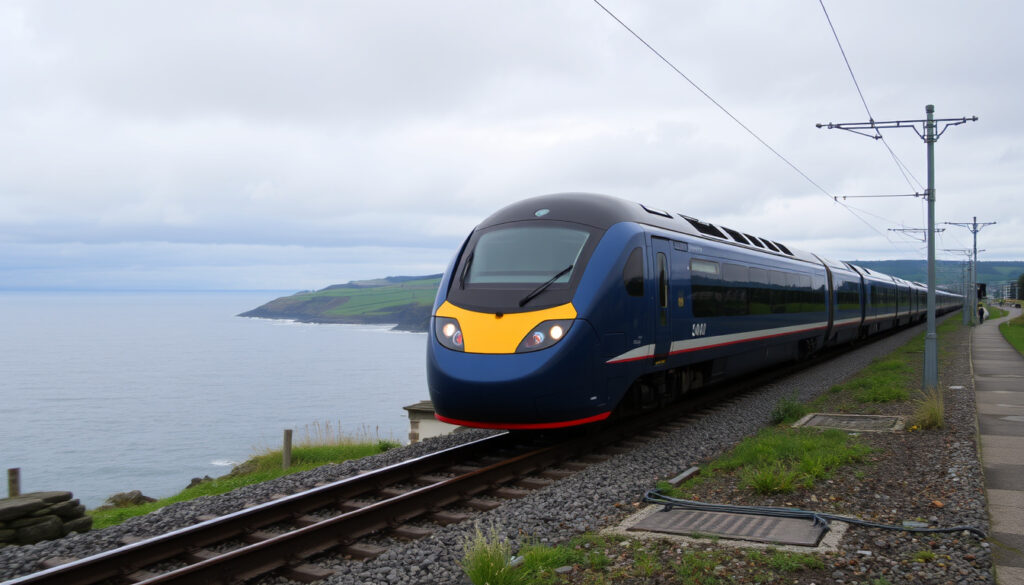
Dublin to Belfast Train: Direct Service, Fares & Times
There’s something reassuring about stepping onto a direct train and letting the tracks do the rest. The Dublin–Belfast Enterprise service offers exactly that: a straightforward rail link between two capitals, with a journey time barely over two hours, whether you’re commuting for business or heading north for a weekend, this guide covers the fares, timetables, and practical comparisons to help you decide if the train is the right choice.
Direct train operator: Enterprise (Iarnród Éireann/Translink) ·
Average journey time: 2 hours 8 minutes ·
Fare range (one-way standard): £15–£38 (approx €18–€44) ·
Daily departures: 8–10 per direction
Quick snapshot
- Enterprise train direct, no changes (Seat 61 (independent rail guide))
- Dublin Connolly to Belfast Grand Central (Irish Rail (national rail operator))
- Journey time 2h 8min (Seat 61)
- Exact future fare changes or service reductions (Irish Rail fare page)
- Dynamic pricing specifics (discount thresholds) (Seat 61)
- Hourly service Mon–Sat from Oct 2024 (Seat 61)
- Belfast Grand Central opened 13 Oct 2024 (LILIGO (travel comparison))
- Advance online booking may lower fare (Irish Rail fare info)
- Open return tickets available from €8.40 (Irish Rail)
Key specifications of the Enterprise service are listed below.
| Fact | Value |
|---|---|
| Operator | Enterprise (Iarnród Éireann/Translink) |
| Distance | Approx 165 km (103 miles) |
| Average speed | ~77 km/h (48 mph) |
| Onboard features | WiFi, power sockets, café car, first class |
| Accessibility | Wheelchair accessible stations and trains |
Is there a direct train from Dublin to Belfast?
Dublin Connolly to Belfast Grand Central: direct service overview
- Yes, the Enterprise train is a direct service operated jointly by Iarnród Éireann and Translink (Seat 61 (independent rail guide)).
- No changes required; the journey is end-to-end from Dublin Connolly to Belfast Grand Central (Irish Rail timetable page).
How many direct trains run daily?
- Service runs 8–10 trains per direction, roughly every 60 minutes on weekdays (LILIGO (travel comparison)).
- First train from Dublin Connolly around 7:00 AM; last around 7:00 PM (Translink journey planner (NI rail authority)).
The implication: for anyone seeking a straightforward journey, the train eliminates transfers and uncertainty.
How much is a train ride from Dublin to Belfast?
Standard and first-class fare comparison
Tickets vary by class and advance purchase, as shown below.
| Ticket type | One-way price range | Return price range |
|---|---|---|
| Adult Standard | €18–€44 (approx £15–£38) | €30–€70 (approx £25–£60) |
| First Class | £35–£55 (approx €41–€64) | Available but not separately listed |
| Child (5–18) | €3.60–€22 | Up to half adult return |
Irish Rail states that tickets starting in the Republic of Ireland are priced in euro and include child tickets from €3.60, with children under 5 travelling free (Irish Rail fare chart (official pricing)).
Return ticket pricing from Belfast to Dublin
- Adult open return fares start from €8.40 for some station pairs (Irish Rail).
- Tickets originating in Northern Ireland are priced by Translink in sterling; expect similar ranges (Seat 61).
The pattern: flexibility costs more, so plan ahead if possible.
What is the fastest train from Dublin to Belfast?
Enterprise train journey time (2h 8min)
- The Enterprise train covers the 165 km route in an average of 2 hours 8 minutes.
- This is the fastest rail option between the two cities.
Comparison with buses and driving
Below is a comparison of travel options across time, cost and comfort.
| Mode | Journey time | One-way cost (approx) | Comfort notes |
|---|---|---|---|
| Enterprise train | 2h 8min | €18–€44 | WiFi, power, café car, first class available |
| Bus (Aircoach, Dublin Express) | 2h 45min–3h 30min | €12–€20 | Limited legroom, Wi‑Fi variable, no café |
| Driving (car) | ~1h 40min (no traffic) | €30–€45 (fuel+toll+parking) | Flexible timing, parking costs in Belfast |
- Buses are slower but can be cheaper; journey times depend on traffic and stops (LILIGO).
The pattern: the train beats the bus on time and comfort, while driving wins on speed (outside peak) if you have access to a car in the city centre.
Where is the train station in Dublin to get to Belfast?
Arriving at Dublin Connolly station
- Dublin Connolly (Connolly Station) is on Amiens Street, Dublin 1 (Irish Rail station info).
- Accessible by Luas Red Line (Busáras or Connolly stops), DART, Dublin Bus, and car (pay parking adjacent). For drivers, the Red Cow Park and Ride offers a convenient option to avoid city-centre traffic.
Where is the train station in Belfast for arrivals from Dublin?
- All Enterprise trains now arrive at Belfast Grand Central (formerly Lanyon Place), the main station since October 2024 (Seat 61).
- Belfast Grand Central is a modern hub with shops, cafés, and connections to local buses and the Glider system.
The move to Grand Central improves Belfast’s rail access, but travelers used to Lanyon Place (a short walk from the city centre) now face an extra 10–15 minute walk or bus ride. For first-time visitors, that can be a small confusion factor.
What this means: allow extra time when arriving in Belfast if you are unfamiliar with the new station.
Is it better to take a bus or train from Dublin to Belfast?
Travel time comparison: train vs bus
- Train: 2h 8min (consistent, no traffic jams).
- Bus: 2h 45min–3h 30min (depends on stops, traffic, border checks).
Cost comparison: train vs bus
- Bus one-way from €12 (Aircoach) vs train from €18 (advance) to €44 (walk-up).
- Bus return from €20, train return from €30.
Comfort and convenience factors
- Train offers first class, power sockets at every seat, a café car, and more legroom (Seat 61).
- Buses often have less legroom, no café, and inconsistent WiFi.
Budget-conscious solo travellers may save €10–€15 with a bus. But for anyone who values time, reliable WiFi, and a seat that doesn’t feel cramped, the extra cost of the train is well justified.
The implication: the train is the clear winner for comfort and reliability, while the bus suits those on a tight budget.
Is it cheaper to get the train or drive?
Cost breakdown: train fares vs driving costs
Driving costs can add up for a solo traveller; here’s a direct comparison.
| Cost item | Train (1 person) | Driving (1 person) |
|---|---|---|
| One-way fare / cost | €18–€44 | Fuel ~€25, toll €2.10 (M1), parking ~€12–€15 |
| Total one-way | €18–€44 | ~€39–€42 |
| Return total | €30–€70 | ~€78–€84 |
- Fuel costs based on 165 km at 6.5 L/100 km and €1.60/L (LILIGO (estimated)).
- For two or more people, driving can be cheaper per person.
What this means: a solo traveller will almost always pay less with a train advance fare than with driving. For groups, driving splits costs and offers door-to-door flexibility.
What is the Enterprise train timetable from Dublin to Belfast?
Typical departure times (hourly, 7:00–19:00)
- Mon–Sat: first departure ~7:00 AM, last ~7:00 PM, roughly every hour (Irish Rail timetable).
- Sun: reduced frequency (every 2 hours).
Where to check live timetable
- Official sources: Translink journey planner (NI rail authority) and Irish Rail (IRE rail operator).
- Real-time updates visible on both sites.
Step-by-step: How to book and travel
- Choose your origin – Dublin (Republic) or Belfast (Northern Ireland). This determines which booking site to use.
- Check timetable – Visit irishrail.ie (ROI) or translink.co.uk (NI) for live departure times.
- Compare fares – Standard one-way €18–€44, advance purchases usually cheaper. First class available from £35.
- Book online – For tickets starting in Dublin, use irishrail.ie. For Belfast-originating, use translink.co.uk (Seat 61 booking advice).
- Collect tickets – Hard-copy tickets from Irish Rail machines if booked online from Dublin; from Belfast Grand Central or other staffed stations if booked via Translink (Seat 61).
- Arrive at station – Allow 15–20 minutes before departure for ticket collection and boarding.
- Board the Enterprise – Find your seat (reserved or unreserved), enjoy WiFi and the café car.
Confirmed facts
- Enterprise direct service operates daily with no changes (Seat 61).
- Journey time approx 2h 8min (Irish Rail).
- One-way standard fares €18–€44, child €3.60+ (Irish Rail fare chart).
- Belfast Grand Central is the current terminus (LILIGO).
What’s unclear
- Exact future fare adjustments or service cuts.
- Dynamic discount thresholds (how far in advance yields the best price).
- First-class return pricing not consistently published.
What travelers are saying
“The Enterprise service offers direct connections between Dublin Connolly and Belfast Grand Central with a journey time of approximately 2 hours.”
Irish Rail (official timetable information)
“Our Enterprise trains run hourly on weekdays, providing a reliable link for commuters and leisure travelers alike.”
Translink (Northern Ireland transport authority)
“The Belfast–Dublin railway line is one of Ireland’s most important inter-city routes, with a history stretching back over 150 years.”
Wikipedia (historical and operational background)
For the solo traveller or remote worker heading between the two capitals, the Enterprise train remains the most balanced choice: it’s faster than the bus, cheaper than driving alone, and offers the comfort of a café car and reliable WiFi. If you’re travelling with family or a group, driving may be cheaper per person, but factor in parking and city traffic. The implication for anyone planning a trip: book ahead on irishrail.ie or translink.co.uk to secure the best fare, and let the train do the driving.
For a detailed breakdown of schedules and fares, check out this guide to the Enterprise train service between Belfast and Dublin.
Frequently asked questions
Do I need a passport to travel by train from Dublin to Belfast?
No passport is required. Both cities are within the Common Travel Area (Republic of Ireland and Northern Ireland). You may be asked for ID, but a passport is not mandatory.
Can I use a Leap card on the Enterprise train?
No, the Leap card is only valid on Dublin’s local transport (bus, Luas, DART). Enterprise tickets must be purchased separately.
Is there Wi-Fi on the Dublin to Belfast train?
Yes, free Wi-Fi is available on Enterprise trains (subject to coverage).
Can I bring a bicycle on the Enterprise train?
Yes, bicycles are allowed but spaces are limited. You must reserve a bike space in advance when booking your ticket.
Are there toilets on board the Enterprise train?
Yes, all Enterprise trains have standard and accessible toilets.
How early should I arrive at Dublin Connolly station before the train?
Arrive at least 15–20 minutes ahead to collect tickets (if booked online) and find your platform. For first class or bike reservations, allow 30 minutes.
Is the Enterprise train covered by the InterRail pass?
Yes, the InterRail Global Pass and InterRail One Country Pass (Ireland) are valid on Enterprise trains. Seat reservations are recommended.
For more intercity rail guides, see our Dublin to Galway Train Timetable.
More related posts
 When Is High Tide Today? Dublin, Cork & Ireland Times
 How to Start a Workout Plan: Complete Guide for Beginners
 5STAR TV Guide: Catch Up & Channel Numbers
 Nkuku Discount Code UK: 15% Off, NHS, Blue Light & More
 Hotels in Donegal Town: Best Places to Stay
 5’7″ in cm – Convert 5 Feet 7 Inches to Centimeters
 Man Utd v Leeds 2026: Croke Park Tickets, Time & History
 iPhone 17 Pro Ireland Price: Official & Carrier Deals