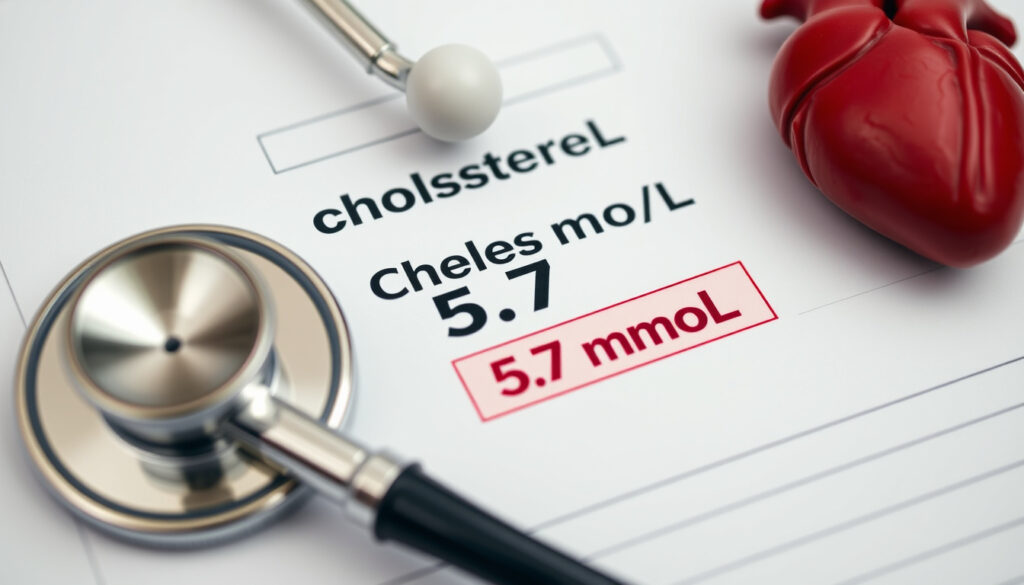
Is a Cholesterol Level of 5.7 High? Risks & Next Steps
Getting a cholesterol reading of 5.7 mmol/L can feel like a grey area. It’s not low enough to ignore, but not high enough to trigger alarms — and in fact it’s exactly the UK average. Under NHS guidelines (the UK’s national health service), a total cholesterol of 5.7 falls into the borderline high range (5.0–6.4 mmol/L), which means context matters more than the number. This article explains what that number means for your health, when treatment is warranted, and how to take action.
Average total cholesterol in the UK: 5.7 mmol/L · Borderline high range (total cholesterol): 5.0 – 6.4 mmol/L · Healthy total cholesterol target: Less than 5.0 mmol/L · Healthy LDL cholesterol target: Less than 3.0 mmol/L · Very high total cholesterol (BHF): Above 7.5 mmol/L
Quick snapshot
- 5.7 mmol/L is borderline high per NHS guidelines
- UK average total cholesterol is 5.7 mmol/L (British Heart Foundation)
- Healthy target is below 5.0 mmol/L (Heart UK)
- Whether 5.7 alone requires treatment depends on overall cardiovascular risk (NHS)
- Long-term effect of borderline high cholesterol in older adults is still debated (NHS)
- Soluble fiber can reduce LDL by 5–10% within weeks (Mayo Clinic)
- Get a full lipid panel and QRISK3 assessment (NHS treatment guidance)
- Discuss lifestyle changes with your GP before deciding on statins (NHS treatment guidance)
The pattern: 5.7 sits above the healthy ideal but matches the UK average — context determines the next step.
| Measurement | Value |
|---|---|
| Total cholesterol 5.7 mmol/L | Borderline high per UK guidelines |
| Average for UK adults | Yes, exactly the national average |
| Recommended upper limit | 5.0 mmol/L |
| Statin therapy threshold | Usually >7.5 mmol/L or high risk |
| LDL ideal level | Less than 3.0 mmol/L |
Is cholesterol of 5.7 bad?
What does a total cholesterol of 5.7 indicate?
- A reading of 5.7 mmol/L means total cholesterol sits in the borderline high range of 5.0–6.4 mmol/L, as defined by NHS guidelines (the UK’s national health service).
- The NHS states that a good target level depends on age, health conditions, and cardiovascular disease risk (source).
- In the UK, 5.7 is the average total cholesterol, meaning it is not unusually high for the general population, per the British Heart Foundation (cardiovascular charity).
How does it compare to normal and high ranges?
- Healthy total cholesterol is below 5.0 mmol/L according to Heart UK (the cholesterol charity).
- The NHS considers above 6.0 mmol/L “high” and above 7.5 mmol/L “very high” (NHS).
- For comparison, a healthy non-HDL cholesterol is below 4.0 mmol/L, and after a heart attack or stroke below 2.6 mmol/L (BHF).
The pattern: 5.7 is above the healthy ideal but within the average range. Whether it is “bad” depends on your personal risk factors, not the number alone.
Do I need statins for 5.7 cholesterol?
When are statins prescribed?
- NICE (the National Institute for Health and Care Excellence) guidelines recommend discussing statin treatment with adults whose 10-year cardiovascular risk is 10% or more (QRISK3).
- If the 10-year risk is less than 10%, statin treatment is not usually needed for primary prevention (NICE).
- Statins are typically recommended when total cholesterol is above 7.5 mmol/L, unless other high-risk factors are present (NHS treatment guidance).
What are the benefits and risks of statins for borderline cholesterol?
- Benefit: A 40% reduction in non-HDL cholesterol from baseline is the NICE target after starting a statin for primary prevention (NICE).
- Risk: Statins can cause muscle pain, liver enzyme changes, and increased blood sugar, though serious side effects are rare.
- The decision hinges on absolute risk, not the single cholesterol number. Age, blood pressure, diabetes, smoking history, and family history all factor into the QRISK3 score (NHS).
For someone with a QRISK3 score below 10%, skipping statins is reasonable — the downside (daily medication, potential side effects) may not outweigh the benefit. But for a person over 50 with high blood pressure and a family history of heart disease, a 5.7 reading could tip the balance toward treatment.
What should a 70 year old’s cholesterol be?
Are cholesterol targets different for older adults?
- The NHS advises that treatment targets should be individualised for older adults; a general healthy total cholesterol is still below 5.0 mmol/L (NHS).
- Heart UK notes that LDL targets can be lower for people at higher cardiovascular risk or with established disease.
- Some studies suggest that high cholesterol in older adults (over 70) may not carry the same risk as in younger people, leading to relaxed targets in some guidelines.
What about cholesterol after age 75?
- After age 75, the focus often shifts to overall health and medication tolerance rather than strict cholesterol targets (NHS).
- For adults over 75, a shared decision with a GP about statin continuation is recommended, weighing benefits against potential side effects and quality of life.
The catch: strict targets may be less relevant in older adults. A 5.7 reading at 75 might not trigger treatment if overall risk is low and the patient is healthy.
What foods should I avoid with high cholesterol?
Which foods are worst for cholesterol?
- Foods high in saturated and trans fats raise LDL cholesterol. The six worst include: red meat, full-fat dairy, processed meats, fried foods, baked goods with trans fats, and coconut oil (Mayo Clinic (academic medical centre)).
- Replacing saturated fats with unsaturated fats (e.g., olive oil, nuts, fish) can help lower cholesterol, per BHF.
What are the six worst foods for high cholesterol?
- Red meat (beef, lamb, pork) – high in saturated fat.
- Full-fat dairy (butter, cream, cheese).
- Processed meats (sausages, bacon).
- Fried foods (especially deep-fried).
- Baked goods with trans fats (cookies, cakes, pastries).
- Coconut oil and palm oil – despite being plant-based, they raise LDL (Healthline (health information publisher)).
Why this matters: cutting these foods can lower LDL by 5–10%, which for a 5.7 reading could bring total cholesterol under 5.0 mmol/L without medication.
How can I lower my cholesterol from 6 to 4?
What lifestyle changes are most effective?
- The Mayo Clinic recommends five key changes: eat heart-healthy fats, exercise regularly, quit smoking, lose weight, and limit alcohol.
- Soluble fiber (oats, beans, apples, barley) can reduce LDL by 5–10% (Mayo Clinic).
- Physical activity: at least 150 minutes of moderate aerobic exercise per week (BHF).
How much can diet and exercise lower cholesterol?
- A comprehensive lifestyle programme can reduce LDL by up to 20% in some people, which would bring a total cholesterol from 6.0 to roughly 4.8 mmol/L (assuming proportional LDL reduction).
- For a drop from 6.0 to 4.0, a 33% reduction is needed — often achievable only with statins added to lifestyle changes (NICE).
- Even a 10% LDL reduction lowers cardiovascular risk significantly; small steps add up (Heart UK).
For many people with a total cholesterol around 6.0, combining diet, exercise, and possibly statins is the most realistic path to 4.0. Pure lifestyle change alone rarely achieves that magnitude of drop, but even a 0.5–1.0 mmol/L reduction meaningfully lowers risk.
Comparison: Cholesterol targets across guidelines
Five key measurements, one pattern: the healthy ranges are consistent across UK and US authorities, but the interpretation of borderline values depends on individual risk.
| Measurement | NHS (UK) | Heart UK | MedlinePlus (US) |
|---|---|---|---|
| Total cholesterol target | Below 5.0 mmol/L | Below 5.0 mmol/L | Below 5.2 mmol/L (200 mg/dL) |
| LDL target | Below 3.0 mmol/L | Below 3.0 mmol/L (high-risk: below 2.0) | Below 2.6 mmol/L (100 mg/dL) |
| HDL target | Above 1.0 (men) / 1.2 (women) mmol/L | Above 1.0 (men) / 1.2 (women) mmol/L | Above 1.6 mmol/L (60 mg/dL) is best |
| Non-HDL target | Below 4.0 mmol/L | Below 4.0 mmol/L (high-risk: below 2.6) | Below 3.4 mmol/L (130 mg/dL) |
| Triglycerides target | Below 1.7 mmol/L | Below 1.7 mmol/L | Below 1.7 mmol/L (150 mg/dL) |
The implication: regardless of which guideline you follow, a total cholesterol of 5.7 is above every “healthy” threshold, but still within a range where lifestyle changes are the first recommended step.
Specifications: Lipid profile components & healthy levels
Eleven values, one pattern: the lower the total and LDL, and the higher the HDL, the better — but targets adjust for age and risk.
| Component | Healthy level (NHS) | Healthy level (MedlinePlus, age 20+) | Healthy level (MedlinePlus, age 19 & under) |
|---|---|---|---|
| Total cholesterol | Below 5.0 mmol/L | Below 5.2 mmol/L (200 mg/dL) | Below 4.4 mmol/L (170 mg/dL) |
| LDL cholesterol | Below 3.0 mmol/L | Below 2.6 mmol/L (100 mg/dL) | Below 2.6 mmol/L (100 mg/dL) |
| HDL cholesterol | Above 1.0 (men), 1.2 (women) | Above 1.6 mmol/L (60 mg/dL) is best | Above 1.0 mmol/L (40 mg/dL) |
| Non-HDL cholesterol | Below 4.0 mmol/L | Below 3.4 mmol/L (130 mg/dL) | Below 3.4 mmol/L (130 mg/dL) |
| Triglycerides | Below 1.7 mmol/L | Below 1.7 mmol/L (150 mg/dL) | Below 1.7 mmol/L (150 mg/dL) |
| Total/HDL ratio | Below 4.5 | Below 4.0 | Below 4.0 |
The trade-off: a 5.7 total with good HDL and low triglycerides is less concerning than a 5.7 with low HDL and high triglycerides. The ratio matters.
Pros & cons of statins for borderline cholesterol (5.7 mmol/L)
Upsides
- Reduces LDL by 40% on average (NICE)
- Lowers 10-year cardiovascular risk by 20-30% in people with elevated risk
- Single daily tablet, well-tolerated for most
Downsides
- Possible muscle pain, increased blood sugar, liver enzyme changes
- Lifetime commitment; discontinuing can reverse benefits
- May not be cost-effective or beneficial for very low-risk individuals
Steps to lower cholesterol from 6 to 4 (or anywhere in between)
Step 1: Get a full lipid panel and QRISK3 assessment
- Request a fasting or non-fasting lipid test from your GP, including total cholesterol, LDL, HDL, non-HDL, and triglycerides.
- Your GP can calculate your QRISK3 score — a 10-year cardiovascular disease risk estimate (NHS treatment guidance).
Step 2: Adopt a heart-healthy diet
- Cut saturated fat: replace butter with olive oil, choose lean meats, switch to low-fat dairy.
- Eat soluble fibre daily: oats, barley, beans, apples, carrots (target 5–10 g/day).
- Include omega-3-rich foods: oily fish (salmon, mackerel), walnuts, flaxseeds.
Step 3: Increase physical activity
- Aim for at least 150 minutes of moderate aerobic activity per week (brisk walking, cycling, swimming).
- Add strength training twice per week for additional metabolic benefits (BHF).
Step 4: Lose weight if overweight
- Even 5–10% weight loss can improve cholesterol ratios (Mayo Clinic).
- Focus on a balanced diet with portion control, not extreme restrictions.
Step 5: Consider medication if lifestyle changes aren’t enough
- If after 3–6 months your total cholesterol remains above 5.0 and your QRISK3 score is ≥10%, discuss statins with your GP (NICE).
- Statins are most effective when combined with continued lifestyle changes.
What this means: a 2 mmol/L drop (e.g., from 6.0 to 4.0) is a big target. Most people need both lifestyle changes and medication to get there. But even a 0.5–1.0 reduction significantly cuts risk.
Clarity: What’s confirmed vs. what’s unclear about 5.7 cholesterol
Confirmed facts
- 5.7 mmol/L is in the borderline high range (5.0–6.4 mmol/L) per NHS guidelines.
- The UK average total cholesterol is 5.7 mmol/L (BHF).
- Cholesterol targets differ by age and risk profile (Heart UK).
What’s unclear
- Whether 5.7 alone requires treatment depends on overall cardiovascular risk, not the number itself.
- Long-term effect of borderline high cholesterol in older adults is still debated among experts.
- The optimal non-HDL target for people with 5.7 but low risk is not precisely defined.
Expert perspectives
“Total cholesterol levels: above 6 mmol/L is considered high.”
— NHS guidelines
“Very high total cholesterol is above 7.5 mmol/L.”
— British Heart Foundation
“Five key changes can significantly reduce levels: eat heart-healthy fats, exercise, quit smoking, lose weight, and limit alcohol.”
— Mayo Clinic
A cholesterol reading of 5.7 mmol/L is not a crisis, but it’s a clear signal to pay attention. For the average UK adult with a 5.7 reading, the choice is clear: focus on lifestyle changes and get a full risk assessment before worrying about medication. Ignoring it is not an option, but panicking is unnecessary. The real action is in the next steps — diet, exercise, and knowing your numbers beyond total cholesterol.
my.clevelandclinic.org, archerpharmacy.co.uk, medlineplus.gov
Frequently asked questions
Is 5.7 cholesterol high for a woman?
For women, the same borderline high range (5.0–6.4 mmol/L) applies. However, women typically have higher HDL levels, which can be protective. A reading of 5.7 in a woman with good HDL (above 1.2 mmol/L) and no other risk factors is less concerning than in a man with low HDL. The NHS advises interpreting results with overall risk.
What is a dangerously high cholesterol level?
According to the British Heart Foundation, a total cholesterol above 7.5 mmol/L is considered very high and requires medical treatment. Levels above 6.0 mmol/L are simply “high”. Dangerously high levels often come with visible signs like xanthomas (fatty deposits under the skin) but usually no symptoms until a cardiac event occurs.
What happens if your cholesterol is 7?
A total cholesterol of 7.0 mmol/L falls into the “high” category (above 6.0) and approaches very high territory (above 7.5). It significantly increases your 10-year cardiovascular risk. The NICE guidelines recommend statin therapy in most cases with a QRISK3 score of 10% or higher, and lifestyle changes are essential.
Is 5.5 cholesterol high?
A total cholesterol of 5.5 mmol/L is also in the borderline high range (5.0–6.4). It’s slightly below the UK average of 5.7, but still above the healthy target of below 5.0. The same individualised risk assessment applies: check LDL, HDL, and a QRISK3 score to decide if treatment is needed.
Does cholesterol really matter after age 75?
The evidence for aggressive cholesterol lowering in people over 75 is weaker. The NHS emphasises individualised decisions based on overall health and medication tolerance. Some studies suggest that high cholesterol in older adults may not carry the same risk, and relaxing targets can be appropriate.
What is stroke level high cholesterol?
There is no single “stroke level” for cholesterol. However, very high total cholesterol (above 7.5 mmol/L) and especially high LDL (above 4.0 mmol/L) are strong risk factors for atherosclerosis, which can lead to stroke. The NHS advises anyone with a 10-year cardiovascular risk above 10% to discuss statin therapy to reduce stroke risk.
Related reading
- High blood pressure symptoms – High blood pressure is a key input to QRISK scoring alongside cholesterol, making it essential reading for anyone assessing cardiovascular risk.
- When to worry about low heart rate – Understanding heart rate thresholds complements cholesterol management for a full picture of heart health.
More related posts
 The Shelbourne Afternoon Tea: Price, Menu, Time & Booking
 2025 U.S. Open Leaderboard: Final Results & Winner J.J. Spaun
 What GAA Matches Are on TV Today: Live TV Schedule
 Holiday Inn Dublin Airport: Closure, Parking, and Location Guide
 The Last of Us – Complete Franchise Guide 2025
 Time in Washington DC – Current Local Time EDT/EST
 Best French Bakeries Near Me: Dublin & Paris Guide
 173 cm in Feet: Is It 5’8″ or 5’9″? Height Conversion Guide