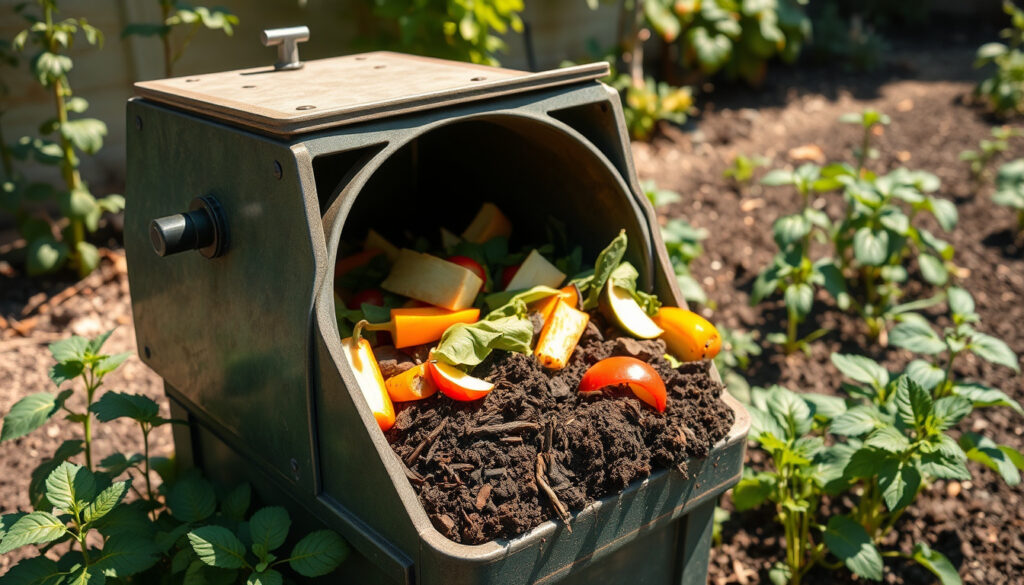
What Is a Compost Tumbler? Pros, Cons & How It Works
Anyone who’s spent a weekend turning a traditional compost pile already knows the workout isn’t worth the bragging rights. A compost tumbler sidesteps that grind entirely — it’s a sealed drum mounted on a frame, designed so you spin it instead of shovel it. Gardeners with limited space or aching backs find this trade-off obvious: a well-managed tumbler churns out finished compost in 6–8 weeks, roughly three times faster than a stationary bin left alone.
Typical Capacity: Up to 200 litres · Compost Production Speed: Faster than static bins · Rotation Mechanism: Drum on frame with wheels · Models Available: JK125, JK270, JK400 · Key Benefit: Easier mixing without guesswork
Quick snapshot
- Rotating drum design (Eartheasy gardening guide)
- 200L capacity options (Eartheasy gardening guide)
- Wheel-mounted frame (Practical Mama home composter)
- Small spaces (Franklin County KY extension service)
- Fast composting (Eartheasy gardening guide)
- Beginners (CompostingCorner YouTube reviewer)
- Joraform JK series (Eartheasy gardening guide)
- Maze Compost Tumbler (Eartheasy gardening guide)
- Metal variants (Eartheasy gardening guide)
- 6–8 weeks typical cycle (Eartheasy gardening guide)
- UK study: 14 weeks in controlled test (GrowVeg via Which? Gardening study)
- 6 months optimal for dual-chamber (CompostingCorner YouTube reviewer)
These capacity figures highlight the trade-off between tumbler efficiency and bin volume. The table below summarizes key specifications from multiple gardening sources.
| Attribute | Value |
|---|---|
| Definition | Rotating drum for composting |
| Capacity | 4–15 cubic feet (up to 200 litres) |
| Advantage | Faster mixing and aeration |
| Models | Joraform JK125, JK270, JK400 |
| Tumbler Processing Time | 6–8 weeks |
| Bin Processing Time (unturned) | 2–3 months |
How does a compost tumbler work?
Rotation mechanism
A compost tumbler is a sealed drum-shaped container mounted on a steel frame with castor wheels. You load kitchen scraps and yard waste through a side hatch, then crank or spin the drum to tumble the contents. Most models use a simple axle design — the whole barrel rotates, bringing material from the bottom to the top with every turn. According to Eartheasy gardening guide, this sealed design keeps moisture and heat inside, creating conditions that speed bacterial activity.
Mixing process
Frequent turning does the heavy lifting that traditional bins need from a pitchfork. When you spin the drum, materials that were pressed against the sides fall to the center, while outer layers move inward — eliminating the stratification that slows down stationary piles. A Practical Mama home composter with five years of tumbler experience notes that “waste decomposes much faster than in a compost bin” without any stirring beyond a few spins per week.
Aeration benefits
Each tumble introduces oxygen into the material, feeding aerobic bacteria rather than the anaerobic microbes that produce foul odors. GrowVeg gardening resource explains that tumblers reduce anaerobic smells from grass clippings better than open heaps, because the sealed environment controls moisture while the tumbling action forces air through. Some tumblers even collect runoff as “compost tea,” a liquid fertilizer you can dilute for garden use.
What is the point of a compost tumbler?
Easier composting
The pitchfork is optional. Traditional bins demand you jab, turn, and wrestle the material every few days to prevent compaction and smelly anaerobic pockets. A tumbler replaces that physical labor with a simple crank or spin — typically 4–5 rotations every 2–3 days. CompostingCorner YouTube reviewer calls it “probably the easiest to use for beginners” because the mechanism itself handles the aeration.
Speed advantages
The sealed drum retains heat better than an open pile, and tumbling distributes it evenly — both factors accelerate microbial activity. Eartheasy gardening guide reports that tumblers cycle through batches in about 6–8 weeks, compared to 2–3 months for a bin if left unturned. In cold winters, tumblers retain warmth visibly — users report seeing warm mist when opening the hatch — while open bins slow significantly.
User-friendly design
Emptying a finished batch requires no scooping. You position a wheelbarrow beneath the drum, lock the brake, and rotate the opening downward — gravity handles the rest. Practical Mama home composter notes this inversion method works well for composters with mobility limitations. Dual-chamber models take this further: you load one side while the other finishes, enabling continuous use without waiting for a full cycle.
What is the disadvantage of a compost tumbler?
Capacity limits
Tumblers typically hold 4–15 cubic feet, while traditional bins offer 7–20 cubic feet for a similar footprint. Eartheasy gardening guide notes that bins drain excess moisture better due to open-bottom design — an advantage when handling large volumes of wet kitchen scraps or fresh grass clippings. If your household generates heavy food waste daily, a single-chamber tumbler may feel cramped.
Cost factors
Tumblers run about 30% more than bins with equivalent capacity, according to Eartheasy gardening guide. The tradeoff is durability: tumbler barrels use thicker plastic or powder-coated steel, while bins often have thinner walls that become brittle over time. Practical Mama home composter notes that bin edges wore after a decade of use — durability varies by model and material quality.
Maintenance issues
Tumbler legs can sink into soft soil under the weight of a full drum. Practical Mama home composter experienced this on their property, requiring them to place the tumbler on a hard surface or paving slab. Assembly is also more involved — most tumblers require tools and take longer to set up than simple bin brackets. In freezing climates, tumbler contents can freeze solid over winter, halting the tumbling action until spring thaw.
Compost Tumblers vs Compost Bins: Pros & Cons
Speed comparison
The conventional wisdom says tumblers win on speed, but a 2011 UK study from Which? Gardening via GrowVeg complicates that narrative. When heaps received regular turning, they produced usable compost in 10 weeks versus 14 weeks for tumblers — suggesting that human effort, not the container type, drives the speed difference. The catch: regular turning is exactly the labor tumblers are supposed to eliminate.
The speed advantage disappears if you don’t actually tumbler regularly. For gardeners who will spin the drum every few days, tumblers deliver faster results — but lazy turning means lazy results regardless of container.
Ease of use
Bins win on volume. Franklin County KY extension service recommends bins for households with large food waste volumes or easy yard access — the open bottom accommodates big additions without disassembly. Tumblers win on user experience: no leaning over, no pitchfork jabbing, no compacted bottom layers. The Consumer Reports home garden experts comparison highlights that rotating barrels offer easier material turning but smaller access hatches for adding bulky yard waste.
Pest control
Tumblers are essentially pest-proof. The sealed drum sits above ground level, and the solid walls prevent burrowing mice from entering. Eartheasy gardening guide confirms this 100% pest-proof rating. Traditional bins, by contrast, can attract burrowing pests — Franklin County KY extension service cites this as a downside for ground-level units. Both systems produce the same quality finished compost from identical input materials.
If rodents are a known problem in your area — whether from the local environment or nearby improper composting — the sealed tumbler design eliminates that concern entirely, with no additional hardware or management required.
Four features distinguish tumblers from bins at the data level. The comparison below synthesizes findings from multiple expert sources.
| Factor | Compost Tumbler | Compost Bin |
|---|---|---|
| Processing time (regular use) | 6–8 weeks | 2–3 months (unturned) |
| Capacity range | 4–15 cubic feet | 7–20 cubic feet |
| Pest resistance | Sealed, elevated, 100% pest-proof | Open bottom, ground-level, vulnerable |
| Typical cost premium | ~30% higher | Baseline |
| Emptying method | Invert drum over wheelbarrow | Shovel from bottom hatch |
| Durability | Thick steel/plastic, longer lifespan | Thinner plastic, can become brittle |
How long does it take a compost tumbler to make compost?
Factors affecting time
No single answer fits every situation. Eartheasy gardening guide identifies three variables: carbon-to-nitrogen balance (the “browns-to-greens” ratio), moisture level, and tumbling frequency. Tumblers need balanced green/brown materials and spinning every few days — neglecting any factor extends the cycle noticeably.
Typical timelines
Under ideal conditions — balanced inputs, consistent moisture, 3–4 spins per week — a single-chamber tumbler finishes in 6–8 weeks. A dual-chamber model yields harvestable compost in about 6 months with continuous loading, according to CompostingCorner YouTube reviewer. The UK Which? study, which used regular turning for both tumbler and heap, found tumblers slower at 14 weeks — a reminder that “tumbler” doesn’t automatically mean “faster” if regular effort is part of the equation anyway.
Tips for faster results
Shred bulky materials before adding them — larger surface area accelerates bacterial colonization. Maintain the drum’s moisture at roughly a wrung-out sponge consistency; sealed tumblers retain water naturally but can dry out in prolonged heat. GrowVeg gardening resource notes that larger tumblers produce compost more efficiently than smaller ones, as the larger thermal mass retains heat better. Larger models like the Joraform JK400 (14.2 cu ft) are easier to spin when full because of their balanced axle design.
What not to put in a compost tumbler
Materials that cause problems
A sealed tumbler is not a garbage disposal. Avoid meat, fish, dairy, and cooked food — these attract rats and flies even in a closed system if odours escape through small gaps. Practical Mama home composter confirms that tumblers prevent rodent access when sealed, but the claim assumes the unit is properly closed and sited. Diseased plant material should go to municipal green waste rather than home compost, where incomplete heating can allow pathogens to survive.
Common mistakes to avoid
Continuous adding without full emptying makes the drum heavy and hard to turn — a common user error. Practical Mama home composter learned this the hard way, noting that accumulated material in a tumbler without a dedicated “finishing” phase adds unnecessary weight and strain on the axle. Avoid adding pet waste from carnivores (dogs, cats) regardless of container type — these carry parasites that survive home composting temperatures.
Meat and dairy will eventually break down in a tumbler’s heat, but the odour risk and pest attraction make them poor choices for residential settings. Stick to vegetable scraps, fruit waste, coffee grounds, eggshells, and yard trimmings — the same inputs that work in any home composting system.
How to use a compost tumbler effectively
Effective tumbler use follows a straightforward monthly rhythm based on guidance from multiple gardening sources.
- Week 1: Load with balanced greens and browns. Fill to ⅓–½ capacity; add water if dry.
- Week 2: Spin 3–4 times. Check moisture; add browns if too wet.
- Week 3: Spin 3–4 times; check progress. Material should be dark and crumbly at edges.
- Week 4: Spin 3–4 times; assess readiness. Finished compost smells earthy, not sour.
- Week 5–8: Empty and cure or use directly. Apply to garden or age in separate pile.
The critical habit is spinning every 2–3 days, not waiting until the material compacts. Eartheasy gardening guide recommends this frequency as the baseline for achieving the 6–8 week cycle. For dual-chamber models, stagger your loads so one side finishes while you add fresh material to the other.
Upsides
- Faster compost in 6–8 weeks with regular use
- Sealed design prevents rodent and fly access
- Easier emptying via drum inversion
- Better heat retention in cold weather
- Reduces anaerobic smells from grass clippings
- Easier for beginners than traditional bins
Downsides
- Smaller capacity (4–15 cu ft vs 7–20 cu ft for bins)
- ~30% higher upfront cost
- Contents can freeze in winter climates
- Legs may sink into soft ground
- Harder assembly requiring tools
- Continuous loading without emptying makes drum heavy
Compost Tumbler Specs
Three specs matter most when sizing up a tumbler for your garden. The table below details specific model capacities and chamber configurations.
| Model | Capacity (cu ft) | Capacity (litres approx) | Chambers |
|---|---|---|---|
| Joraform JK125 | 4.5 | ~127 | Dual |
| Joraform JK270 | 9 | ~255 | Dual |
| Joraform JK400 | 14.2 | ~402 | Dual |
| Maze Compost Tumbler | 10.6 | ~300 | Single |
| Generic metal tumbler | 8–12 | ~225–340 | Varies |
Eartheasy gardening guide: “Jora tumbler models (4.5, 9, 14.2 cu ft) are easy to spin when full.”
CompostingCorner YouTube reviewer: “Tumbler is probably easiest to use for beginners.”
Which? Gardening via GrowVeg: “Tumblers actually took a month longer to create usable compost than heaps when turned regularly.”
The trade-off is clear for anyone who’s wrestled a pitchfork on a Saturday morning. A compost tumbler costs more upfront and holds less volume, but it eliminates the physical labor of turning a pile, finishes compost faster under consistent use, and keeps rodents out without extra hardware. For small-space gardeners, beginners, or anyone who wants the output without the effort, the premium is justified. For large households with abundant yard waste and existing bin infrastructure, the capacity and cost savings may outweigh the convenience gains.
Related reading: Grow a Garden Roblox codes
Novice composters using tumblers often benefit from grasping essential composting dos and donts to accelerate decomposition and avoid pitfalls.
Frequently asked questions
Do tumbler composters really work?
Yes. Compost tumblers process organic waste through the same biological process as any composter. The sealed drum retains heat and tumbling introduces aeration — both accelerate bacterial activity. Eartheasy gardening guide confirms a 6–8 week cycle under regular use, and five-year user reviews from Practical Mama home composter corroborate consistent results with proper maintenance.
What are three items you should never put into a compost tumbler?
Meat and cooked food attract pests and cause odour issues even in sealed systems. Pet waste from carnivores (dogs, cats) contains parasites that survive home composting temperatures. Diseased plant material should go to municipal green waste to prevent reinfection of garden soil.
What is the laziest way to compost?
A dual-chamber compost tumbler is the lowest-effort option for active composting. You load one chamber, spin it every few days when you remember, and empty when finished — no turning with a pitchfork, no lifting heavy panels. The drum handles aeration mechanically. An alternative requiring even less effort is vermicomposting (worm bin), which needs only feeding and occasional harvesting.
Do potato peelings in compost attract rats?
Potato peelings themselves are fine in a tumbler — the sealed design prevents rat access regardless of what you add. In an open bin or pile, starchy scraps can attract rodents if not covered with brown materials. The tumbler’s sealed walls and elevated position eliminate this concern, assuming the unit is properly closed.
Are metal compost tumblers durable?
Metal tumblers (typically powder-coated steel) are generally more durable than plastic models, resisting UV degradation and physical impact better. Eartheasy gardening guide notes that tumbler construction tends to be more robust than bin construction, and the sealed environment limits exposure to weather. The trade-off is higher weight, which matters if you need to reposition the unit.
What is a Maze Compost Tumbler?
The Maze Compost Tumbler is a single-chamber plastic model with a reported capacity of around 10.6 cubic feet (~300 litres). It features a tumbling barrel design on a fixed stand, with a side hatch for adding materials and a bottom hatch for harvesting. User reviews highlight its beginner-friendly operation but note that the single chamber requires a waiting period between batches.
Can you make a DIY compost tumbler?
Yes — a basic DIY tumbler requires a sealed barrel (plastic drum with lid), an axle rod, and a frame to support rotation. Practical Mama home composter notes that tumblers are harder to assemble than bins, and DIY builds require careful sealing to prevent pest access and moisture loss. Commercial tumblers are sealed units by design — a homemade barrel may have gaps that defeat the pest-proof advantage.
More related posts
 When Is Stranger Things Coming Out? Final Season Dates
 Du Plessis vs Chimaev: UFC 319 Winner, Scorecard & Stats
 Urban Decay Setting Spray Review: Is It Worth the Hype
 Arthur Onslow Edward Guinness, Viscount Elveden – Biography, Family and WWII Legacy
 An Post Pet Insurance 2026: Review, Costs & Comparison
 Multi Trip Travel Insurance Ireland: Costs, Cover & Providers
 Joanne Cantwell Husband Shay: Family Life and Career Guide