What Is VO2 Max? How to Measure and Improve It
Marathon runners who breeze through 26.2 miles and sedentary individuals who struggle with a single mile often differ in one key physiological trait: VO2 max. It’s the metric that tells you exactly how efficiently your body uses oxygen during exercise—and according to research from the Norwegian Institute of Science and Technology, it may be one of the strongest predictors of how long you’ll live. The good news is that you don’t need a lab to estimate yours, and you can improve it with nothing more than a pair of running shoes and a stopwatch.
Measures: maximum oxygen consumption during exercise · Indicates: aerobic fitness and physical fitness level · Associated with: lower risk of health issues · Tested via: maximal exercise effort · Units: ml/kg/min
Quick snapshot
- Higher VO2 max links to better health outcomes (Healthline)
- Reflects heart, lungs, blood vessels, and muscles efficiency (Pocket Lint)
- Age and biological sex shift what counts as a good score (REI Expert Advice)
- How menstrual cycles affect female VO2 max measurements
- Specific dietary interventions for independent VO2 max improvement
- Long-term improvement timelines across different training protocols
- 2025: Garmin fenix 6 showed 7% error margin in independent testing (Runner’s World)
- 2025: Apple Watch VO2 max estimates were off by approximately 13% (Runner’s World)
- 1968: Cooper 12-minute run test established as validated method (Runner’s World)
- Consumer wearables will likely improve accuracy as algorithms mature
- Home testing options are becoming increasingly accessible
- Threshold training remains the most evidence-backed improvement strategy
| Attribute | Details |
|---|---|
| Full Name | Maximal oxygen uptake |
| Measures | Oxygen use in ml/kg/min |
| Gold Standard Test | Graded exercise test |
| Influenced By | Genetics, training, age |
What Is VO2 Max?
VO2 max stands for maximal oxygen uptake—the maximum rate at which your body can consume oxygen during intense exercise. It’s expressed in milliliters of oxygen per kilogram of body weight per minute (ml/kg/min), and it essentially measures how well your heart, lungs, blood vessels, and muscles all work together as a system. According to Healthline (health information publisher), this number serves as a benchmark for aerobic fitness levels and provides an objective snapshot of your cardiovascular capacity.
Why does this matter? Research consistently links higher VO2 max values to lower risk of cardiovascular disease, improved metabolic health, and even longer lifespan. The REI Expert Advice team notes that the same VO2 max score can signify drastically different fitness levels depending on your age and biological sex, which is why raw numbers alone don’t tell the whole story without context.
VO2 Max Definition
The scientific definition, per Pocket Lint (technology and fitness publication), describes VO2 max as measured in METs (metabolic equivalents) representing your aerobic fitness capacity. Smartwatch algorithms anchor their initial calculations in age, biological sex, estimated maximum heart rate, height, and weight before refining estimates using GPS pace tracking and heart rate response data.
Your VO2 max isn’t just about athletic performance—it predicts how well your body will age. A higher maxed-out oxygen uptake in your 40s and 50s correlates with significantly lower all-cause mortality rates.
Why VO2 Max Matters for Fitness
VO2 max matters for fitness because it quantifies the bottleneck in your aerobic system—the point at which your muscles demand more oxygen than your cardiovascular system can deliver. Athletes use this metric to calibrate training intensity; coaches use it to track adaptation; and increasingly, consumer wearables are putting estimates directly on your wrist.
However, Runner’s World (running publication) reports that most coaches and exercise physiologists recommend treating smartwatch VO2 max estimates with skepticism. The margin of error varies by device, which means tracking trends over time matters more than fixating on any single number.
What’s a Good VO2 Max by Age?
There’s no universal “good” VO2 max—context is everything. The REI Expert Advice team (outdoor gear specialists) emphasizes that VO2 max varies by age, gender, and overall fitness level, with higher values consistently indicating better cardiovascular fitness. Understanding where you fall relative to your peer group gives you a realistic target rather than chasing an abstract number.
VO2 Max Norms for Men and Women
The Healthline reference tables show how VO2 max classifications work for men aged 20-29:
| Classification | VO2 Max (ml/kg/min) |
|---|---|
| Superior | 55.4 or higher |
| Excellent | 51.1 |
| Good | 45.4 |
| Fair | 41.7 |
These percentiles shift downward with age. The Norwegian Institute of Science and Technology created an online calculator based on large population data that allows you to input your age, sex, and test results to find your percentile ranking within your demographic group.
VO2 Max at Age 55
For men in their 50s, median VO2 max values drop to approximately 35-40 ml/kg/min depending on fitness level, according to population research cited by REI Expert Advice. Women typically score 15-30% lower than men at equivalent fitness levels due to physiological differences in hemoglobin content and muscle distribution.
Age-related decline in VO2 max averages about 10% per decade after age 30, but regular endurance training can cut that rate in half. This makes your current fitness investment worth twice as much in terms of preserving your aerobic capacity.
How Do I Calculate My VO2 Max?
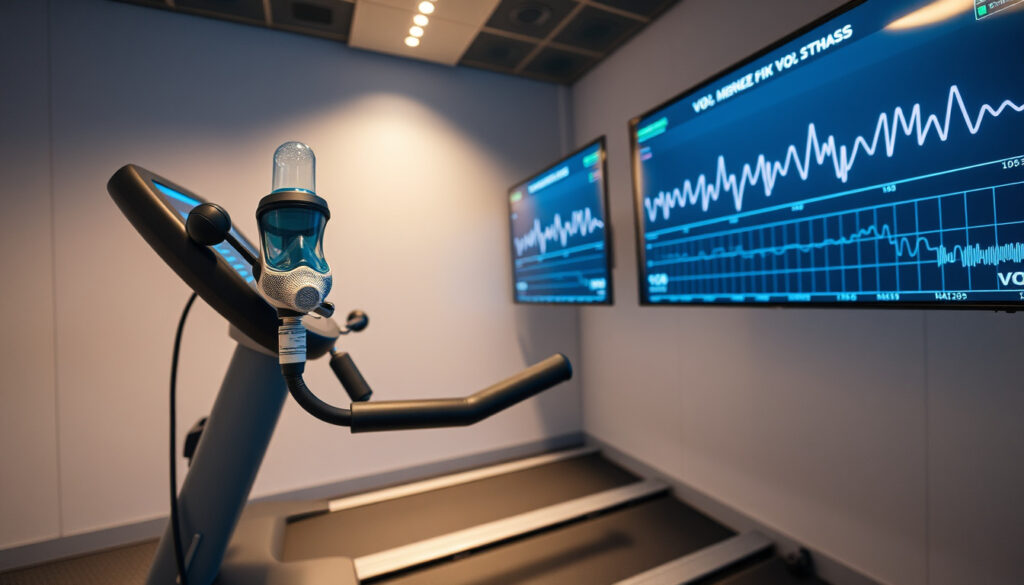
Calculating VO2 max ranges from high-tech lab tests to free DIY methods you can do in your neighborhood. The gold standard is a graded exercise test where you run on a treadmill or cycle an ergometer while wearing a mask that measures expired gas—the equipment directly quantifies oxygen consumption at increasing workloads until exhaustion. This gives you the most accurate number but requires a clinical setting and trained technicians.
Lab VO2 Max Test
Lab tests typically involve a metabolic cart measuring gas exchange in real-time, ramping resistance every 1-3 minutes while heart rate and perceived exertion are monitored. According to Pocket Lint, Fitbit specifically requires a 10-minute steady-pace run with GPS connection for its precise VO2 max measurement, highlighting how even lab-adjacent methods have specific protocols.
Home Estimation Methods
Field tests offer practical alternatives. The Cooper 12-minute run test, developed in 1968, asks you to cover as much distance as possible in 12 minutes, then apply the formula: VO2 max = (35.97 × distance in miles) − 11.29. Runner’s World notes this method is approximately as accurate as smartwatch VO2 max estimators, making it particularly useful for individuals whose scores fall well above or below average for their age range.
Smartwatch algorithms use GPS to track pace while monitoring heart rate response, incorporating environmental factors including elevation, incline, and temperature. Occasional high-intensity runs help these algorithms adjust maximum heart rate estimates for improved accuracy over time.
How Can I Check My VO2 Max at Home?
Checking VO2 max at home is increasingly practical thanks to step tests and wearable technology, though accuracy varies. Pocket Lint (technology publication) explains that Apple Watch measures VO2 max continuously during routine movement without requiring dedicated long runs, making it the most convenient option for daily tracking.
Step Tests
The Chester step test and similar protocols involve stepping up and down on a 12-inch platform at a set tempo for five minutes while your heart rate is monitored. After recovery heart rate is measured, equations estimate VO2 max based on how quickly your cardiovascular system returns to baseline. These require only a step, a metronome or rhythm guide, and a heart rate monitor.
Wearables and Smartwatch Estimates
Smartwatch estimates have documented error margins worth knowing. A 2025 study found that the Runner’s World testing showed Garmin fenix 6 achieved approximately 7% margin of error in VO2 max estimation, while Apple Watch estimates were off by approximately 13%. Garmin devices measure VO2 max during everyday movement and provide fitness age comparisons that contextualize your number against ideal values for your age group.
Most coaches and exercise physiologists recommend treating smartwatch VO2 max estimates with skepticism. The margin of error means a single number from your watch isn’t a diagnosis—track trends over months rather than obsessing over daily readings.
How Can I Improve My VO2 Max?
Improving VO2 max requires challenging your aerobic system with intensity, consistency, and patience. Pocket Lint reports that threshold training—exercising at your anaerobic threshold heart rate—is particularly effective for improving VO2 max, as it forces your cardiovascular system to deliver oxygen more efficiently before fatigue sets in.
Training Methods
High-intensity interval training (HIIT) remains the most efficient method for raising VO2 max in the shortest time. Typical protocols involve 4-6 intervals of 3-5 minutes at 85-95% of maximum heart rate with equal recovery periods. The REI Expert Advice team notes that adding just one or two additional walks per week can improve VO2 max scores in previously sedentary individuals, demonstrating that the ceiling for improvement is accessible at all starting levels.
Does Walking Improve VO2 Max?
Yes, walking does improve VO2 max, particularly for beginners or those returning from a sedentary period. While the absolute improvement per session is smaller than high-intensity exercise, the lower injury risk and higher adherence rates often lead to greater total gains over 6-12 months. The Pocket Lint team confirms adding one or two walks per week meaningfully boosts VO2 max scores.
Smoking negatively impacts VO2 max scores and should be eliminated for optimal results. Diet and lifestyle habits significantly impact VO2 max beyond exercise alone—sleep quality, stress management, and nutrition all contribute to your cardiovascular efficiency ceiling.
What Experts Say
“VO2 max is an objective way to tell just how fit you are.”
— Harvard Health (health information provider)
“VO2 max reflects how much oxygen you can absorb and use.”
— Cleveland Clinic (academic medical center)
“Maximum rate of oxygen consumption attainable during exercise.”
— Wikipedia (collaborative encyclopedia)
Related reading: healthy snack ideas · Ozempic weight loss
Athletes tracking VO2 max often reference age-specific charts and tests, much like those in this charts tests and training guide that outlines effective improvement strategies.
Frequently Asked Questions
What does VO2 max tell you about health?
VO2 max indicates how efficiently your cardiovascular system delivers oxygen to working muscles. Higher values correlate with lower risk of heart disease, diabetes, and all-cause mortality. It’s one of the most evidence-backed predictors of longevity in exercise science.
What is a good VO2 max for men?
For men aged 20-29, a VO2 max of 45.4 ml/kg/min is considered good, 51.1 is excellent, and 55.4 or higher is superior. Values decline with age—by your 40s, the 50th percentile drops to around 37.8 ml/kg/min for sedentary individuals.
What is a good VO2 max for women?
Women typically score 15-30% lower than men at equivalent fitness levels due to physiological differences. The same percentile tables apply but with female-specific norms. Focus on your own trend over time rather than comparing raw numbers to male benchmarks.
What is a VO2 max exercise?
A VO2 max exercise is any activity that pushes your cardiovascular system to its maximum oxygen uptake ceiling—typically sustained high-intensity effort like running, cycling, rowing, or swimming. The exercise must elevate heart rate to 85-95% of maximum for several minutes to stress the aerobic system sufficiently.
How accurate is VO2 max on Garmin?
According to 2025 independent testing by Runner’s World, Garmin fenix 6 achieved approximately 7% margin of error in VO2 max estimation—the most accurate consumer smartwatch tested. Garmin measures during everyday movement and incorporates fitness age comparisons.
How accurate is VO2 max on Apple Watch?
A 2025 study found Apple Watch VO2 max estimates can be off by approximately 13%. Apple measures continuously during routine movement without requiring dedicated runs, which is convenient but sacrifices some precision compared to GPS-tracked exercise sessions.
What factors lower VO2 max?
Sedentary lifestyle is the primary factor, along with smoking, poor sleep, chronic stress, and certain medications. Illness, dehydration, and high altitude exposure can temporarily lower measured VO2 max even in trained athletes.
How often should I test my VO2 max?
Lab tests every 6-12 months if you’re following a structured training program. Smartwatch users should track weekly trends rather than daily values—the algorithms need multiple data points to refine estimates. Quarterly reviews of your trend line give you actionable feedback without over-testing.
More related posts
 Virgin Media Two Champions League: Channel, Schedule & Stream
 High Blood Pressure Symptoms: Signs, Warnings & Risks
 Galaxy M32 to Buy – Current Prices and Availability in India
 Urban Decay Setting Spray Review: Is It Worth the Hype
 Man City Transfer News – Summer 2024 Ins and Outs
 Peter O’Mahony’s Wife: Jessica O’Mahony Biography
 Wexford Bus 740A Timetable: Leap Card, Cash & Live Tracking
 How to Relieve Back Pain Fast: 7 Simple Home Care Tips