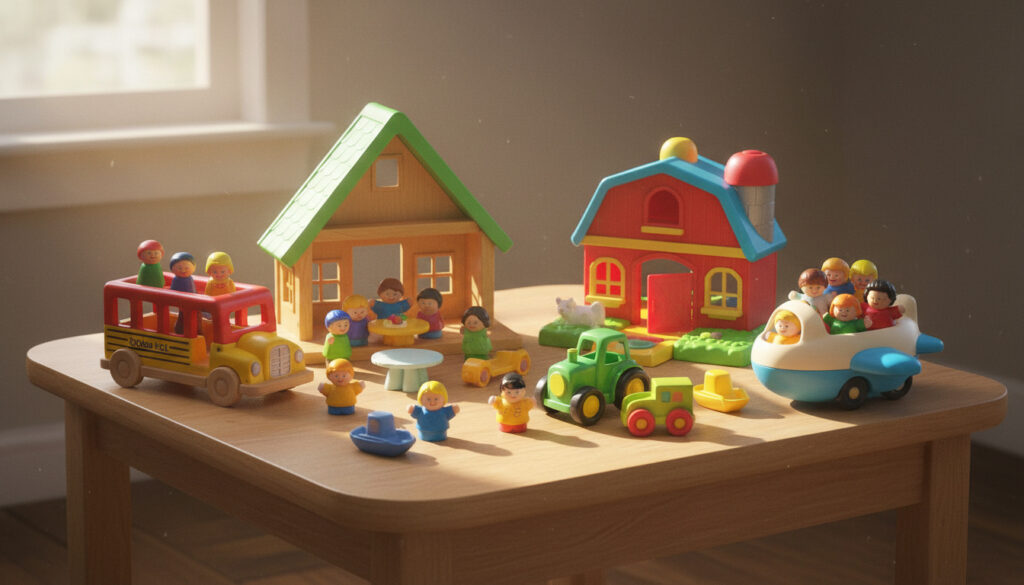
Fisher Price Little People – History Safety Best Sets Guide
Fisher-Price Little People represent one of the most enduring toy lines in American manufacturing history, spanning seven decades of design evolution and safety adaptation. Originally emerging from Fisher-Price’s 1950s experimental lines, these figures transitioned from wooden barrel-shaped bodies to the chunky, child-safe plastic forms recognized in preschools today. Currently produced under Mattel’s ownership following the 1993 acquisition of Fisher-Price, the brand maintains dual age recommendations targeting both infants and preschoolers through distinct product architectures.
The product ecosystem centers on interchangeable human figures and animal companions designed for thematic playsets including farms, airports, and urban environments. Unlike many contemporary toys emphasizing electronic components, Little People historically prioritized tactile manipulation and imaginative narrative play, though modern iterations incorporate educational elements such as the A to Z Learning Zoo introduced in 2004. The line’s manufacturing history reflects broader shifts in American toy safety regulations, particularly the 1991 physical redesign that fundamentally altered figure proportions to prevent choking incidents.
Contemporary sets feature named characters—Eddie, Tessa, Mia, Koby, and Sofie—replacing the anonymous peg-style figures of previous generations, while retaining compatibility within the current production line. However, this compatibility does not extend backward to vintage collections, creating distinct market segments for collectors and active play.
What Are Fisher-Price Little People?
Chunky, kid-safe plastic designs for toddler grip and manipulation
Thematic environments including farms, zoos, schools, and airports
Dual ranges: 6–36 months and 3 years and up
Mattel-owned since 1993 acquisition of Fisher-Price
Key facts defining the brand’s market position:
- Originated in 1950 as permanently attached firemen figures before evolving into removable Play Family characters
- Trademarked as “Little People” in 1985 following Mattel’s corporate acquisition
- Underwent four distinct physical design phases: wood/cardboard (1950s), narrow plastic pegs (1970s–1990), chunky safety redesign (1991), and detailed molded figures (1997–present)
- First licensed property partnership with Sesame Street in 1975, predating McDonald’s licensing in 1990
- Shifted from generic figures to named characters (Eddie, Tessa, Mia, Koby, Sofie) in the late 1990s
- Introduced educational animal-focused sets with the 2004 A to Z Learning Zoo
- Maintains collector value for pre-1990 “classic” sets, with mint condition vintage vehicles commanding significant secondary market prices
| Fact | Details |
|---|---|
| Introduction | 1950 (Looky Fire Truck); removable figures introduced 1960 |
| Current Owner | Fisher-Price (Mattel subsidiary since 1993) |
| Trademark Registration | 1985 (Mattel and Fisher-Price) |
| Age Range | 6–36 months (toddler) and 3+ years (preschool) |
| Material Evolution | Wood/cardboard → Plastic peg → Chunky plastic → Detailed molded plastic |
| First Major Playset | Play Family Barn (1968) |
| First Licensed Set | Sesame Street (1975) |
| Safety Redesign | 1991 “Chunky” format to prevent choking |
| Character Introduction | Named characters (Eddie, Tessa, etc.) debuted 1997 |
| Educational Expansion | A to Z Learning Zoo (2004) |
What Is the History of Fisher-Price Little People?
Origins in the 1950s
The conceptual foundation emerged in 1950 with the “Looky Fire Truck” featuring three round-headed firemen permanently attached to the vehicle. This design limitation prompted innovation; by 1959, the #959 Safety School Bus introduced removable figures constructed from cardboard tubes. The breakthrough occurred in 1960 with the Snorky Fire Engine and Nifty Station Wagon, which featured removable plastic figures—effectively establishing the “Play Family” product category that would define the line for three decades.
The Golden Age of Playsets
Fisher-Price consolidated the brand identity in 1968 with the Play Family Barn, distinguished by its signature “moo” door and integrated carry handle. This release established the playset architecture that would expand through the 1970s: the Dollhouse (1969), Airport (1972), and the commercially significant Sesame Street licensing partnership (1975). The 1980s saw diversification into the Action Garage, School, Western Town, and Fire Station sets, while 1990 brought the McDonald’s licensing arrangement.
Design Evolution and Corporate Changes
Physical figure construction underwent four distinct phases. The 1950s and 1960s utilized wood or early plastic barrel bodies; the 1970s through 1990 featured narrow peg bodies transitioning to all-plastic construction by the 1980s. Mattel’s 1993 acquisition of Fisher-Price initiated production shifts, including a transition to rubbery-plastic materials and lighter set constructions post-1996.
The 1991 “Chunky” redesign represented a fundamental alteration to figure geometry—wider, shorter bodies specifically engineered to exceed swallowing thresholds. According to documented accounts, this change immediately impacted market perception, with older children categorizing the toys as exclusively for “babies,” resulting in measurable sales decline despite resolving critical safety hazards.
The 1997 redesign restored detailed molding with articulated arms, individual hands, and facial features, introducing the named character roster (Eddie, Tessa, Mia, Koby, and Sofie) that persists in current production. Educational positioning strengthened in 2004 with the A to Z Learning Zoo, integrating alphabetic learning into animal figure collections.
Are Fisher-Price Little People Safe for Kids?
Historical Safety Concerns
During the late 1970s and early 1980s, the narrow peg-style figures presented documented hazards when heads detached from bodies, creating choking risks for the target demographic. This hazard profile directly prompted the 1991 physical redesign. While sources indicate parental concerns and regulatory pressures influenced this change, specific Consumer Product Safety Commission recall documentation for individual vintage sets remains unclear in available records.
Pre-1990 “classic” Little People figures do not comply with contemporary swallowing-prevention standards. Small peg-style heads from the 1970s–1980s era can detach, presenting choking hazards incompatible with current toddler safety protocols. Collectors should store vintage items separately from modern children’s toys.
Current Safety Standards
Contemporary production utilizes the 1991 “Chunky” safety architecture and subsequent detailed molding techniques that maintain size thresholds exceeding standard choking test cylinders. The dual age recommendations—6–36 months and 3 years plus—reflect graduated complexity rather than safety differentiation, as both age categories utilize the same physical figure specifications under Mattel’s current manufacturing protocols.
What Age Are Little People Toys Recommended For and What Are the Best Sets?
Age-Specific Recommendations
Fisher-Price maintains dual age categorizations: the 6–36 months range emphasizes chunky, graspable designs suitable for early motor development, while the 3 years and up designation targets complex imaginative play scenarios. The original 1959 Safety School Bus explicitly targeted small children for introductory imaginative play, establishing a developmental continuity that modern sets maintain through graduated complexity within consistent safety parameters.
Compatibility Constraints
Collector documentation confirms that pre-1990 classic wooden and plastic peg figures are physically incompatible with post-1997 detailed figures due to dimensional and structural discrepancies. The 1991 Chunky redesign and 1997 detailed redesign created distinct compatibility zones: modern sets (1997–present) maintain interchangeability within the contemporary line, while vintage collections (1950–1990) constitute a separate ecosystem. Parents purchasing secondary market items should verify production eras to ensure set compatibility.
When purchasing vintage Little People for collection purposes, verify pre-1990 status through figure construction—narrow peg bodies indicate vintage status incompatible with current playsets. For active play, restrict purchases to post-1997 sets featuring named characters to ensure safety compliance and set interoperability.
Notable Playsets and Availability
The Play Family Barn (introduced 1968) remains the line’s defining playset, featuring the iconic “moo” door mechanism and portable carry handle design. Subsequent enduring themes include the A to Z Learning Zoo (2004), airport configurations, and school environments. The Sesame Street licensing (1975) and McDonald’s sets (1990) represent significant historical licensed properties, though current availability focuses on the core character roster (Eddie, Tessa, Mia, Koby, and Sofie) within farm, zoo, and urban thematic environments.
Current production continues under Mattel’s global manufacturing network. Specific 2024 release data remains unavailable in public records, though historical patterns indicate continued emphasis on the farm and zoo educational sets that have dominated the line since the 1968 barn introduction and 2004 alphabetic zoo launch. Classic themes—barn, airport, school, and fire station—persist as the structural foundation of current catalogs alongside character-centric narrative sets.
How Have Fisher-Price Little People Evolved Over Time?
- : Looky Fire Truck introduces permanently attached wooden firemen figures
- : Safety School Bus (#959) debuts removable cardboard tube figures
- : Snorky Fire Engine and Nifty Station Wagon establish removable plastic “Play Family” format
- : Play Family Barn becomes first major playset with “moo” door feature
- : Dollhouse playset expands domestic play scenarios
- : Airport set introduces transportation infrastructure themes
- : Sesame Street licensing marks first character partnership
- : “Little People” name formally trademarked by Mattel and Fisher-Price
- : “Chunky” redesign implemented to address choking hazards
- : Mattel acquires Fisher-Price, consolidating ownership
- : Detailed molded figures with arms/hands and named characters (Eddie, Tessa, Mia, Koby, Sofie) replace anonymous peg figures
- : A to Z Learning Zoo introduces educational animal-focused play
- : Continued production under Mattel with rubbery-plastic figures and lightweight set construction
What Is Definitively Known Versus What Remains Unclear?
Established Information
- Current models comply with contemporary swallowing-prevention standards through the 1991 redesign legacy
- Mattel has owned Fisher-Price and the Little People trademark since 1993
- Historical timeline from 1950 origins through present is documented through multiple primary sources
- Named characters Eddie, Tessa, Mia, Koby, and Sofie have anchored the line since 1997
- Age recommendations of 6–36 months and 3+ years remain consistent across current packaging
- Pre-1990 and post-1997 figures are physically incompatible due to dimensional changes
Information That Remains Unclear
- Specific Consumer Product Safety Commission recall numbers or dates for vintage 1970s–1980s sets are not documented in available sources, though redesign pressures imply regulatory engagement
- Exact 2024 sales figures and specific new release catalog details are not available in public research records
- Current retail pricing for specific 2024 sets is not established in the provided documentation
- Precise manufacturing location distribution across Mattel’s global network remains unspecified
Why Do Fisher-Price Little People Remain Significant in Toy History?
The Little People line constitutes a case study in American toy manufacturing adaptation, surviving seven decades through explicit responsiveness to safety regulation rather than despite it. The 1991 redesign, though commercially disruptive initially, established the template for modern toddler toy safety standards. This evolution from permanently attached wooden firemen to sophisticated molded characters reflects broader industry shifts from simple durability to complex developmental psychology considerations.
Culturally, the brand occupies a unique position bridging generational play patterns—grandparents who manipulated 1968 barn doors now purchase mint condition Nifty Station Wagons for secondary markets while introducing grandchildren to contemporary Eddie and Tessa figures. The collector market values pre-1990 classics significantly, with pristine vintage sets commanding substantial premiums, though the exact valuation methodology remains specialized within niche collecting communities.
Educational positioning has shifted from purely imaginative play toward structured learning, exemplified by the 2004 A to Z Learning Zoo’s integration of alphabetic recognition into traditional animal figure collections. This pedagogical evolution maintains the line’s relevance against competing electronic learning toys while preserving the tactile manipulation that defined the original 1950s Play Family concept.
What Do Expert Sources and Documentation Reveal?
The 1991 redesign made the parts too big to fit in a child’s mouth, and the kids who considered themselves too old for Little People were now turned off by the look of the toys—they thought the chunky people looked too much like baby toys, and sales dropped.
— Mental Floss, “Little People, Big Fun: A Brief History of Fisher-Price Little People”
The Little People name was trademarked in 1985, by which time Mattel had acquired Fisher-Price. The toys were originally designed to be used with playsets such as the Play Family Barn (1968).
— Wikipedia, “Little People (toys)”
Pre-1990 ‘classic’ wooden/plastic peg figures are incompatible with post-1997 detailed figures due to size/shape changes.
— Fisher-Price Club Documentation
Summary: Essential Knowledge for Parents and Collectors
Fisher-Price Little People constitute a 70-year manufacturing legacy currently maintained under Mattel ownership, featuring distinct safety architectures that strictly separate vintage (pre-1990) and modern (post-1997) collections. Current production targets children from 6 months through preschool ages utilizing chunky, named-character figures incompatible with classic peg-style collections. Parents should verify production eras when purchasing secondary market items, as vintage figures do not meet contemporary swallowing-prevention standards despite their collector value. The farm and zoo playsets remain the line’s commercial and developmental foundation, available through major retailers carrying current Fisher-Price inventory.
Frequently Asked Questions
Are Fisher-Price Little People figures compatible across different production years?
No. Pre-1990 classic figures use narrow peg construction incompatible with post-1997 detailed figures. Only sets produced from 1997 onward maintain interchangeability within the modern line.
What was the first Fisher-Price Little People playset?
The 1968 Play Family Barn established the playset format, featuring the signature “moo” door and integrated carry handle, though removable figures debuted earlier in 1960 with vehicle sets.
Why did Fisher-Price change the Little People design in 1991?
The redesign addressed choking hazards when small peg-style heads detached. The “Chunky” format made parts too large to swallow, though this initially reduced sales among older children who perceived the toys as infantile.
Are vintage Fisher-Price Little People safe for current toddlers?
Pre-1990 vintage figures do not meet current swallowing-prevention standards and can present choking hazards. They should be reserved for collector display rather than active play with children under three.
Where can Fisher-Price Little People be purchased?
Current sets are available through Fisher-Price’s direct retail channels, major toy retailers, and secondary markets. Vintage sets require specialized collector venues or estate sales, with compatibility verification essential before purchase.
More related posts
 Paddy’s Powerful Bottle Where to Buy: Shops & Online
 Call of Duty Modern Warfare 2: Player Count & Guide 2026
 Apple Watch Series 3 in 2026: Still Good or Outdated
 Burnley FC vs Manchester United FC Timeline: History & Finances
 At the Races Racecards Today: Live, Picks & Results
 261 Bus Timetable Cork – Schedules, Stops and Frequencies
 Emmerdale Spoilers Next 2 Weeks – Detailed Storyline Guide
 Brasileirão Série A Statistics 2026: Top Scorers & Table