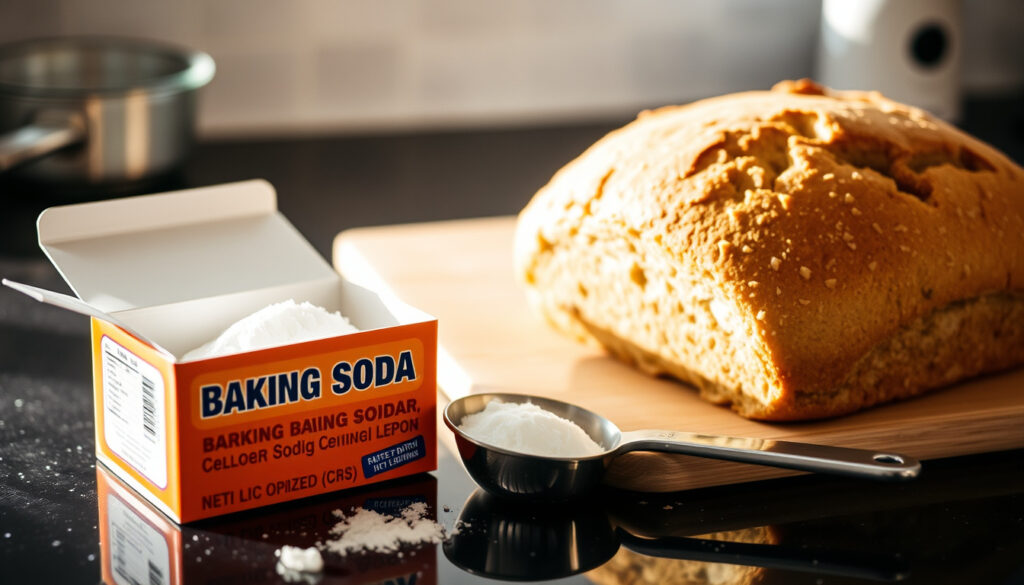
Is Bread Soda the Same as Baking Soda? Yes, Here’s Why
Few kitchen cupboards cause as much head-scratching as the small box of white powder beside the flour. If you learned to bake in Ireland or the UK, you probably call it bread soda; if you are reading a US recipe, it is baking soda. Same sodium bicarbonate (NaHCO₃) chemistry, same leavening job — yet the names keep confusing even experienced bakers, especially when baking powder sits right next to it. Here is how to tell them apart and swap them without flattening a loaf.
Also known as: sodium bicarbonate (NaHCO₃) ·
Common names in Ireland and UK: bread soda, bicarbonate of soda, baking soda ·
Distinct from: baking powder (contains added acid and buffer) ·
Cleaning applications: gentle abrasive, deodorizer, drain cleaner
Quick snapshot
- Bread soda, baking soda, and bicarbonate of soda are all the same compound, sodium bicarbonate (Britannica (encyclopaedia reference)).
- Baking powder is a different leavener because it adds acid salts to the sodium bicarbonate (Wikipedia (community reference)).
- Irish soda bread relies on bread soda reacting with the acid in buttermilk. (Britannica (encyclopaedia reference))
- Exactly when Irish cooks adopted the phrase “bread soda” is not pinned to one documented first use; the name is tied to the 1830s rise of soda bread. (Healthline (health media))
- Internet claims about baking-soda water for digestion and constipation outrun the clinical evidence (Healthline (health media)).
- 1791 — sodium bicarbonate first produced commercially by Nicolas Leblanc (Britannica).
- 1836 — soda bread appears in Irish cookbooks, giving “bread soda” its everyday job (Wikipedia).
- 1846 — Church & Dwight begin selling baking soda at scale in the US (Arm & Hammer (baking-soda maker)).
- Swap bread soda into a US baking-soda recipe at a 1:1 ratio — the compound is identical (BBC Good Food (UK food media)).
- In UK and Irish shops, look for “bicarbonate of soda” on the label; in the US, look for “baking soda.” (BBC Good Food (UK food media))
- Keep an acid such as buttermilk or yogurt in the recipe, or the loaf will come out dense and bitter. (BBC Good Food (UK food media))
One compound, a handful of labels: this is the cheat sheet for every name you will meet in the baking aisle.
| Attribute | Value |
|---|---|
| Chemical name | Sodium bicarbonate (NaHCO₃) |
| Other common names | Bread soda, baking soda, bicarbonate of soda |
| Primary use | Leavening agent in quick breads such as Irish soda bread |
| Activation | Needs an acid (buttermilk, yogurt, lemon juice) to release carbon dioxide |
| Baking powder difference | Contains added acid salts and a starch buffer, so it works without a separate acid (BBC Good Food) |
| Cleaning role | Mild abrasive, deodorizer, and drain cleaner when paired with vinegar (Arm & Hammer) |
| Antacid role | Neutralises stomach acid, but high sodium limits regular use (NHS (UK health authority)) |
| Regional label in Ireland | Bread soda |
| Regional label in the US | Baking soda |
| Regional label in the UK | Bicarbonate of soda |
What is bread soda?
Chemical composition of bread soda
Bread soda is sodium bicarbonate — the same white powder that US recipes call baking soda.
On a molecular level, bread soda is an alkaline salt with the formula NaHCO₃. In Irish and British baking it does exactly the same job as US baking soda: it reacts with an acid and moisture to release carbon dioxide, which lifts the dough.
That is why traditional soda bread recipes reach for buttermilk: the lactic acid sets off the fizz. Without an acid, bread soda has nothing to react with and the loaf stays flat.
How bread soda got its name in Irish baking
- “Bread soda” is shorthand for “the soda you put in bread.”
- The ingredient arrived in Irish kitchens alongside soda bread in the 1830s (BBC Good Food).
The name is practical rather than scientific. Irish cooks wanted a word for the specific leavening agent in soda bread, and “bread soda” told you exactly where it went. Across the Atlantic, the same white powder was doing double duty in cakes, cookies, and cleaning — so the US settled on the broader label “baking soda.”
Is bread soda simply sodium bicarbonate?
- Bread soda = sodium bicarbonate
- Baking soda = sodium bicarbonate
- Bicarbonate of soda = sodium bicarbonate
Strip away the packaging, and you cannot tell these three apart by chemistry, taste, or baking behaviour. If a recipe calls for bread soda and you only have baking soda, reach for it without adjusting the chemistry — they are the same ingredient, just with different regional names (Wikipedia).
The implication: every label on the box is regional shorthand for one alkaline salt. The only real trap is confusing it with baking powder.
Is bread soda the same as baking soda?
Why the names are used interchangeably
- Same chemical formula (NaHCO₃) in every region.
- Same leavening reaction with acid and moisture.
- Same swap ratio: 1:1 by weight.
The interchangeability is not a close approximation; it is a chemical identity. Bread soda and baking soda are the same compound, made the same way, and used at the same dose. The only difference is which English-speaking country the recipe came from.
Regional naming: Ireland vs UK vs US
Ireland: bread soda · UK: bicarbonate of soda · US: baking soda · Australia/NZ: bicarb soda
One compound, four labels: regional shelves simply package it under different names.
| Region | Common label | Same compound? |
|---|---|---|
| Ireland | Bread soda | Yes |
| UK | Bicarbonate of soda | Yes |
| US | Baking soda | Yes |
| Australia / New Zealand | Bicarb soda | Yes |
Walk into a Dublin supermarket and the baking aisle will say “bread soda” or “bicarbonate of soda.” In London, the same shelf slot usually says “bicarbonate of soda.” In New York, it says “baking soda.” All three boxes hold the same white powder.
When a recipe can substitute one for the other
A 1:1 bread-soda-for-baking-soda swap is safe because the ingredients are identical — the recipe only fails if you forget the acid.
For most quick breads, cookies, and pancakes, swap bread soda and baking soda one-for-one without adjusting anything else. What you cannot do is swap in baking powder at the same ratio; it is a weaker, self-contained leavener and will change the texture and rise (Wikipedia).
What this means: if the recipe says “baking soda” and your tin says “bread soda,” relax — it is the same ingredient at the same dose.
Bread soda vs baking powder: what is the difference?
Leavening mechanism of bicarbonate of soda vs baking powder
Bread soda / baking soda: single alkaline ingredient · Baking powder: alkaline base + acid salts + starch · When baking powder activates: once when wet, again when heated
Bread soda is a solo act. It only produces carbon dioxide when it meets an acid — buttermilk, yogurt, lemon juice, or vinegar. Baking powder is a self-contained team: it already includes the acid, usually cream of tartar, plus a starch buffer to keep the two from reacting in the jar. That is why baking powder leavens cakes that contain no acidic ingredient.
Acid–base reactions in baking
- Bread soda + buttermilk → CO₂ bubbles → lift in soda bread.
- Baking powder + water → first rise; + oven heat → second rise.
- Too much bread soda, too little acid → bitter, soapy aftertaste.
The reaction is straightforward chemistry. When sodium bicarbonate meets an acid in the presence of water, it produces carbon dioxide gas. Those bubbles get trapped in the dough, and the heat of the oven fixes the structure. If the balance is off, the unreacted bicarbonate leaves a metallic, soapy taste.
Can bread soda be substituted for baking powder?
Yes, you can make a baking-powder substitute at home — but it will not be single-acting or double-acting in quite the same way, so expect texture differences.
If you only have bread soda and a recipe calls for baking powder, you can approximate: mix 1 part bread soda, 2 parts cream of tartar, and optionally a little cornflour. The homemade blend works, but commercial baking powder is formulated for consistent double action, which is why results can vary.
Is bread soda the same as baking soda for cleaning?
Using bicarbonate of soda as a mild abrasive cleaner
- Mild alkali: lifts grime without harsh scratching on sinks, hobs, and ovens.
- Mixed with water into a paste, it works as a gentle scouring agent.
The same chemical compound that leavens bread also sits in countless cleaning tutorials. Because sodium bicarbonate is a mild alkali, it dissolves grease and neutralises odours, while its soft crystals provide gentle abrasion. Arm & Hammer, the brand that scaled up baking-soda production, has long marketed it for everything from fridge deodorising to scrubbing surfaces (Arm & Hammer).
Deodorising with baking soda in the fridge
An open box of bread soda in the fridge is a deodorizer, not a magic odour eraser — it absorbs odours best when replaced every few weeks.
The classic trick of leaving an open box in the fridge works because sodium bicarbonate reacts with, and neutralises, acidic odour molecules in the air. It is a legitimate, cheap cleaning hack — and a reason many Irish households keep bread soda in the cupboard even when they are not baking.
Is there any difference between food-grade and cleaning-grade product?
- Food-grade bread soda is safe for baking and cleaning.
- Cleaning-specific baking soda may include added fragrances or larger crystals.
- For cooking, always check the label says food-grade or bicarbonate of soda.
In theory, the same sodium bicarbonate can do both jobs. In practice, cleaning products sometimes add fragrance or use coarser granules, so they are not always suitable for baking. If the box does not say food-grade, keep it under the sink rather than in the dough.
What is baking soda called in Ireland?
Irish terminology for sodium bicarbonate
- Bread soda — the everyday name in Irish kitchens.
- Bicarbonate of soda — the printed name on many Irish and UK packs.
- Baking soda — the US label you might see in imported products.
In Ireland, the most common spoken name is “bread soda,” and you will also see “bicarbonate of soda” on packaging. The phrase “baking soda” is understood — especially because US recipes and TV shows use it — but it is not the default label on an Irish shopping list.
The role of bread soda in Irish soda bread
Soda bread is chemically simple: flour, buttermilk, salt, and bread soda. No yeast, no proving — the rise happens in the oven.
Irish soda bread is the reason the term exists. The loaf depends on bread soda reacting with the lactic acid in buttermilk, which means the name tells you exactly what the recipe needs. Food historians trace the bread’s Irish popularity to the 1830s, when cheap bread soda made yeast-free loaves practical (BBC Good Food).
Finding bread soda outside Ireland
- US: look for baking soda in the baking aisle.
- UK: look for bicarbonate of soda — same powder, different label.
- Online: the same compound is sold under all three names.
If you are outside Ireland and a recipe asks for bread soda, do not order a special product. The American baking-soda box, the British bicarbonate of soda, and the Australian bicarb soda are all sodium bicarbonate and can be swapped one-for-one.
The takeaway: “bread soda” is a local name for a global pantry staple — one that travelled from Irish soda bread to the rest of the English-speaking baking world.
Is bread soda good for acid reflux?
Editor’s note: this is general information, not medical advice. Talk to a clinician before using baking soda for any health condition.
How sodium bicarbonate works as an antacid
- Sodium bicarbonate is an alkali that neutralises stomach acid quickly.
- A folk dosage is about half a teaspoon of bread soda in water, but it should only be occasional.
- The effect is temporary, not a treatment for acid reflux.
When heartburn strikes, a small amount of alkaline bread soda can indeed settle the burn by neutralising acid in the stomach. Health media describe this as a short-term home remedy rather than a medical treatment (Healthline (health media)).
Risks of using baking soda regularly for heartburn
Every dose of baking-soda water is a dose of sodium — which makes it a poor habit for anyone with high blood pressure or kidney concerns.
The catch is the salt. Bread soda is high in sodium, and regular use can lead to fluid retention, bloating, and electrolyte imbalances. NHS heartburn guidance recommends established antacids and alginate treatments instead of improvised bicarbonate cocktails (NHS (UK health authority)).
When to see a doctor instead
- Heartburn more than twice a week may signal GERD, not just indigestion.
- Trouble swallowing, vomiting, or weight loss need prompt medical attention.
- People on low-sodium diets or certain blood-pressure medications should avoid baking-soda antacids.
Frequent heartburn deserves a diagnosis, not a pantry hack. A doctor can recommend proper antacids, acid reducers, or lifestyle changes that treat the cause instead of masking the symptom.
Why this matters: an occasional pinch of bread soda may relieve the burn, but the sodium cost and the risk of masking GERD make it a poor default remedy.
Is bread soda good for constipation?
Does baking soda act as a laxative?
- Sodium bicarbonate is not a recognised laxative.
- The internet “fizz trick” has no backing in clinical guidance.
- Regular use can set off bloating, cramping, or electrolyte problems.
Despite persistent folk claims, sodium bicarbonate is not an established treatment for constipation. Medical reviews of laxatives point to fibre, stool softeners, and osmotic laxatives such as lactulose — not baking soda. Health media similarly warn that drinking bicarbonate water for bowel relief is unsupported (Medical News Today (health media)).
Electrolyte risk of drinking bicarbonate solutions
A concentrated dose of bread soda shifts the body’s acid-base balance and sodium load — a risky trade for a problem usually solved with water, fibre, and movement.
Sodium bicarbonate is a salt. In large doses it can raise sodium levels and push the body toward alkalosis, which in severe cases causes muscle twitching, weakness, or irregular heart rhythm. Healthline’s guidance on digestive issues is clear: this is not a routine laxative (Healthline).
Safer alternatives for constipation relief
- Drink more water and add fibre from fruit, vegetables, and oats.
- Regular movement and exercise help keep the gut active.
- Oral rehydration solutions and osmotic laxatives are the clinically established approaches.
If constipation keeps coming back, the evidence points to hydration, fibre, and exercise first. When those are not enough, a pharmacist or doctor can recommend a proper laxative that works with your body’s chemistry — without the sodium hit of bread soda.
The pattern: bread soda’s fizzy reaction is perfect for a loaf and pointless for a bowel; the online shortcut is not backed by clinical evidence.
Bread soda vs baking soda vs baking powder: at a glance
Three leaveners, two of them identical: the rows below show where the chemistry matches and where it diverges.
| Bread soda / baking soda | Baking powder | |
|---|---|---|
| Main ingredient | Sodium bicarbonate (NaHCO₃) | Sodium bicarbonate + acid salts (e.g. cream of tartar) + starch |
| Needs acid to work? | Yes — buttermilk, yogurt, lemon juice, vinegar | No — contains its own acid |
| When it activates | Immediately when mixed with acid and liquid | Once when wet, again when heated (double-acting) |
| Best recipes | Soda bread, cookies, pancakes with buttermilk | Cakes, scones, recipes without acidic ingredients |
| Swap for bread soda? | Yes — 1:1 | No — not a direct 1:1 swap; needs recipe adjustment |
The trade-off: bread soda is a single ingredient that demands the right recipe; baking powder is the convenience product that handles the chemistry for you.
Bread soda at a glance: the key specifications
One compound, a short spec sheet: these are the facts that matter in the kitchen.
| Specification | Value |
|---|---|
| Chemical name | Sodium bicarbonate (NaHCO₃) |
| Common names | Bread soda (Ireland), baking soda (US), bicarbonate of soda (UK) |
| Primary function | Alkaline leavening agent for quick breads |
| Activation | Reacts with an acid (buttermilk, yogurt, lemon juice) to release CO₂ |
| Distinction from baking powder | Contains no added acid; baking powder does |
| Household use | Mild abrasive cleaner and deodorizer (Arm & Hammer) |
| Antacid use | Neutralises stomach acid short-term; high sodium limits regular use (NHS) |
| Laxative use | Not recommended; risk of electrolyte imbalance |
| Regional label in Ireland | Bread soda |
| Regional label in the US | Baking soda |
What bread soda is good at — and where it falls short
Upsides
- Chemically identical to baking soda and bicarbonate of soda, so a 1:1 swap works.
- Cheap, widely available, and a genuine workhorse in baking.
- Doubles as a mild cleaner, deodorizer, and gentle scouring agent.
- No special storage; a dry airtight cupboard keeps it ready to react.
Downsides
- Not the same as baking powder — recipes without acid will fall flat and taste bitter.
- High sodium content makes it a poor everyday antacid.
- Not a safe or effective remedy for constipation.
- Mixed with strong acids in a sealed container, it can fizz violently.
Confirmed facts vs what’s unclear
Some claims about bread soda are settled science; others are kitchen folklore with a following.
Confirmed facts
- Bread soda, baking soda, and bicarbonate of soda are all sodium bicarbonate (NaHCO₃) (Britannica).
- Baking powder contains added acid salts and is a distinct leavener (Wikipedia).
What’s unclear
- Exactly when “bread soda” became the default Irish name is not tied to a single documented first use.
- Online claims about baking-soda water for digestion and constipation outrun the clinical evidence.
- Whether homemade baking-powder substitutes truly match commercial double-acting formulas is kitchen-dependent.
What the experts say
Bread soda, baking soda, and bicarbonate of soda are the same chemical compound — sodium bicarbonate — used as the leavening agent in quick breads.
— Encyclopaedia Britannica
Soda bread’s rise comes from the reaction between bread soda and the acid in buttermilk, with no yeast needed.
— Wikipedia, “Soda bread”
As a cleaner, sodium bicarbonate works as a mild abrasive and odour neutraliser — the same ingredient that lifts a loaf of bread.
— Arm & Hammer
The consistent message: the chemistry is identical wherever you buy it; the health claims need more scrutiny than the cooking claims.
The takeaway
The next time a recipe asks for bread soda, you already know the answer: it is the same sodium bicarbonate sold as baking soda in the US and bicarbonate of soda in the UK. For Irish home bakers following an American recipe, the swap is a straight 1:1, no conversion maths required. For anyone tempted to treat that kitchen box as a wellness remedy, the consequence of ignoring the sodium load is real — regular doses can raise blood pressure and disturb electrolyte balance. A well-risen loaf is worth the knowledge; a self-prescribed bicarbonate habit is not.
Related reading: JSON Schema · IBM Docs
docs.open-metadata.org, github.com, ibm.com, github.com, ibm.com, notebooklm-guide.com, ibm.com, ibm.com, ibm.com, ydb.tech
Frequently asked questions
Are bread soda and baking soda interchangeable?
Yes. Both are sodium bicarbonate (NaHCO₃), and a 1:1 swap by weight works without any other recipe changes.
Can I substitute bread soda for baking soda in a recipe?
Yes — they are the same ingredient. Use the same amount the recipe calls for, and keep the acid component (buttermilk, yogurt, lemon juice) as written.
What is the difference between bicarbonate of soda and baking powder?
Bicarbonate of soda is pure sodium bicarbonate. Baking powder contains sodium bicarbonate plus acid salts and usually a starch, so it can leaven recipes that have no acidic ingredient.
Why do Irish recipes call it bread soda?
Because it is the soda used for bread — specifically the leavener in Irish soda bread. The name is regional shorthand, not a different product.
Is bread soda good for cleaning surfaces?
Yes. It is a mild alkali and gentle abrasive, which makes it useful for scrubbing sinks, deodorising fridges, and unblocking drains when combined with vinegar and hot water.
What should you never mix with baking soda?
Avoid mixing it with strong acids in a sealed container, because the rapid carbon-dioxide release can build up pressure. Also avoid regular use alongside medications that depend on stomach acid.
Does bread soda help with constipation?
No. It is not a recognised laxative, and concentrated bicarbonate water risks electrolyte imbalances. Water, fibre, and clinically tested laxatives are safer options.
More related posts
 League of Ireland Premier Division Table 2025
 Best Guiso de Mondongo Near Me in Sligo: Top Restaurants
 Cast of The Bear: Every Actor & Character Guide (2026)
 How to Change Default Printer – Guide for Windows, Mac, Mobile
 Liverpool vs Inter Milan: Szoboszlai penalty wins without Salah
 What Is a Cookie on a Website? Guide to Uses & Privacy
 Are Mini Eggs Easter Eggs Discontinued? Calories & Buying Guide
 Best Pay As You Go SIM 2025: UK and Ireland Options Compared