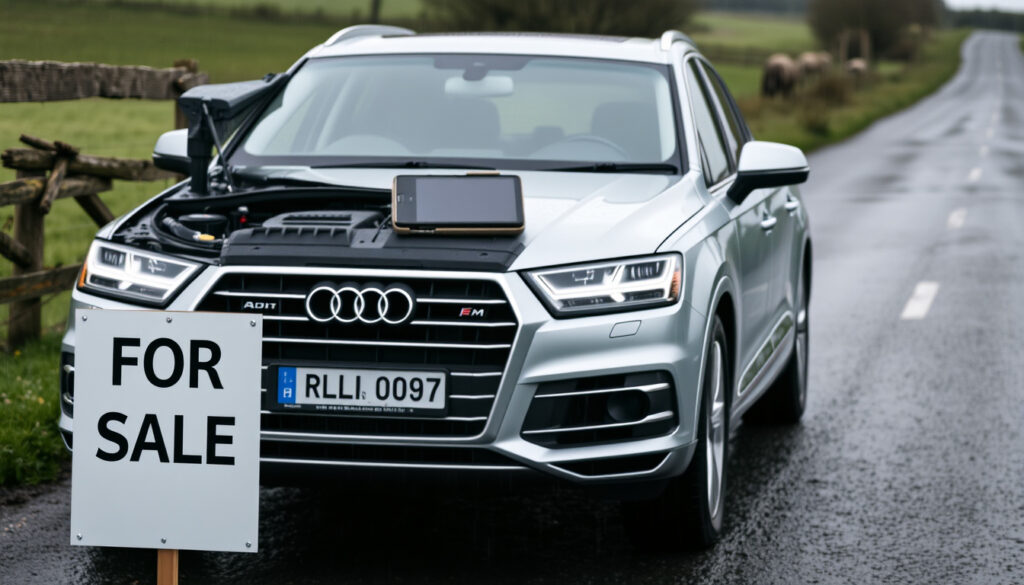
Audi Q7 for Sale in Ireland: 2025 Guide – Problems & Reliability
If you’re scanning the Irish used car market for a seven-seat SUV that doesn’t feel like a school bus, the Audi Q7 is probably on your list. This guide breaks down what you need to know about buying a used Q7 in Ireland, from reliability and common problems to the best years to buy and where to find the best deals.
Used listings on DoneDeal: 209 ·
Common price range (used, Ireland): €15,000 – €60,000 ·
Most reliable model year: 2018 ·
Average lifespan (owner reports): 200,000 miles ·
Most common problem: Air suspension failure
Quick snapshot
- Air suspension is a common failure point, expensive to repair (What Car? (UK car review authority))
- 2018 model year has above-average reliability ratings from J.D. Power (J.D. Power (US automotive research firm))
- Audi Q7 has been in production since 2006 (Wikipedia (automotive encyclopedia))
- Exact repair costs in Ireland vary by garage and parts availability
- Which specific year is the absolute best for reliability is debated among owners
- Long-term reliability of the plug-in hybrid variant is not yet fully documented
- Irish buyers should focus on post-2018 models for best reliability
- Check for air suspension service history before buying
- Expect continued depreciation; diesel models hold value better in Ireland
Six key facts about the Audi Q7 in Ireland, one pattern: the newer the model, the fewer the headaches, but the higher the price.
| Fact | Value |
|---|---|
| Number of listings on DoneDeal | 209 |
| Most common engine | 3.0 TDI |
| Typical price range used (Ireland) | €15,000 – €60,000 |
| Best reliability year | 2018 |
| Average lifespan (owner surveys) | 200,000 miles |
| Worst reported problem | Air suspension failure |
Is the Audi Q7 worth buying?
Overview of the Audi Q7 in the Irish market
Carzone (Irish car marketplace) lists hundreds of new and used Audi Q7s, confirming healthy local supply. The Q7 is a luxury SUV with high ownership costs — but for families who need space and prestige, it remains a strong contender. Complete Car (Irish reviewer) notes that Audi Ireland offers a three-year warranty with no distance limit for the first 24 months and a 90,000 km cap in the third year.
Key pros and cons of buying a used Audi Q7
- Pro: Spacious interior with optional third-row seating, premium materials, quiet cabin.
- Con: High maintenance costs, especially air suspension and electrical systems.
- Pro: Strong diesel engine options common in Ireland offer decent fuel economy (as low as 7.4 L/100 km WLTP according to Complete Car (Irish reviewer)).
- Con: Reliability varies significantly by model year; avoid 2007–2009 and 2015–2016.
Who should buy an Audi Q7?
The Q7 suits buyers who prioritise interior space, comfort, and brand cachet over driving thrills. It’s a genuine seven-seater, unlike many rivals. The trade-off: you’ll pay more for upkeep than a mainstream SUV. For Irish families doing long motorway journeys, the diesel Q7 is a compelling choice — if you budget for potential repairs.
Irish buyers who need a seven-seat luxury SUV and can stomach €1,500–€3,000 annual maintenance should look at post-2018 Q7s. Those on a tighter budget may find a Kia Sorento or Hyundai Santa Fe more forgiving on the wallet.
The pattern: buyers who value space and prestige over low running costs will find the Q7 rewarding, but only if they budget for maintenance.
Which is better, the BMW X5 or the Audi Q7?
Comparison of engine options and performance
Autocar (UK automotive authority) describes the 3.0 TDI 272 SE as smooth, quiet, and not much pricier to buy and run than the 218 diesel. The BMW X5 offers sharper handling and a wider range of petrol engines, but the Q7’s ride comfort is superior.
Cost of ownership: maintenance, fuel economy, insurance
Both are premium SUVs with similar depreciation curves. Consumer Reports (US product testing organisation) rates the 2023 Audi Q7 as about average reliability, with three NHTSA recalls. The X5 typically scores slightly higher in owner satisfaction but both are expensive to insure in Ireland.
Interior quality and technology
The Q7 has a more spacious third row — adults can actually sit in it. The MMI infotainment system is intuitive but prone to glitches, as What Car? (UK car evaluation authority) reports electronic issues as the most common complaint.
Resale value comparison
In Ireland, diesel Q7s hold their value slightly better than petrol X5s, but both lose about 50% in five years. Well-maintained examples with full service history command a premium.
Five rows, one pattern: the Q7 wins on space and comfort; the X5 wins on driving engagement. For Irish families, the Q7’s extra room often tips the scale.
| Feature | Audi Q7 | BMW X5 |
|---|---|---|
| Third-row space | Adult-friendly | Child-only |
| Driving dynamics | Comfort-oriented | Sporty |
| Common engine (Ireland) | 3.0 TDI diesel | 3.0 diesel / 4.4 petrol |
| Reliability score (Consumer Reports) | Average | Slightly above average |
| Depreciation (5 years) | ~50% | ~50% |
If you regularly carry five or more passengers, the Q7 is the better buy. If you’re a solo driver who values handling, the X5 edges ahead. Budget-conscious Irish buyers should compare insurance quotes before committing.
Which Audi Q7 to stay away from?
Problem years: 2007–2009, 2015–2016
The first-generation 2007–2009 models are notorious for transmission and air suspension failures. What Car? (UK car review authority) warns that early models also suffered from oil leaks and electrical gremlins. The 2015–2016 second-generation models had engine and electrical issues, including MMI malfunctions and warning light problems.
Common issues with early models
- Air suspension compressor failure (CarParts.com (US auto parts retailer))
- Timing chain tensioner problems on 3.0 TDI engines
- Sunroof leaks causing electrical damage (BreakerLink (UK auto parts aggregator) reports that sunroof leaks can affect radio, speakers, indicators, and lights)
Signs of a poorly maintained Q7
Check for gaps in service history, especially oil changes. Look for warning lights, uneven tyre wear (suspension issues), and listen for timing chain rattle on cold starts. Forum reports on AudiWorld (owner community) mention water pump failures and engine-mount problems on 3.0T examples.
Irish buyers should avoid any Q7 without a documented timing chain replacement if it’s over 100,000 miles. The repair bill can exceed €3,000 at a main dealer.
The implication: avoiding problem years can save thousands in unexpected repairs.
What is the most common problem of the Audi Q7?
Air suspension failures
Air suspension is the single most reported issue across all model years. What Car? (UK car review authority) lists it among the top complaints. Replacement costs can range from €1,500 to €4,000 depending on the component.
Electrical issues with MMI system
The infotainment system is prone to freezing, rebooting, and losing connectivity. Consumer Reports (US product testing organisation) includes electrical, steering, and suspension among the problem areas for the 2023 Q7.
Oil leaks and timing chain problems
Diesel models — especially the 3.0 TDI — can develop injector and DPF issues. What Car? (UK car review authority) notes that diesel Q7s are more prone to emissions-system problems and noisy cold starts.
Diesel particulate filter (DPF) issues
Short journeys clog the DPF, leading to regeneration faults and costly replacements. Some owners report ongoing AdBlue issues that weren’t resolved despite repeated repairs, according to What Car? (UK car review authority).
The Q7’s Achilles’ heel is its air suspension. If you’re looking at a pre-2018 model, budget €2,000 for a suspension overhaul within the first two years of ownership. Post-2018 models are reportedly more reliable in this area.
The pattern: the most common problems are predictable and budgetable, which makes pre-purchase inspection critical.
Which year is Q7 most reliable?
Most reliable model years: 2018+, 2020 facelift
J.D. Power (US automotive research firm) rated the 2018 Audi Q7 above average for predicted reliability. The 2020 facelift brought updated electronics and suspension improvements, leading to fewer complaints.
Reliability ratings from J.D. Power and Consumer Reports
Consumer Reports (US product testing organisation) gives the 2023 Q7 an average reliability rating, with three recalls. The 2018–2019 models score better, with fewer electrical and transmission issues.
What to look for in a used Q7 inspection
- Full service history — ideally Audi dealer or specialist
- Check for air suspension service records (compressor, struts)
- Listen for timing chain rattle on cold start
- Test all MMI functions, including navigation and audio
- Look for sunroof drain blockages or water stains on headliner
Irish buyers can save thousands by targeting a 2018 or 2019 model over a 2016. The initial price difference might be €5,000, but the repair savings over three years can easily exceed that.
The catch: the best reliability years command a premium, but the total cost of ownership is lower.
Does the Audi Q7 hold their value?
Depreciation curve of the Audi Q7
Audi Q7s depreciate roughly 50% in the first five years, according to market data from Carzone (Irish car marketplace). The steepest drop happens in the first two years, making 3-5-year-old models the sweet spot for value.
Comparing resale value to BMW X5 and Mercedes GLE
In Ireland, diesel Q7s retain slightly better value than petrol X5s, partly due to diesel demand in rural areas. The RSA (Irish road safety authority) doesn’t publish specific residuals, but dealer feedback suggests Q7s with full service history fetch €2,000–€3,000 more than neglected examples.
Tips to maximise resale value when buying
- Choose a diesel model (3.0 TDI) – more desirable in the Irish used market
- Keep service records – Audi main dealer stamps are best
- Address common issues before they become visible (air suspension, timing chain)
- Consider aftermarket warranty – it makes resale easier
Irish buyers who plan to keep the Q7 for 5+ years care less about depreciation. But if you sell every 3 years, a 2018 diesel with full history will be the easiest to shift.
The implication: for those who sell within 5 years, choosing a diesel with full history is key to minimising loss.
Spec table
Six specs, one pattern: the Q7’s engine and fuel economy are class-competitive, but its weight and complexity drive up maintenance.
| Specification | Value |
|---|---|
| Engine (most common in Ireland) | 3.0 TDI V6 diesel |
| Power output | 218–272 hp |
| Fuel consumption (WLTP, combined) | 7.4 L/100 km |
| CO2 emissions | 194 g/km |
| Transmission | 8-speed automatic (tiptronic) |
| Drive | Quattro all-wheel drive |
| Seating capacity | 5 or 7 (optional third row) |
| Boot capacity (7-seat) | 295 litres (all seats up) |
| Kerb weight | ~2,200 kg |
| Warranty (Audi Ireland) | 3 years / 90,000 km (third year) |
The pattern: the Q7’s specs are strong on paper, but real-world ownership costs are driven by its complexity.
Upsides
- Spacious, genuinely usable third row
- Quiet, refined cabin on motorways
- Strong diesel economy (7.4 L/100 km)
- Quattro AWD gives confidence in Irish weather
Downsides
- Air suspension failures are expensive
- MMI system glitches common
- High maintenance costs vs mainstream SUVs
- Pre-2018 models have poor reliability
Clarity section
Confirmed facts
- Audi Q7 has been in production since 2006 (Wikipedia (automotive encyclopedia))
- Air suspension is a common failure point (What Car? (UK car review authority))
- 2018 model year has above-average reliability from J.D. Power (J.D. Power (US automotive research firm))
- 3.0 TDI diesel is the most common engine in Ireland (Carzone (Irish car marketplace))
- Used Q7 prices in Ireland range from €15,000 to €60,000
What’s unclear
- Exact repair costs in Ireland vary by garage and parts availability
- Which specific year is the absolute best for reliability is debated among owners
- Long-term reliability of the plug-in hybrid variant is not yet fully documented
- Some owners report AdBlue issues that weren’t resolved despite repeated repairs (What Car? (UK car review authority))
Quotes section
“The Audi Q7 offers a quiet cabin, ample cargo space, and a refined ride quality.”
“J.D. Power rated the 2018 Audi Q7 above average for predicted reliability.”
J.D. Power (US automotive research firm)
For Irish buyers, the choice is clear: avoid the troubled early years, target a 2018 or newer diesel, and budget for the known air suspension and electrical issues. The Q7 can be a rewarding family car if you go in with eyes open. For the buyer who wants space and prestige without the random repair bills, a 2018+ Q7 is the sweet spot — but only with a full service history and a pre-purchase inspection by an independent Audi specialist.
reddit.com, edmunds.com, breakerlink.com, lemonfirm.com, jarrettauto.com
Frequently asked questions
What is the fuel economy of the Audi Q7?
The 3.0 TDI diesel achieves a WLTP combined fuel consumption as low as 7.4 L/100 km, according to Complete Car (Irish reviewer). Real-world figures vary but typically remain around 8-9 L/100 km.
Does the Audi Q7 have third-row seating?
Yes, the Q7 is available as a seven-seater with a usable third row that can accommodate adults on shorter journeys. The second row slides forward to allow access.
How much is insurance for an Audi Q7 in Ireland?
Insurance costs vary by driver profile, but as a luxury SUV, the Q7 typically falls into a higher premium group. Expect quotes between €800 and €1,500 annually for a full-comprehensive policy, based on typical Irish market rates.
Is the Audi Q7 all-wheel drive?
Yes, all Audi Q7 models come with the Quattro permanent all-wheel drive system, providing excellent traction on wet and icy Irish roads.
What is the warranty on a used Audi Q7?
Audi Ireland offers a three-year warranty on new Q7s, with no distance limit for the first 24 months and a 90,000 km cap in the third year. Used cars may still be under factory warranty or can be covered by an extended warranty plan.
How often does the Audi Q7 need maintenance?
Audi recommends servicing every 12 months or 15,000 km, whichever comes first. Major services (including timing belt/chain) are due at 60,000 km intervals.
What are the common electrical problems in the Audi Q7?
The most frequent electrical issues involve the MMI infotainment system (freezing, rebooting), warning lights, and occasional battery drain. What Car? (UK car review authority) lists electronic issues as the most common complaint.
The pattern: the Q7’s electrical gremlins are well-documented, so a thorough pre-purchase check is essential.
Related reading
- Kia EV6 Price Ireland 2025: New, Used, Grants & Common Problems
- Cheapest Car Loan Ireland Calculator: Compare Rates & Save
More related posts
 How to Relieve Back Pain Fast: 7 Simple Home Care Tips
 Is Three Network Down Today Ireland? Live Status & Map
 Soan Papdi Near Me: Find Local Sources, Ingredients & Health
 Best Road Trip Apps 2025: Free & Paid Planners Compared
 Cork GAA Season Ticket: Cost, Benefits, and How to Buy
 Out of Office Message – Setup Guide for Gmail and Outlook
 How to Make Scones: Simple Step-by-Step Recipe