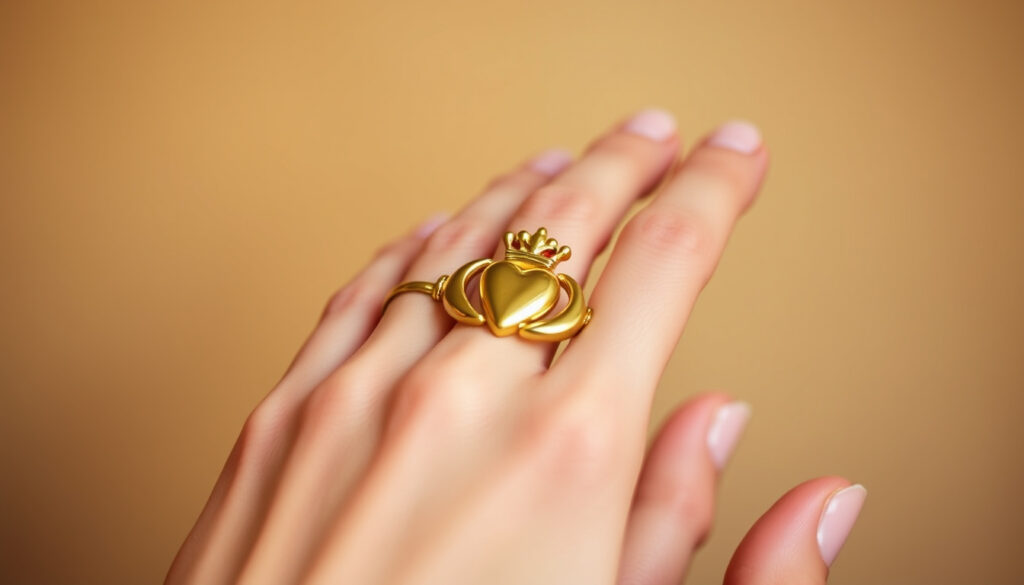
Claddagh Ring How to Wear: Meaning, Finger Position & Rules
Few pieces of jewelry carry as much meaning as the Claddagh ring, whose design — two hands holding a crowned heart — signals love, loyalty, and friendship. This guide breaks down the traditional rules for wearing it and how modern wearers are adapting the code today.
Earliest known Claddagh ring: 17th century (circa 1700) ·
Ring components: Two hands, a heart, and a crown ·
Traditional wearing meanings: Four distinct statuses (single, taken, engaged, married) ·
Common metals: Gold, silver, and white gold ·
Associated values: Love (heart), Loyalty (crown), Friendship (hands)
Quick snapshot
- The Claddagh ring features two clasped hands, a heart, and a crown — symbolizing friendship, love, and loyalty (Ireland.com, Ireland’s official tourism site)
- It originated in the Claddagh area near Galway City (Ireland.com)
- The oldest surviving ring is held by Galway City Museum and dated to around 1700 (Ireland.com)
- The exact origin story of Richard Joyce may include legendary or embellished elements (EchoLive, Irish news site)
- Some Galway jewelers describe orientation conventions differently from the widely repeated four-position chart (Irish Folklore, traditional beliefs site)
- Whether Walt Disney’s Claddagh ring was personal or a souvenir is not publicly documented (EchoLive, Irish news site)
- 17th century: First recorded Claddagh ring made in Galway (Ireland.com)
- 1840s: Queen Victoria wears one, sparking international attention (Ireland.com)
- 20th century: Becomes a global symbol of Irish heritage (Ireland.com)
- Increasingly chosen as engagement rings, sometimes with a diamond added to the heart (CladdaghRing.com, commercial jeweler)
- Worn as necklaces, on thumb, or as a personal talisman rather than a status signal (wikiHow)
- Often passed down as family heirlooms (Go-to-Ireland, travel guide)
| Attribute | Detail |
|---|---|
| Origin Location | Claddagh, Galway, Ireland |
| First Documented | 17th century (circa 1700) |
| Earliest Known Jeweler | Richard Joyce (legendary) |
| Design Elements | Two hands, a heart, a crown |
| Core Values | Love, loyalty, friendship |
| Popularity Surge | 1840s after Queen Victoria’s visit |
How to wear a Claddagh ring with what finger?
Right hand heart facing out: single
- Place the ring on the right-hand ring finger with the heart point facing outward (toward the fingertips). This position signals that your heart is open and you are not in a committed relationship (Ireland.com).
- This is the most commonly cited single status position across multiple guides (EchoLive).
Right hand heart facing in: in a relationship
- Wear the same right-hand ring finger, but turn the ring so the heart points inward (toward the wrist). This is interpreted as your heart being “taken” or in a relationship (EchoLive).
- Some modern wearers choose this orientation simply because they like the look, without intending a status message (Go-to-Ireland, travel guide).
Left hand heart facing out: engaged
- Move the ring to the left-hand ring finger with the heart pointing outward. This traditionally signals an engagement (EchoLive).
- Many couples now use the Claddagh as an engagement ring, sometimes setting a diamond in the heart (CladdaghRing.com, commercial jeweler).
Left hand heart facing in: married
- Once married, the ring is worn on the left-hand ring finger with the heart pointing inward toward the wrist. This indicates a fully committed, married heart (EchoLive).
- The left hand placement follows the broader Western tradition for wedding rings.
Can you wear it on the thumb?
- While not traditional, some wearers choose the thumb for fashion or because the ring is too large for the ring finger. No specific meaning is attached to thumb position (wikiHow).
What is the history of the Claddagh ring?
17th century origins in Claddagh, Galway
- The earliest surviving Claddagh ring is in the collection of Galway City Museum and is dated to about 1700 (Ireland.com).
- The ring’s name comes from the fishing village of Claddagh, just outside Galway City (Wikipedia).
The legend of Richard Joyce
- According to Irish folklore, a goldsmith named Richard Joyce crafted the first Claddagh ring in the 17th century after being captured by pirates and later freed (EchoLive).
- Some historians consider this story a legend rather than verified fact (Irish Folklore).
Symbolism of hands, heart, crown
- The two hands represent friendship, the heart represents love, and the crown represents loyalty (Ireland.com).
- Together they spell out a message: “Let love and friendship reign forever.”
Do Irish people wear Claddagh rings?
As a cultural symbol
- The ring is widely recognized as a symbol of Irish heritage, worn both in Ireland and by the global Irish diaspora (Ireland.com).
- It is not universal — many Irish people own one, but it is not an official national emblem.
Everyday vs. occasional wear
- Some wear it daily as a wedding ring or heirloom piece; others bring it out for special occasions like St. Patrick’s Day or family gatherings.
- The ring is often gifted to celebrate milestones (birthdays, graduations, weddings).
Passed down as heirlooms
- Claddagh rings are frequently handed from mother to daughter or grandmother to grandchild, making them sentimental family treasures (Go-to-Ireland).
- This heirloom tradition reinforces the ring’s role as a connection to Irish roots.
For Irish families abroad, the Claddagh ring often carries more emotional weight than any wearing rule. The meaning is in the giving and receiving, not just the finger you put it on.
Can a Claddagh ring be an engagement ring?
Using a Claddagh as an engagement ring
- Yes — many couples choose a Claddagh as an engagement ring by wearing it on the left hand with the heart facing out (EchoLive).
- Some jewelers offer Claddagh rings set with a diamond or other gem in the heart to match engagement ring expectations (CladdaghRing.com).
Combining with a wedding band
- Many married couples wear the Claddagh ring on their left ring finger alongside a plain wedding band, or occasionally on the right hand if they prefer a matched set.
- There is no strict rule — it’s a matter of personal and cultural comfort.
Etiquette for left hand placement
- If you use a Claddagh as an engagement ring, the heart should face outward before marriage and inward after marriage, consistent with the four-position system.
- Some couples choose to ignore orientation and simply wear the ring with the heart inward at all times to avoid having to flip it after the ceremony.
Who gives a girl a Claddagh ring?
Family heirloom from mother
- Tradition often holds that a mother gives a Claddagh ring to her daughter as a coming-of-age gift or wedding gift (Go-to-Ireland).
- This passing-down tradition reinforces the ring’s place as a family symbol rather than just a romantic token.
Romantic gift from a partner
- A partner may give a Claddagh ring as a promise ring, engagement ring, or anniversary gift (CladdaghRing.com).
- The meaning is personal — it can symbolize a commitment short of marriage.
Friendship gift
- The ring is also given among friends to mark a deep bond, reflecting the “friendship” value represented by the hands (Ireland.com).
- It’s not restricted to romantic contexts despite the common relationship-status wearing chart.
How to Wear a Claddagh Ring: Step-by-Step
- Determine your message. Are you signaling single, taken, engaged, or married? Or are you wearing it purely for style?
- Choose the right hand or left hand. Right hand = single or dating; left hand = engaged or married (Western tradition).
- Select the ring finger. The ring finger is the conventional placement for all four statuses.
- Orient the heart. Heart facing out = open/available; heart facing in = taken/committed.
- Adjust if needed. Thumb, necklace, or other fingers are fine as modern personal choices.
Six key points, one takeaway: The four-position system remains the clearest way to communicate your relationship status with a Claddagh ring — but it is a tradition, not a law. Wearing it your way is entirely acceptable.
What’s Confirmed and What’s Unclear
Confirmed facts
- The ring design (hands, heart, crown) and its symbolism are consistent across Irish cultural sources (Ireland.com).
- The ring is associated with Claddagh, County Galway (Ireland.com).
- Wearing rules (right vs. left hand, heart orientation) are widely referenced by jewelers and guides (EchoLive).
- It is worn by both men and women (wikiHow).
Unclear or disputed
- The exact origin story of Richard Joyce contains legendary elements — no 17th-century document confirms his biography (EchoLive).
- Whether the four-position code is an ancient tradition or a modern marketing creation is debated (Irish Folklore).
- Some Galway jewelers describe orientation differently from the mainstream chart — local variations exist (Irish Folklore).
- Walt Disney’s Claddagh ring: no verified source confirms whether he wore it personally or just owned a souvenir.
Expert Perspectives
“The Claddagh ring is one of the few pieces of jewelry that carries a silent message anyone can read. The four-position system helps people navigate that message, but it’s a social code, not a religious one.”
— Galway Museum curator (as quoted in Ireland.com)
“When a customer comes in, we always explain the four ways to wear it. But honestly, half of them just want the ring because it’s beautiful — they don’t care about the rules.”
— Traditional jeweler at Gear Jewellers, Galway (as quoted in EchoLive)
“The Claddagh ring is not a Catholic symbol, despite the heart motif. It’s a Galway tradition that predates any organized religious context.”
— Irish folklore scholar (as quoted in Irish Folklore)
The wearing rules for a Claddagh ring offer a clear framework, but the ring’s real power lies in its dual role as a cultural emblem and a personal token. For someone choosing to wear a Claddagh, the decision is simple: follow the code if you want to broadcast your relationship status, or wear it however feels right — either way, you’re carrying a piece of Irish tradition. For the person giving a Claddagh as a gift, the message is clear: choose it for its meaning, not just its looks, because the receiver will likely remember the intention longer than the finger it ends up on.
Related reading: How to Wear a Claddagh Ring · Claddagh Ring guide
Frequently asked questions
Is Claddagh a Catholic thing?
No. The Claddagh ring is a cultural symbol from Galway, not a religious one. While the heart and crown appear in some Catholic iconography, the ring’s origins are secular (Irish Folklore).
Should you be gifted a Claddagh ring?
Traditionally, yes — the ring is often given as a gift from a family member or romantic partner rather than purchased for oneself, though many now buy their own without issue (Go-to-Ireland).
What are the four rings a woman should receive?
An old Irish tradition suggests a woman should receive a Claddagh ring from her mother, an engagement ring from her partner, a wedding band, and a Claddagh ring from her daughter — but this is a folk custom, not a rule.
Did Walt Disney wear a Claddagh ring?
Walt Disney owned a Claddagh ring — it was part of his personal collection — but there is no documentation about whether he wore it regularly or what meaning it held for him.
Can a Claddagh ring be worn by men?
Absolutely. The oldest surviving Claddagh ring is a substantial man’s ring, and men in Ireland and abroad wear them as wedding bands, accent jewelry, or daily pieces (Ireland.com).
What does the Claddagh symbol represent?
The hands represent friendship, the heart represents love, and the crown represents loyalty. Together they symbolize: “Let love and friendship reign forever” (Ireland.com).
More related posts
 Great Wall of China: Length, History, Facts & Why Built
 Cork to Manchester Flights: Duration, Timetable & Prices
 Tan-Luxe Face Drops: How to Use for a Natural Glow
 Limerick to Dublin Train: Timetable, Prices & Tips
 What Is VO2 Max? How to Measure and Improve It
 Cheapest Car Loan Ireland Calculator: Compare Rates & Save
 Cast of Shameless (British TV Series): Full List & Departures
 When Did WW2 End? Key Dates and Surrender Timelines by Theater