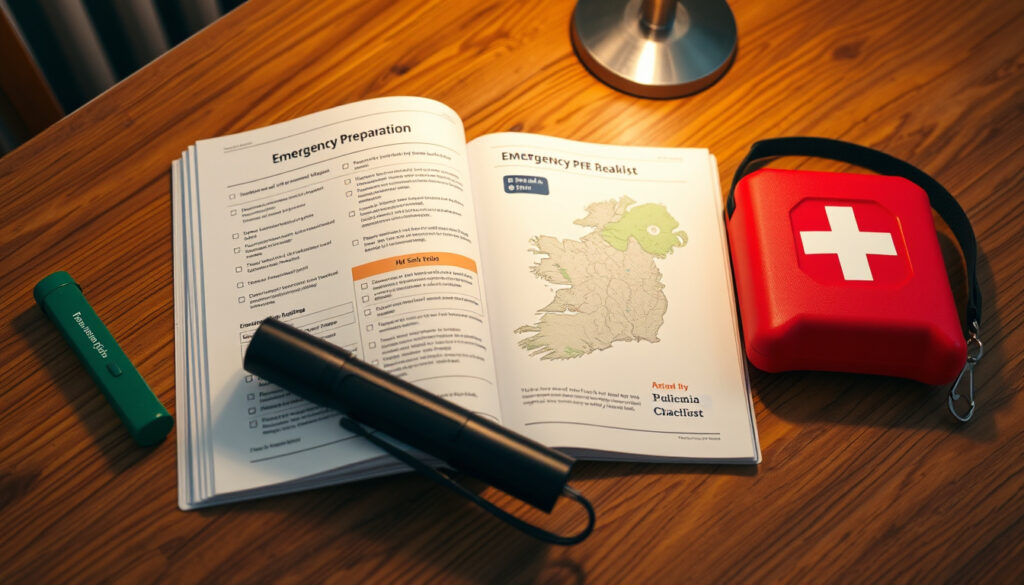
Emergency Preparation Booklet Ireland: Official Checklist
There’s something about a booklet landing on every doormat that makes preparedness feel real. Ireland’s Office of Emergency Planning has just done that — sending a household resilience guide to 1.8 million homes in January 2026, packed with the kind of practical steps that could make a real difference when the lights go out.
Households in Ireland: 1.8 million received the emergency booklet in 2026 ·
72-hour emergency kit recommended by: Office of Emergency Planning, Ireland ·
Top 10 food items to stockpile: canned vegetables, rice, pasta, peanut butter, dried fruit, nuts, oats, canned meat, beans, water ·
Government task force on emergency planning: established since 2001
Quick snapshot
- The booklet was delivered to 1.8 million households in January 2026 (RTÉ News)
- Published by the Office of Emergency Planning on behalf of the Government Task Force on Emergency Planning (The Irish Times)
- Recommendation came after Storm Éowyn review group examined Ireland’s emergency response (RTÉ News) (RTÉ News)
- Booklet is a practical preparedness checklist for households and communities (The Irish Times) (RTÉ News)
- Exact number of households that have prepared a kit after receiving the booklet
- Future updates or additional distribution rounds
- Precise rollout timeline beyond “coming weeks” as reported in January 2026
- Whether translated versions of the booklet are available
- 2001: Government Task Force on Emergency Planning established in Ireland (The Irish Times)
- January 2026: Households across Ireland receive the new emergency preparation booklet (RTÉ News)
- Households encouraged to review and follow the booklet’s checklist
- HSE and local councils expected to reinforce the 72-hour preparedness message
- Ongoing review of community resilience plans by the Government Task Force
Five key facts from the official guidance, one pattern: the same core recommendations appear consistently across national and local authority sources.
| Fact | Value | Source |
|---|---|---|
| Households that received booklet | 1.8 million | RTÉ News |
| Year of booklet distribution | 2026 | The Irish Times |
| Recommended water storage | 3 litres per person per day | Monaghan County Council |
| Emergency kit duration | At least 72 hours | Government of Ireland, Department of Defence |
| Government body responsible | Office of Emergency Planning, Ireland | The Irish Times |
What is the emergency preparation booklet for Ireland?
The emergency preparation booklet is a government-produced guide designed to help every household in Ireland improve its readiness for unexpected events — from storms and power cuts to wider emergencies. Its arrival on 1.8 million doormats in January 2026 marked the largest civilian preparedness campaign in the State’s recent history, as reported by RTÉ News.
Who published the booklet?
The booklet was published by the Office of Emergency Planning, which operates under Ireland’s Department of Defence, on behalf of the Government Task Force on Emergency Planning — a body that has been coordinating national emergency management since 2001, as confirmed by The Irish Times.
When was it distributed to households?
Distribution began in January 2026, following a recommendation from the review group that examined Ireland’s response to Storm Éowyn, which struck approximately a year earlier. The Irish government spokesperson described the booklet as a tool to “help households and communities improve their resilience,” according to The Irish Times.
The implication: this booklet turns abstract government planning into a concrete action for every household.
What are the 5 P’s of emergency preparedness?
The 5 P’s framework is a memory aid used by emergency management agencies globally to help households prioritise what matters most when evacuation or disruption looms. Each P represents a category of essential items or actions that should not be overlooked.
What does each P stand for?
- People — Everyone in your household, including pets and vulnerable individuals. Plan who collects children from school if roads are blocked.
- Prescriptions — At least a week’s supply of any medication, plus glasses, hearing aids, and medical devices.
- Papers — Important documents: passports, insurance policies, medical cards, birth certificates. Store in a waterproof bag.
- Personal needs — Hygiene items, diapers, baby formula, sanitary products, hand sanitiser, and a change of clothes.
- Priceless items — Sentimental things you cannot replace: photographs, heirlooms, digital backups on a USB drive.
How do the 5 P’s apply to Ireland?
The Office of Emergency Planning and local authorities including Monaghan County Council have adapted this framework for Irish households. The Department of Defence’s “Being Prepared” guidance specifically adds that families should identify a single agreed contact person — including that person’s address and phone numbers — so relatives can let each other know they are safe.
Irish households face specific risks — Atlantic storms, flooding, and rural power outages that can last days. A spokesperson for the Office of Emergency Planning stated: “Active preparation leads to a better response in an emergency,” as reported by RTÉ News.
The pattern: the 5 P’s remind us that emotional preparedness matters as much as physical supplies.
What to stockpile for 72 hours?
The three-day window is the standard resilience benchmark recommended by every major Irish authority. The review group linked to Storm Éowyn recommended that households have a checklist of actions to stay safe, warm, fed, and hydrated during loss of power, water, and communications for up to 72 hours, as reported by The Irish Times.
Steps to build your 72-hour kit
- Store at least 3 litres of water per person per day in clean, sealed containers.
- Gather non-perishable food for three days: canned goods, rice, pasta, and oats.
- Assemble a first aid kit and ensure you have a 7-day supply of prescription medications.
- Include a torch, spare batteries, and a battery-powered radio to stay informed.
- Add tools: manual can opener, whistle, wrench or pliers to shut off utilities.
- Keep important documents and a small amount of cash in a waterproof bag.
Essential food and water supplies
- Water — at least 3 litres per person per day, stored in clean, sealed containers (Monaghan County Council)
- Non-perishable food such as canned vegetables, rice, pasta, beans, and lentils (Monaghan County Council)
- Peanut butter, nuts, dried fruit for quick energy
- Oats, cereals, and cooking oil
- Sugar, honey, coffee, tea, or powdered milk
- Canned meat and fish — protein source that does not require refrigeration
Medication and first aid
- Prescription medications — at least 7 days’ supply
- A small home first aid kit with plasters, antiseptic, bandages, and pain relievers (Monaghan County Council)
- Any medical devices or supplies (glucose test strips, inhalers, contact lens solution)
Tools and safety items
- Battery-powered radio and spare batteries — to receive important information (Monaghan County Council)
- Torch and spare batteries (Monaghan County Council)
- Battery-operated candles for lighting during outages
- Power bank for mobile phone (Monaghan County Council)
- Whistle to alert others if help is needed
- Wrench or pliers to turn off utilities
- Manual can opener (electric ones will not work without power)
- Small amount of cash in different denominations (Monaghan County Council)
Stockpiling for 72 hours is the minimum, not the maximum. Ireland’s Department of Defence recommends supplies for up to three days when power, gas, and water are cut, as outlined in its official guidance. But if you have space and budget, extending to 7 days gives a wider safety margin — especially for rural homes on private wells or septic systems.
What are 10 items you need for an emergency kit?
The National Weather Service’s core list has become the de facto template, and Irish local authorities have adopted it with only minor local adjustments. Here is the checklist as it applies in Ireland, based on the guidance from Monaghan County Council and the Department of Defence.
- Water — 3 litres per person per day (for drinking and basic hygiene)
- Food — non-perishable, 3-day supply (canned goods, rice, pasta, oats)
- First aid kit — small home kit plus prescription medications (Monaghan County Council)
- Torch and batteries — battery-operated candles as supplementary lighting (Monaghan County Council)
- Whistle — to signal for help
- Dust mask — for air quality during debris or smoke
- Moist towelettes — for sanitation when water is limited
- Wrench or pliers — to turn off gas or water mains (Department of Defence)
- Manual can opener — because electric openers are useless in a blackout
- Local maps — printed, not digital, since mobile networks may fail
What this means: most items are cheap and take minutes to gather — the real hurdle is remembering to do it before the storm.
What are the top 10 foods to stockpile?
When the shelves go dark and the fridge grows warm, the foods that matter are the ones that stay stable at room temperature and require no cooking or only minimal preparation. Here are the top 10 recommended by Irish emergency planners.
- Canned vegetables and fruits — buy in tins with pull-tops if possible
- Canned meat and fish — chicken, tuna, corned beef
- Rice and pasta — calorie-dense, long shelf life
- Peanut butter and nuts — high protein, no refrigeration needed
- Dried fruit — raisins, apricots, dates for quick energy
- Oats and cereals — filling and shelf-stable
- Beans and lentils — canned or dried, excellent protein source
- Cooking oil and salt — essential for basic food preparation
- Sugar and honey — natural preservatives and energy sources
- Coffee, tea, or powdered milk — morale boosters that require only boiled water
The pattern: consistency across all sources — the same top foods appear on every official list.
“The booklet will help households and communities improve their resilience.”
— Government spokesperson, via The Irish Times
“Active preparation leads to a better response in an emergency.”
— Office of Emergency Planning, via RTÉ News
For a deeper look at the checklist and stockpile recommendations, see the official 2026 government guide that expands on the 5 P’s and 72-hour kit.
Frequently asked questions
How often should I update my emergency kit?
Twice a year — when the clocks change is a handy reminder. Check food expiry dates, replace batteries, and swap out seasonal clothing. Rotate stored water every 6 months.
What is the shelf life of emergency food supplies?
Canned goods typically last 2–5 years, while dried foods like rice and pasta can last 1–2 years if stored in a cool, dry place. Check each item’s best-before date.
Should I include cash in my emergency kit?
Yes. Monaghan County Council advises keeping a small amount of cash in different denominations. When the power is out, card machines and ATMs may not work.
How do I store water for emergencies?
Use clean, food-grade containers. Store in a cool, dark place. Replace every 6 months. The recommendation is 3 litres per person per day — enough for drinking and basic hygiene.
What counts as a priceless item in the 5 P’s?
Photographs, family heirlooms, digital backups on a USB drive, children’s keepsakes, and any item with sentimental value that cannot be replaced.
Can I get the booklet in Irish or other languages?
As of the January 2026 distribution, the primary version is in English. Check the Office of Emergency Planning’s website or contact your local county council for updates on translated versions.
Where can I get the emergency preparedness booklet in Ireland?
It was delivered to all 1.8 million households in January 2026. If you missed it, contact your local county council or visit the Office of Emergency Planning section on gov.ie.
For Irish households, the choice is simple: spend 20 minutes tonight gathering a torch, a first aid kit, and a bag of non-perishable food, or spend those same 20 minutes in the dark during a storm, wondering where the candles went.
Internal links: Fuel Allowance Ireland: Partial Payment Warning Explained · Weather for Next Week in Ireland: Met Éireann Forecast
More related posts
 Easter Sunday 2026 Date – April 5 Confirmed with Key Details
 Pictures of Cellulitis on Legs: Symptoms & Healing Guide
 Galaxy M32 to Buy – Current Prices and Availability in India
 The Inn at Dromoland Rebranded as The Rine – Guide
 261 Bus Timetable Cork – Schedules, Stops and Frequencies
 Miriam O’Callaghan Age: How Old Is She? Family, Children & More
 Apple Watch Series 3 in 2026: Still Good or Outdated
 High Blood Pressure Symptoms: Signs, Warnings & Risks