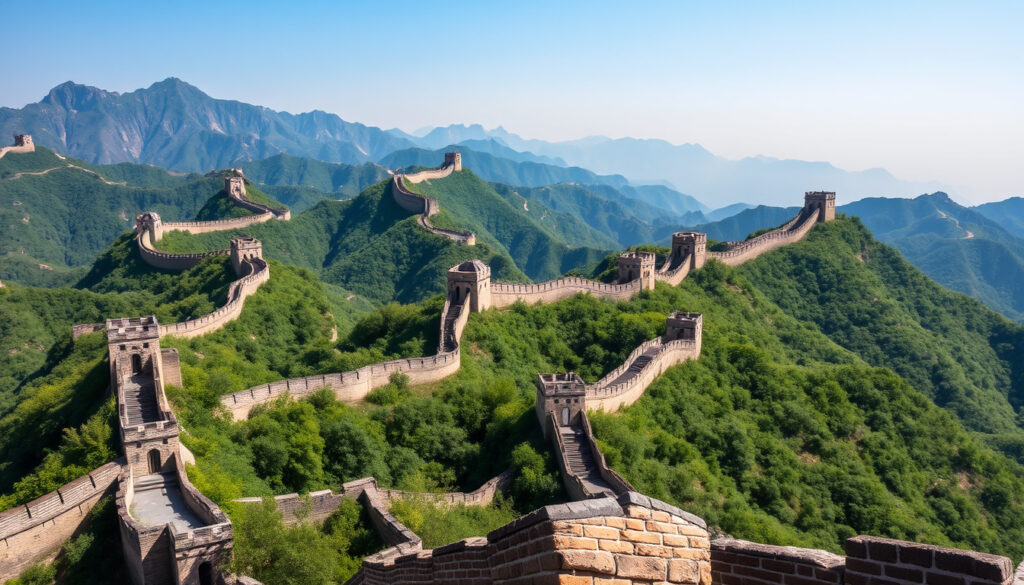
Great Wall of China: Length, History, Facts & Why Built
You have probably heard that the Great Wall of China is the only man-made object visible from space. Astronauts have repeatedly said otherwise — but the myth persists because the Wall itself is genuinely extraordinary. Stretching thousands of kilometers across northern China, it ranks among the most ambitious construction projects in human history. This guide cuts through the folklore to bring you verified data on its length, who actually built it, and why its story spans more than two millennia.
Total Length: over 20,000 km ·
Construction Period: 3rd century BC to 17th century AD ·
UNESCO Status: World Heritage Site ·
Primary Builder Dynasties: Qin and Ming ·
Location: Northern China
Quick snapshot
- 21,196 km total length measured in 2012 survey (HistoryExtra archaeology survey)
- UNESCO World Heritage Site since 1987 (HistoryExtra archaeology survey)
- Ming Dynasty built 8,851.8 km of stone wall (1368–1644 AD) (China Highlights construction timeline)
- Exact number of workers who died during construction remains disputed across sources
- Precise total cost in lives has never been independently verified
- Labor numbers for non-Qin dynasties lack documentation
- First walls: 680–656 BC (Chu State)
- Major phases: Qin (221 BC), Han, Ming (1368), final (1681 AD)
- Total construction span: over 2,300 years
- New satellite surveys may refine the total length estimate
- Restoration efforts continue on less-visited sections
- Research ongoing into regional material variations
These key metrics come from official surveys and academic sources, illustrating how the Wall’s scale evolved across dynasties.
| Key metric | Value |
|---|---|
| Official Length | 21,196 km (UNESCO 2012 survey) |
| Start Date | 221 BC (Qin Dynasty connection) |
| UNESCO Inscription | 1987 |
| Height Range | 6–7 meters average |
| Width at Top | 4–5 meters |
How long is China’s Great Wall and why was it built?
Length measurements
Pinpointing the Wall’s length is harder than it sounds — the structure winds through mountains, deserts, and grasslands, with multiple parallel walls and forgotten branches. A 2012 archaeological survey by China’s State Administration of Cultural Heritage measured 21,196 km total, including all sections and branches (HistoryExtra archaeology survey). Earlier estimates ranged from 1,500 to 5,000 miles, reflecting different survey methods and which sections researchers counted.
The Wall’s measured length keeps growing as archaeologists discover buried or forgotten sections. The 21,196 km figure represents the best available data, but future surveys may add more kilometers — this is how archaeological knowledge typically expands, not a flaw in the research.
Historical purpose
The Wall was built primarily as a defensive barrier against nomadic groups from the north. Each dynasty adapted the concept: the Qin unified existing walls into a connected defense line, while the Ming transformed it into the monumental stone fortress most visitors see today. Beyond defense, the Wall also served as a border control system and a network for signal towers — smoke and fire communicated military movements across great distances.
The implication: the Wall was never a single project but an evolving response to security threats that persisted across two millennia of Chinese history.
Who actually built the Great Wall?
Qin Dynasty origins
Emperor Qin Shi Huang initiated the major unified construction effort around 214 BCE, drawing on an enormous labor force. Britannica reports that construction lasted a decade and involved hundreds of thousands of laborers (Britannica authoritative history). China Highlights cites figures of 300,000–500,000 soldiers supplemented by up to 1.5 million laborers, including soldiers, prisoners, and conscripted commoners (China Highlights dynasty records).
Over a million workers reportedly died during Qin construction — a human cost that reflects the brutal scale of imperial ambition rather than any technical limitation of ancient builders.
Ming Dynasty expansions
The Ming Dynasty (1368–1644) built the majority of the stone walls that survive today. China Highlights documents 8,851.8 km of Ming-era construction (China Highlights construction timeline). The Jinshanling section, constructed starting in 1368, exemplifies Ming engineering — approximately 650 years old by today. The Ming walls stretched from Jiayuguan in the west to Hushan in the east, nearly 7,000 km of continuous stone fortification built over roughly 200 years.
The pattern: the Qin built fast with earth and early methods; the Ming built to last with stone, brick, and sophisticated watchtowers.
How long did it take to build the Great Wall of China?
Timeline spans
Construction did not happen in one continuous effort — it unfolded in distinct phases across centuries. China Highlights records the first Great Wall section, the Chu Great Wall, built between 680 BC and 656 BC, a 24-year project in what are now Hubei and Henan provinces (China Highlights ancient origins). From there, various states built their own walls before the Qin Dynasty connected them around 221 BC.
The Han Dynasty reportedly extended the wall to about 20,000 km over 120 years, though sources vary on this figure. The Ming Dynasty then added the most substantial remaining structures from 1368 onward. Final significant construction wrapped in the 17th century around 1681 AD, bringing the total construction span to over 2,300 years.
Major construction phases
- 680–656 BC: First Chu Great Wall sections
- 221 BC: Qin unification of existing walls
- 214 BCE: Major Qin construction begins
- 1368–1644 AD: Ming Dynasty stone walls
- 1681 AD: Final imperial construction ends
What are 5 facts about the Great Wall of China?
Key statistics
- Total length: 21,196 km (2012 survey)
- Longest man-made structure on Earth
- Ming Dynasty contributed 8,851.8 km of the total
- Most standing sections are 400–650 years old
- UNESCO World Heritage Site since 1987
Unique features
The Wall’s width at its widest point reaches 9 meters, and its color blends with the landscape — factors that contribute to its notorious invisibility from space. The structure incorporates watchtowers at regular intervals, averaging 400–500 meters apart, which served both military and communication functions.
The Wall’s legendary invisibility from space is not a mark of failure — it reflects how well the structure integrates with the terrain. Engineers designed it for function, not for visibility from orbital altitudes.
What this means: the Wall’s monumental reputation in the West partly stems from a myth that its scale would make it unique in the cosmos — but its real grandeur lies in its persistence and the human cost of its construction.
What city is closest to the Great Wall of China?
Popular access points
Beijing serves as the primary gateway for most visitors, with several well-preserved sections within a 2-hour drive of the city. Badaling, the most touristed section, lies approximately 80 km northwest of Beijing and offers the most developed infrastructure. Mutianyu, about 70 km northeast of the capital, provides a more restored but less crowded alternative with a cable car option.
Beijing proximity
The Jinshanling section, roughly 140 km from Beijing, attracts hikers seeking dramatic scenery and a more rugged experience. Most standing sections like Badaling and Mutianyu date from the Ming Dynasty — around 400 to 650 years old. For visitors staying in Beijing, day trips to Mutianyu or Badaling are straightforward, while Jinshanling requires more planning and typically a full day.
The trade-off: popular sections like Badaling get crowded, especially during Chinese holidays. Less-visited sections like Jinshanling or Simatai offer a more authentic experience but require better fitness and preparation.
The visibility myth: can you see the Great Wall from space?
The claim that the Great Wall is visible from the Moon became one of the most persistent geographical myths in Western culture. English antiquary William Stukeley first made the comparison in a 1754 letter, noting the Wall’s scale against Britain’s Hadrian’s Wall (The Vintage News historical record). The myth gained mainstream traction through Robert Ripley’s “Believe It Or Not!” cartoon, which claimed the Wall would be the only human artifact visible from lunar distance.
The myth persisted for centuries before anyone actually traveled to space — it reflected Western fascination with Chinese scale rather than observational reality.
Chinese astronaut Yang Liwei, who conducted China’s first space flight in October 2003, directly stated he could not see the Wall from orbit (HistoryExtra astronaut account). Research published in PMC confirms that the Wall’s 20-foot width places it below the threshold of human visual resolution from low Earth orbit — the naked human eye simply cannot distinguish features that narrow from that distance, regardless of atmospheric conditions (PubMed Central visual research).
The implication: the myth tells us more about human psychology — our tendency to believe the most extraordinary claims about the most extreme scale — than about the Wall itself.
What the evidence supports
- Total length of 21,196 km from 2012 survey
- Ming Dynasty built most surviving sections
- Construction spanned 2,300+ years across multiple dynasties
- Yang Liwei could not see Wall from orbit in 2003
- Wall is barely visible from low Earth orbit under perfect conditions
What remains uncertain
- Exact death toll from construction
- Precise labor numbers for non-Qin dynasties
- Complete count of all wall sections
- Modern maintenance costs and recent survey updates
“It was Robert Ripley… who called the Great Wall ‘The mightiest work of man – the only one that would be visible to the human eye from the Moon.'”
— HistoryExtra, historian
“Not even the best of human eyes at a simple glance could see the Great Wall of China from Space.”
— PMC, researcher
For travelers and history enthusiasts alike, the Great Wall offers something no photograph captures: the physical experience of walking structures built by hundreds of thousands of laborers across more than two millennia. The numbers — 21,196 km, hundreds of watchtowers, multiple dynasties — only become meaningful when you stand on the Wall yourself and feel the scale that no astronaut has ever verified from orbit.
Frequently asked questions
Can the Great Wall of China be seen from space?
No. Multiple astronauts, including China’s Yang Liwei in 2003, have confirmed they cannot see the Wall from orbit. Research published in PubMed Central attributes this to the Wall’s width — roughly 20 feet — falling below the threshold of human visual resolution from low Earth orbit. The myth originated with William Stukeley in 1754 and was popularized by Robert Ripley’s “Believe It Or Not!” before anyone actually traveled to space.
What materials were used to build the Great Wall?
Early sections used packed earth and gravel, while Ming Dynasty construction employed fired brick and stone. Regional variations exist — desert sections used different materials than mountain regions — but the iconic restored sections near Beijing feature stone blocks and fired brick.
Is the Great Wall the only man-made object visible from space?
No object built by humans is visible from space with the naked eye under normal conditions. This applies to the Great Wall as much as any other structure. Some sources note that large cities, airports, and highways become visible from low Earth orbit under ideal conditions, but individual structures require telescopic assistance.
How many people died building the Great Wall?
Estimates vary widely. Some sources report over a million workers died during Qin Dynasty construction, though exact figures remain unverified and historians debate the accuracy of historical records. What is certain is that the human cost was enormous, with soldiers, prisoners, and conscripted laborers facing harsh conditions.
What is the most visited section of the Great Wall?
Badaling, located approximately 80 km northwest of Beijing, is the most visited section due to its accessibility and developed tourist infrastructure. However, it gets extremely crowded during peak seasons. Mutianyu and Jinshanling offer less crowded alternatives with different characteristics — Mutianyu is restored with a cable car, while Jinshanling is more rugged.
Is the Great Wall still used for defense?
No military function exists today. The Wall serves as a historical monument, UNESCO World Heritage Site, and tourism destination. Its last defensive use was centuries ago, and modern China has entirely different border security systems.
How tall is the Great Wall of China?
The Wall averages 6–7 meters in height, though this varies by section and terrain. Watchtowers rise higher, reaching 10–12 meters in places. The width at the top measures 4–5 meters, wide enough for several people to walk abreast.
Related reading: Great Wall myths · historical construction
chinaxiantour.com, archaeology-travel.com, study.com, skyatnightmagazine.com, en.wikipedia.org, insightguides.com
Spanning 21,196 km over 2,300 years from Qin to Ming eras, the visiting guide details practical access to its defensive wonders across northern China.
More related posts
 5 Moments of Hand Hygiene: WHO Guide for Healthcare
 International Rugby Results Today: Six Nations Standings
 Best Time to Post on TikTok in Ireland: 2026 Guide
 Burnley FC vs Manchester United FC Timeline: History & Finances
 Pictures of Cellulitis on Legs: Symptoms & Healing Guide
 Call of Duty Modern Warfare 2: Player Count & Guide 2026
 The Shelbourne Afternoon Tea: Price, Menu, Time & Booking
 Shameless (British TV Series): UK vs US, Cast, Ending & Guide