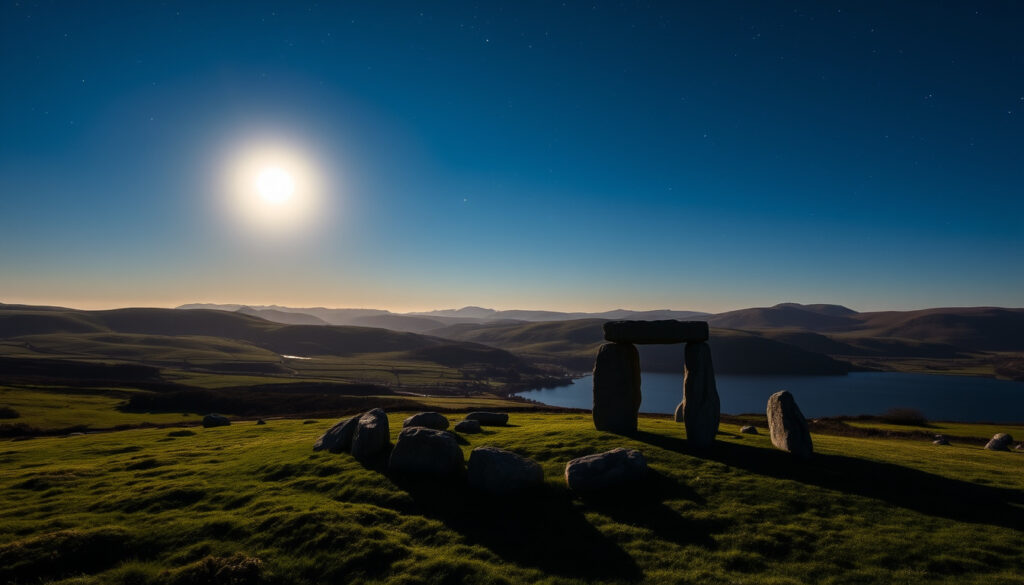
Next Full Moon Ireland 2025–2026: Dates, Names, and Viewing Tips
If you’ve ever looked up at the Irish sky and wondered what kind of moon is shining tonight, you’re not alone. The next full moon in Ireland arrives on May 31, 2026, and it’s a Blue Moon — the second full moon in a single month.
Next full moon in Ireland: May 31, 2026 (Blue Moon) ·
Full moon date for Dublin: May 31, 2026 at 9:45 am IST ·
2026 supermoons for Ireland: January 3, October 12, November 11, December 10 ·
October 2025 supermoon: First supermoon of 2025 on October 7 ·
Full moons per year: 12 (sometimes 13)
Quick snapshot
- May 31, 2026 (Blue Moon) (Royal Observatory Greenwich)
- Rises around sunset (Sky at Night Magazine)
- Visible from Dublin (Sky at Night Magazine)
- October 7, 2025 (Farmers’ Almanac)
- Hunter’s Moon (Royal Observatory Greenwich)
- First supermoon of 2025 (Sky at Night Magazine)
- Look east after sunset (Sky at Night Magazine)
- Clear skies preferred (general advice) (Sky at Night Magazine)
- Best with naked eye or binoculars (general advice) (Sky at Night Magazine)
- Sleep may be slightly lighter (Royal Observatory Greenwich)
- No strong mood effect proven (general scientific consensus) (Royal Observatory Greenwich)
- Full moon names come from folklore (Farmers’ Almanac)
Five key facts, one takeaway: the next full moon visible from Ireland is the Blue Moon on May 31, 2026, but the year also brings several supermoons worth watching.
| Fact | Value |
|---|---|
| Next full moon (Ireland) | May 31, 2026 |
| Tonight’s phase (May 24, 2026) | Waxing Gibbous |
| 2025 supermoon dates | October 7, November 5, December 4 |
| 2026 supermoon dates | January 3, October 12, November 11, December 10 |
| Full moon visibility tip | Rises near sunset, sets near sunrise |
The pattern: May 2026 packs two full moons — the Flower Moon on May 1 and the Blue Moon on May 31 — making it a standout month for moon watchers in Ireland.
What type of moon is out tonight in Ireland?
- Tonight (May 24, 2026) the moon is in a Waxing Gibbous phase, about 80% illuminated on its way to full (Royal Observatory Greenwich).
- The next full moon — a Blue Moon — occurs on May 31, 2026 (Sky at Night Magazine).
Current moon phase for Dublin
- From Dublin on May 24, 2026, the moon sets around 3:30 a.m. and rises again around 8 p.m. local time (Sky at Night Magazine).
- It’s bright enough to cast shadows on clear nights. No special equipment needed to enjoy the view.
How to check the sky tonight
- Use a moon phase app or website like timeanddate.com for precise rise/set times in your Irish town.
- Look east around 8:30 p.m. — the moon should be well above the horizon within an hour after sunset.
For anyone in Ireland wondering “is tonight a full moon?”, the quick answer is no — but the Blue Moon on May 31 is only a week away. Mark your calendar now to avoid missing it.
The implication: if you’re curious about the sky tonight, the Waxing Gibbous phase still offers plenty of moonlight for evening walks.
When is the next full moon in Ireland?
- The next full moon after tonight (May 24, 2026) is the Blue Moon on May 31, 2026 at 9:45 a.m. IST (Royal Observatory Greenwich).
- That same day the moon rises over Dublin at 22:45 local time (Sky at Night Magazine).
- October 7, 2025 is a full moon and the first supermoon of 2025 (Farmers’ Almanac).
Full moon dates for 2025
- October 7 (Hunter’s Moon, supermoon)
- November 5 (Beaver Moon)
- December 4 (Cold Moon)
Full moon dates for 2026
- January 3 (Wolf Moon, supermoon)
- February 1
- March 3
- April 2
- May 1 (Flower Moon)
- May 31 (Blue Moon)
- June 30
- July 29
- August 28
- September 26
- October 26
- November 24 (supermoon)
- December 24 (supermoon)
The implication: 2026 is a 13-full-moon year because May squeezes in two. That makes May 31 a Blue Moon by the monthly definition.
What are the names of full moons throughout the year?
- Wolf Moon (January)
- Snow Moon (February)
- Worm Moon (March)
- Pink Moon (April)
- Flower Moon (May)
- Strawberry Moon (June)
- Buck Moon (July)
- Sturgeon Moon (August)
- Harvest Moon (September)
- Hunter’s Moon (October)
- Beaver Moon (November)
- Cold Moon (December)
These names come from traditional farming and folklore — not astronomy. The Blue Moon is the exception: it’s a calendar quirk, not a seasonal name.
Supermoon frequency
- A supermoon occurs when a full moon coincides with the closest point in its orbit (perigee), making it appear up to 14% larger (Encyclopædia Britannica).
- In 2026 there are four supermoons: January 3, October 12, November 11, and December 10 (Royal Observatory Greenwich).
The catch: supermoons look about 14% larger, but the difference is subtle unless you compare side by side.
October’s Hunter’s Moon in 2025 is both a full moon and a supermoon. For sky watchers in Ireland, that combo — rising at dusk and looking extra big — is a highlight of the autumn calendar.
Why is the October full moon special?
- October 7, 2025, is a supermoon — the first of the year (Sky at Night Magazine).
- It’s also the Hunter’s Moon, the traditional name for the full moon after the Harvest Moon (Farmers’ Almanac).
- In Ireland, October evenings are relatively clear — good conditions for spotting a supermoon low on the horizon (Met Éireann (Irish national meteorological service)).
Hunter’s Moon and supermoon overlap
The overlap of the Hunter’s Moon and a supermoon is rare. In 2025 it’s a spectral unease: a bigger, brighter moon rising right after sunset, casting enough light for late harvests — and for a good photo from a Dublin hill.
Visibility in Ireland
- From Dublin, the October 7 supermoon rises around 18:30 IST (Sky at Night Magazine).
- Look east-northeast just after sunset. Any high point like Howth Head or Killiney Hill gives an unobstructed view.
The trade-off: a supermoon is only about 14% larger and 30% brighter than a regular full moon — noticeable if you compare, but not a “huge” difference.
Can a full moon affect sleep or mood?
- Some studies show that during a full moon, people take 5 minutes longer to fall asleep and sleep about 20 minutes less (Current Biology (peer-reviewed journal)).
- No robust evidence supports a connection between the full moon and mood swings or mental health episodes (American Psychiatric Association).
- The “lunar effect” is largely anecdotal, with centuries of folklore but little reproducible science.
Scientific studies on sleep
- A 2013 study in Current Biology found that near the full moon, brain activity related to deep sleep drops by about 30% and melatonin levels decrease.
- The effect was small — the kind that might matter if you’re already a light sleeper, but not enough to worry most people.
Common beliefs about mood
- Surveys show about 75% of people believe the full moon affects human behaviour, yet controlled studies find no association with emergency room visits, births, or violent crime (Nature (scientific journal)).
- In Ireland, old folktales say the full moon makes people “moonstruck” — but modern data says otherwise.
What this means: if you’re losing sleep, it’s likely the brightness, not a mystical effect.
If you’re an Irish reader losing sleep on full-moon nights, it’s probably not the moon itself — but the bright light that can suppress melatonin. Draw the curtains, and your body won’t know the difference.
Timeline signal
- October 7, 2025 – Full Moon and first supermoon of 2025 (Hunter’s Moon) (Farmers’ Almanac)
- November 5, 2025 – Full Moon (Beaver Moon)
- December 4, 2025 – Full Moon (Cold Moon)
- January 3, 2026 – Full Moon (Wolf Moon supermoon) (Royal Observatory Greenwich)
- May 31, 2026 – Blue Moon (next full moon in Ireland from today) (Sky at Night Magazine)
Clarity check
Confirmed facts
- May 31, 2026 is the next full moon after tonight (May 24, 2026) (Royal Observatory Greenwich)
- October 7, 2025 is a full moon and supermoon (Farmers’ Almanac)
- Full moon names are traditional, not astronomical (Farmers’ Almanac)
What’s unclear
- Exact impact of full moon on sleep duration (studies show small effect, but not universal) (Current Biology)
- Whether full moon reliably affects mood (no robust evidence, but folklore persists) (American Psychiatric Association)
Expert perspectives
The May 31, 2026 Blue Moon is the sixth full Moon of 2026.
— Sky at Night Magazine, astronomy monthly
The Royal Observatory Greenwich lists the full Moon calendar for 2026 with 13 full Moons, including two in May 2026.
— Royal Observatory Greenwich, UK national maritime observatory
The May 31, 2026 full Moon is a Blue Moon because it is the second full Moon in a month.
— Royal Observatory Greenwich, UK national maritime observatory
Farmers’ Almanac identifies the May 31, 2026 full Moon as the Blue Moon and gives its peak illumination at 4:45 a.m. EDT.
— Farmers’ Almanac, long-range weather and astronomy publisher
The bottom line for Irish sky watchers: the next full moon is a rare Blue Moon on May 31, 2026. For anyone who misses that, 2025’s October supermoon is well worth marking in your calendar. The science on sleep and mood effects remains thin — so enjoy the light display without worrying about your mind. For the casual observer in Dublin, the choice is clear: set an alarm for sunset on May 31, look east, and let the Blue Moon do the rest.
For skywatchers in Ireland, keeping track of the exact local times is essential, and Irelands full moon calendar for 2026 provides a detailed breakdown of each lunar event throughout the year.
Frequently asked questions
What time does the full moon rise in Ireland?
On May 31, 2026, the Blue Moon rises over Dublin at 22:45 IST (Sky at Night Magazine). Rise times vary slightly by latitude across Ireland but are usually within 10–15 minutes of the Dublin time.
How often do supermoons occur?
Supermoons happen about 3–4 times a year. In 2026, Ireland will see four: January 3, October 12, November 11, and December 10 (Royal Observatory Greenwich).
Is a Blue Moon always the second full moon in a month?
Yes – the “monthly Blue Moon” definition is the second full moon in a single calendar month. This happens about every 2.7 years (Sky at Night Magazine). There’s also an older “seasonal Blue Moon” definition, but the monthly one is now standard.
What is the difference between a full moon and a new moon?
A full moon is when the Moon is fully illuminated from Earth’s perspective; a new moon is when the Moon is between Earth and the Sun, making it invisible. The full cycle takes 29.5 days (Royal Observatory Greenwich).
Can you see the full moon during the day in Ireland?
Yes – because the Moon is opposite the Sun during a full moon, it rises at sunset and sets at sunrise. That means it’s often visible in the early morning sky before sunrise, but not in the middle of the day unless it’s very low on the horizon.
What causes a supermoon?
A supermoon happens when a full moon coincides with the Moon’s perigee — its closest point to Earth in its elliptical orbit. At perigee the Moon is about 14% larger and 30% brighter than at apogee (Encyclopædia Britannica).
Are full moons more visible in winter in Ireland?
Winter full moons appear higher in the sky because of the Earth’s tilt, and they rise earlier in the evening. Combined with long nights, they often seem more prominent — but the Moon itself is no different (Royal Observatory Greenwich).
More related posts
 Irish Ferries Rosslare to Pembroke: Timetable, Prices & Tips
 How to Steam Dumplings at Home: Tips, Timing & No-Steamer Hacks
 How to Factory Reset Chromecast: 3 Methods for All Generations
 Dublin to Mumbai Flights: No Direct, Duration, Airlines & Cost
 TV Shows with Suranne Jones: Full List & New 2025 Drama
 Peter Mark Price List: Cuts, Colours & Salon Prices 2024
 Lyon vs Man United: Result, Highlights & Head-to-Head
 How to Program a Garage Door Opener: Step-by-Step Guide (2025)