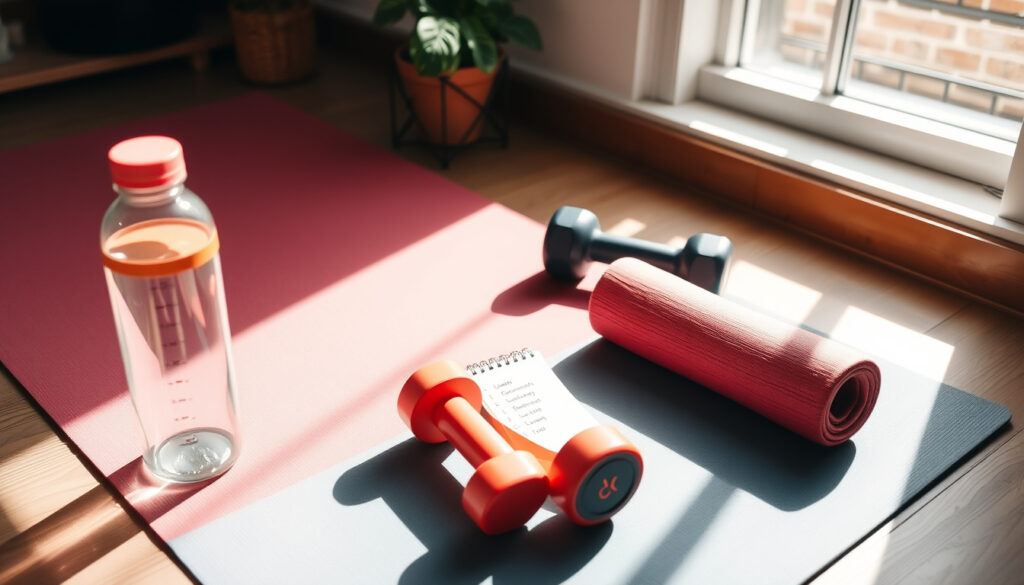
How to Start a Workout Plan: Complete Guide for Beginners
Starting a workout plan can feel like standing at the bottom of a mountain — exciting but steep, but you don’t need a gym membership or a complicated routine to get moving. This guide walks you through two proven frameworks — the Mayo Clinic’s evidence-based 5-step method and the trend-driven 3-3-3 rule — so you can build a plan that actually sticks.
Recommended weekly moderate exercise: 150 minutes ·
Strength training frequency: 2 days per week ·
Typical beginner workout frequency: 2-3 sessions per week
Quick snapshot
- Starting slowly reduces injury risk (Mayo Clinic)
- 3-3-3 rule helps structure weekly workouts (Women’s Health UK)
- Combining cardio and strength is recommended for overall fitness (Mayo Clinic)
- Optimal beginner workout frequency may vary by individual
- Long-term adherence rates for the 3-3-3 rule are not established
- Effectiveness of specific nut avoidance in diabetic exercise is anecdotal
- Mayo Clinic suggests repeating baseline fitness measurements after six weeks (Mayo Clinic Health System)
- Tonum recommends a 12-week progression for the 3-3-3 rule (Tonum)
- Choose a framework (Mayo Clinic 5-step or 3-3-3 rule) and start with 2-3 sessions per week
- Reassess after 6 weeks and adjust intensity or frequency
Four key facts, one pattern: the most reliable guidance comes from institutions that emphasize gradual progression and recovery, not quick results.
| Fact | Value |
|---|---|
| Recommended weekly exercise (CDC) | 150 minutes moderate aerobic + 2 days strength |
| Mayo Clinic 5 steps | Assess, plan, start slow, build, maintain |
| 3-3-3 Rule (Snap Fitness) | 3 days strength, 3 days cardio, 3 days mobility/rest |
| Overtraining warning signs | Fatigue, decreased performance, insomnia, irritability |
How to start a beginner workout plan?
Mayo Clinic’s fitness guide lays out a five-step process: assess your current fitness, design a plan, start slowly, build gradually, and maintain the habit. The key is to avoid the all-or-nothing trap. “Start slow and go forward slowly,” the Mayo Clinic (leading medical research institution) advises, because overdoing early workouts increases soreness and injury risk.
- Assess your current fitness level.
- Design a plan that fits your schedule and goals.
- Start slowly with low intensity and volume.
- Build gradually by increasing duration or frequency.
- Maintain the habit through consistency and recovery.
How to start a workout plan to build muscle?
- Focus on compound exercises: squats, push-ups, rows, and deadlifts. Mayo Clinic (fitness training guide) recommends including strength training at least two days per week.
- Start with bodyweight or light weights, aiming for 2-3 sets of 8-12 repetitions per exercise.
- Allow 48 hours of recovery between strength sessions for the same muscle groups.
How to start a workout plan for weight loss?
- Combine cardio and strength training. The CDC (U.S. public health agency) recommends 150 minutes of moderate aerobic activity plus two strength days per week.
- Use the 3-3-3 rule to structure your week: three strength days, three cardio days, and three mobility or rest days, as described by personal trainer Aimee Victoria Long in Women’s Health UK (fitness publication).
- Monitor nutrition alongside exercise — weight loss is driven by calorie deficit, not just workouts.
How to make a workout plan for a woman?
- Women can follow the same evidence-based principles as men. Mayo Clinic (fitness guide) emphasizes that a well-rounded routine includes aerobic, strength, core, balance, and flexibility work.
- Consider hormonal cycle phases: some women find they perform better during the follicular phase (days 1-14) and may need more recovery during the luteal phase.
- Start with 2-3 full-body sessions per week and progress from there.
Is it better to start with cardio or weights?
Both have distinct benefits, and the best answer is to combine them. Here’s how they compare for a beginner.
Three key differences, one trade-off: cardio burns more calories per session, but weights build long-term metabolic boost.
| Aspect | Cardio first | Weights first |
|---|---|---|
| Primary benefit | Improves cardiovascular endurance, burns calories during the workout | Builds muscle, boosts resting metabolism, improves bone density |
| Energy demand | Higher immediate calorie burn | Higher post-exercise calorie burn (EPOC) |
| Beginner recommendation | Start with 20-30 minutes of moderate cardio (brisk walking, cycling) | Start with bodyweight or light dumbbells, 2-3 sets per exercise |
| Order in a session | Do cardio after weights if strength is the goal; do weights after cardio if endurance is the goal | Do weights first to preserve strength performance |
The implication: for a beginner, the order matters less than consistency. Mayo Clinic (fitness training guide) says a well-rounded routine should include both, plus core, balance, and flexibility work.
What are the benefits of starting with cardio?
- Cardio improves heart and lung function. The CDC (public health authority) notes that 150 minutes of moderate aerobic activity per week reduces risk of chronic disease.
- It’s accessible: walking, jogging, cycling, or swimming require minimal equipment.
- Cardio can be done daily with low risk of overtraining if intensity is moderate.
What are the benefits of starting with weights?
- Strength training increases muscle mass, which raises your basal metabolic rate. Mayo Clinic (fitness training guide) recommends two strength sessions per week.
- It improves bone density and joint stability, reducing injury risk as you age.
- Weights provide a greater “afterburn” effect (EPOC) than steady-state cardio.
What is the 3-3-3 rule for working out?
The 3-3-3 rule is a weekly training framework that divides your week into three strength sessions, three cardio sessions, and three mobility or rest days. It was popularized by Snap Fitness and described by personal trainer Aimee Victoria Long in Women’s Health UK (fitness magazine).
How to apply the 3-3-3 rule in your routine
- Strength (3 days): Full-body compound lifts like squats, push-ups, rows, and overhead press. Tonum (fitness equipment brand) suggests three exercises per session, three sets each.
- Cardio (3 days): 20-30 minutes of moderate activity (brisk walk, jog, cycle) or 15 minutes of HIIT.
- Mobility or rest (3 days): Stretching, yoga, foam rolling, or complete rest. The rule includes seven days, so some days overlap (e.g., a strength day can also include mobility work).
The catch: the 3-3-3 rule may be too ambitious for absolute beginners. Women’s Health UK notes that many beginners feel more supported starting with two strength sessions, two cardio days, and gentle movement for recovery.
Is doing 3 workouts a day enough?
Three workouts per day is excessive for almost everyone. The question likely refers to three workouts per week, which is a solid starting point for beginners.
How many workouts should a beginner do per week?
- 2-3 total sessions per week is the recommended starting frequency. Mayo Clinic (fitness guide) advises beginners to allow time between sessions for recovery.
- Each session can combine cardio and strength, or you can alternate days.
- Quality over quantity: a well-structured 30-minute workout beats a sloppy hour-long session.
Three workouts a day is a recipe for burnout. Beginners who start with 2-3 sessions per week and gradually increase frequency see better long-term adherence than those who go all-in from day one.
What are signs you’re overtraining?
Overtraining syndrome is a real condition with measurable symptoms. Recognizing it early can prevent injury and burnout.
How to prevent overtraining syndrome
- Symptoms: persistent fatigue, decreased performance, insomnia, mood changes, increased resting heart rate, and frequent illness. Mayo Clinic (fitness guide) warns that overdoing early workouts increases soreness and injury risk.
- Prevention: include rest days, prioritize sleep (7-9 hours), eat enough to fuel activity, and vary workout intensity. The 3-3-3 rule’s built-in rest days help prevent overtraining.
- If you experience any of these signs for more than two weeks, reduce volume or take a full rest week.
Overtraining doesn’t happen overnight. It creeps in when you ignore recovery. The 3-3-3 rule’s three mobility/rest days are not optional — they’re the safety valve that keeps the system sustainable.
How to start a workout plan at home?
You don’t need a gym. Bodyweight exercises, resistance bands, and a small space are enough to build a solid routine.
How to create a workout routine at home?
- Bodyweight circuit: 3 rounds of squats (15), push-ups (10), lunges (10 each leg), plank (30 sec). Rest 60 seconds between rounds.
- With equipment: add dumbbells or bands for progressive overload. Tonum (fitness equipment brand) provides sample exercises like back squat, bench press, and Bulgarian split squat.
- Always include a 5-minute warm-up (jumping jacks, arm circles) and 5-minute cool-down (stretching).
How to create a workout split?
- Full body 3x/week: hit all major muscle groups each session. Ideal for beginners.
- Upper/lower split: 4 days/week — upper body one day, lower body the next, rest, repeat.
- Push/pull/legs: 3-6 days/week — push exercises (chest, shoulders, triceps), pull (back, biceps), legs.
- Mayo Clinic (fitness training guide) recommends including core and balance work in any split.
Clarity: What we know and what we don’t
Confirmed facts
- Starting slowly reduces injury risk (Mayo Clinic)
- 3-3-3 rule helps structure weekly workouts (Women’s Health UK)
- Combining cardio and strength is recommended for overall fitness (Mayo Clinic)
- Overtraining syndrome is a real condition with measurable symptoms (Mayo Clinic)
What’s unclear
- Optimal beginner workout frequency may vary by individual
- Long-term adherence rates for the 3-3-3 rule are not established
- Effectiveness of specific nut avoidance in diabetic exercise is anecdotal
- Whether the 3-3-3 rule is superior to other splits for long-term results
Expert perspectives
“Start slow and go forward slowly.”
— Mayo Clinic (fitness guide)
“The 3-3-3 rule is three strength days, three cardio days, and three mobility or rest days for balanced training.”
— Aimee Victoria Long, personal trainer, as quoted in Women’s Health UK
“Many beginners may feel more supported starting with two strength sessions, two cardio days, and gentle movement for recovery instead of the full 3-3-3 split.”
— Women’s Health UK (fitness publication)
Summary: Your next move
The evidence is clear: the safest, most effective way to start a workout plan is to begin with 2-3 sessions per week, combine cardio and strength, and prioritize recovery. The Mayo Clinic’s 5-step method gives you a framework for lifelong fitness, while the 3-3-3 rule offers a structured weekly template. For the beginner who wants to start at home, a bodyweight circuit three times a week is enough to build momentum. For the beginner who wants to lose weight, adding two cardio days and monitoring nutrition will accelerate results. The choice is yours — but the first step is the same: start slow, and go forward slowly.
Frequently asked questions
How much exercise should a diabetic get a day?
The American Diabetes Association recommends at least 150 minutes of moderate-to-vigorous aerobic activity per week, spread over at least three days, with no more than two consecutive days without activity. Strength training twice a week is also advised. Always consult a doctor before starting.
What is the 3-hour rule for diabetics?
The 3-hour rule refers to the recommendation that people with diabetes should not go more than three hours without eating to maintain stable blood sugar levels. This is especially relevant when exercising, as prolonged activity can cause hypoglycemia.
Which nuts should diabetics avoid?
Nuts coated in sugar, salt, or chocolate should be avoided. Plain nuts like almonds, walnuts, and pistachios are generally healthy in moderation due to their low glycemic index and healthy fats.
Does Dr. Stacy Sims have a workout program?
Dr. Stacy Sims, an exercise physiologist and nutrition scientist, has developed training programs tailored for women, focusing on menstrual cycle phases. Her book “Roar” includes workout plans, but she does not offer a single standardized program.
How to create a workout split for home?
Choose a split that matches your schedule: full body 3x/week for beginners, upper/lower 4x/week for intermediates, or push/pull/legs 3-6x/week for advanced. Include compound movements, progressive overload, and rest days.
How to tailor a workout plan for a woman’s cycle?
Follow the same evidence-based principles as for men: start with 2-3 full-body sessions per week, include cardio and strength, and adjust based on menstrual cycle phases if desired. Prioritize recovery and nutrition.
More related posts
 What Date is Easter Sunday 2026? April 5 in Ireland
 Wyndham Grand Costa del Sol: What to Know Before You Book
 Man City Transfer News – Summer 2024 Ins and Outs
 Fluminense FC vs Borussia Dortmund Lineups: Starting XIs & Tactics
 Slipped Disc in Lower Back: Fix, Heal & Treatment Guide
 How to Clean Stainless Appliances Without Streaks: Best Tips
 Audi Q7 for Sale in Ireland: 2025 Guide – Problems & Reliability
 The Lake Hotel Killarney – Comprehensive Guide to Rates and Amenities