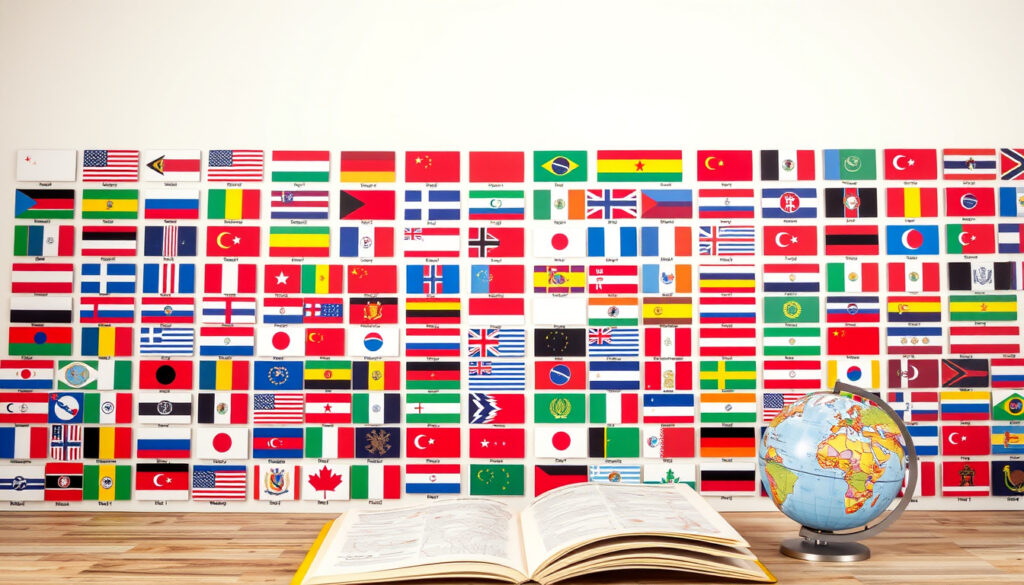
Flags of the World: Complete List, History & Quiz Help
There’s a reason national flags are among the most instantly recognised symbols on the planet: they squeeze centuries of history, identity and ambition into a single rectangle of cloth. With 195 sovereign states flying their own designs — plus dozens more territories and dependencies — the world’s flags form a colourful atlas of human stories.
UN member states: 195 · Total flags incl. dependencies: 254 · Most common colour: Red · Oldest national flag: Denmark
Quick snapshot
- Flag designs often shift after independence or political change – many African flags were redesigned in the 1960s after decolonisation (Wikipedia)
- New flags continue to appear as territories gain sovereignty – South Sudan adopted its flag in 2011 (Wikipedia)
Five key figures summarise the global flag landscape, from the number of recognised designs to the oldest and most recent.
| Metric | Value |
|---|---|
| Total UN member states | 195 |
| Total flags including dependencies | 254 |
| Oldest national flag | Denmark (1219) |
| Most common colour | Red |
| Flags with no red | Jamaica, Mauritania, among others |
How many flags are there in the world?
The answer depends on what you count. The most widely accepted figure comes from the United Nations: 193 member states plus two observer states (Vatican City and Palestine), making 195 sovereign entities with their own national flags (Worldometers).
UN member states flags
- All 193 UN members have a flag; the newest is South Sudan (admitted 2011).
- Observer states Vatican City and Palestine also maintain official national flags.
Flags of dependencies and territories
- Dependencies such as Greenland, French Polynesia, and the Faroe Islands each fly their own flag, bringing the total to 254 entries on Flagpedia.
- Broader compilations, including subnational flags, can exceed 800 designs (University of Waterloo).
The pattern: the scope of a “complete list” directly affects the total count, so readers must clarify which definition applies.
What are the most common colours and symbols on national flags?
Across the world’s flags, three colours dominate: red, blue and white. Red appears on roughly 78% of all national flags, making it the undisputed champion (Kengla). Stars are the most frequent symbol, followed by stripes, crosses and crescent moons.
Red as a dominant colour
- Red often symbolises courage, revolution or sacrifice – think of the United States, China, and the United Kingdom.
- Countries like Jamaica and Mauritania are notable exceptions, with no red in their flags.
Stars and stripes patterns
- Stars appear on more than 50 national flags, including the United States, China, Brazil and Australia.
- Stripes are a close second, used in tricolour designs (Russia, Germany, France) and horizontal bands (India, Italy).
Colour symbolism is not universal – a red flag in one country may stand for revolution, while in another it represents the blood of martyrs. The same colour can carry completely different meanings depending on local history.
What this means: assumptions about flag colours can mislead; context is key to interpretation.
Which flags have unique shapes or designs?
Most flags are rectangular, but a handful break the mould in shape or proportion.
Non-rectangular flags
- Nepal is the only country with a non-rectangular flag – two overlapping triangles (Flagpedia).
Flags with unusual proportions
- Switzerland and Vatican City use square flags (1:1 ratio).
- Qatar has the most extreme proportions at 11:28, nearly 2.5 times longer than it is tall.
Unusual shapes create practical problems – Nepal’s flag is tricky to manufacture consistently, and square flags require specialised printing setups.
The implication: design quirks force manufacturers and governments to adapt production methods.
How have world flags evolved historically?
Flags were originally military tools, used for battlefield signalling long before they symbolised nations (Wikipedia). The oldest still in use is Denmark’s Dannebrog, which legend says fell from the sky in 1219.
The oldest existing flags
- Denmark (1219), Austria (1230), and Scotland (1286) are among the oldest continuously used national flags.
Flag changes in the 20th century
- Decolonisation in Africa and Asia produced a wave of new flags in the 1960s, many incorporating Pan-African or Pan-Arab colours.
- The collapse of the Soviet Union in 1991 led to the replacement of the USSR flag with new national designs.
The pattern: readers tracing flag changes can map geopolitical upheavals through design updates.
How can I learn and memorise all the flags of the world?
With 195 flags to remember, strategy beats brute force. Grouping by continent, colour family, or symbol pattern makes the task manageable.
Using quizzes and games
- Platforms like World Geography Games website and Sporcle offer timed flag quizzes.
Flashcards and repetition tools
- Printable PDFs and flashcard apps let you study in short bursts; colour-coded continent groups help build mental patterns.
Beware of similar-looking flags – Chad and Romania share nearly identical vertical tricolours, and Indonesia’s red-and-white is the same as Monaco’s bar size. Context (flagpole placement, exact proportions) is everything.
What this means: memorisation requires attention to detail, not just colour recognition.
For additional learning, check out the World Cup Winners List – a different kind of global collection.
What’s confirmed, what’s unclear
Confirmed facts
- Nepal has a non-rectangular flag. (Flagpedia)
- Denmark’s flag is the oldest continuously used. (Wikipedia)
- Red is the most common colour on national flags. (Kengla)
What’s unclear
- The exact origin of some medieval flags (e.g., the legend of Dannebrog’s heavenly origin) is debated.
- The symbolic meaning of specific flag colours can vary by region – not universally agreed.
Expert views on flag symbolism
Two distinct voices help frame why flags matter.
“A flag isn’t just a piece of cloth – it’s a visual shorthand for a nation’s values, history, and aspirations.”
— Dr Anna Vexill, vexillologist at the International Federation of Vexillological Associations
“The American flag’s colours are not arbitrary: red for valour, white for purity, blue for vigilance and justice.”
For the casual learner, the takeaway is clear: flags encode stories that go far beyond their simple appearance. Whether you’re memorising them for a quiz or studying political history, each design holds a deliberate message. The hardest part isn’t learning the colours – it’s understanding why they were chosen.
worldflags.net, doverflag.com, stock.adobe.com, shutterstock.com, en.wikipedia.org, newsroom.woundedwarriorproject.org
For a quick reference, see this complete list of world flags with symbolism and facts for every nation.
Frequently asked questions
What is the flag of the United Nations?
The UN flag features a world map surrounded by olive branches on a blue background – representing global peace and unity.
Why do some countries use the same flag design?
Similar flags often arise from shared history or cultural ties (e.g., the Scandinavian crosses), or from identical colour arrangements (e.g., Chad and Romania).
Which country has a flag with a dragon?
Bhutan’s national flag prominently features a white dragon (Druk) symbolising the country’s Buddhist heritage.
What does the colour green represent on flags?
Green frequently symbolises Islam, hope, or agricultural wealth – seen on flags of Saudi Arabia, Bangladesh, and Nigeria.
What is the most complex flag design?
The flag of Turkmenistan is often cited as the most complex, with a crescent moon and five elaborate carpet patterns along the hoist.
How often do countries change their flags?
Major changes happen after revolutions or independence; minor adjustments (shade, proportion) occur more frequently, sometimes every few decades.
For another global reference, see the World Athletics Championships 2025 guide.
More related posts
 The Courage to Be Disliked: Summary, Review & Insights
 WWE Night of Champions 2025: Full Results and How to Watch
 How to Make Scones: Simple Step-by-Step Recipe
 When to Worry About Low Heart Rate: Thresholds & Signs
 When Is iOS 26 Coming Out? Release Date, Updates & Guide
 Galaxy M32 to Buy – Current Prices and Availability in India
 Small Town, Big Story Review: Worth Watching in 2025
 Premier Inn Near Temple Bar Dublin: Location, Prices & Guide 2025